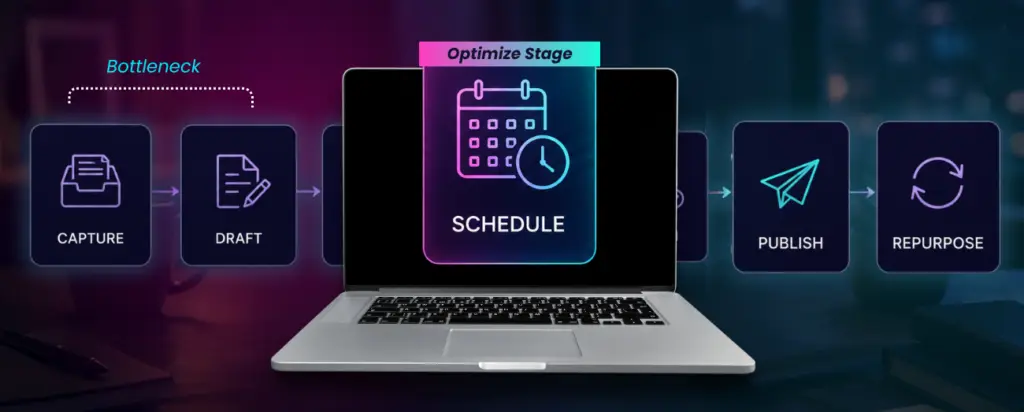
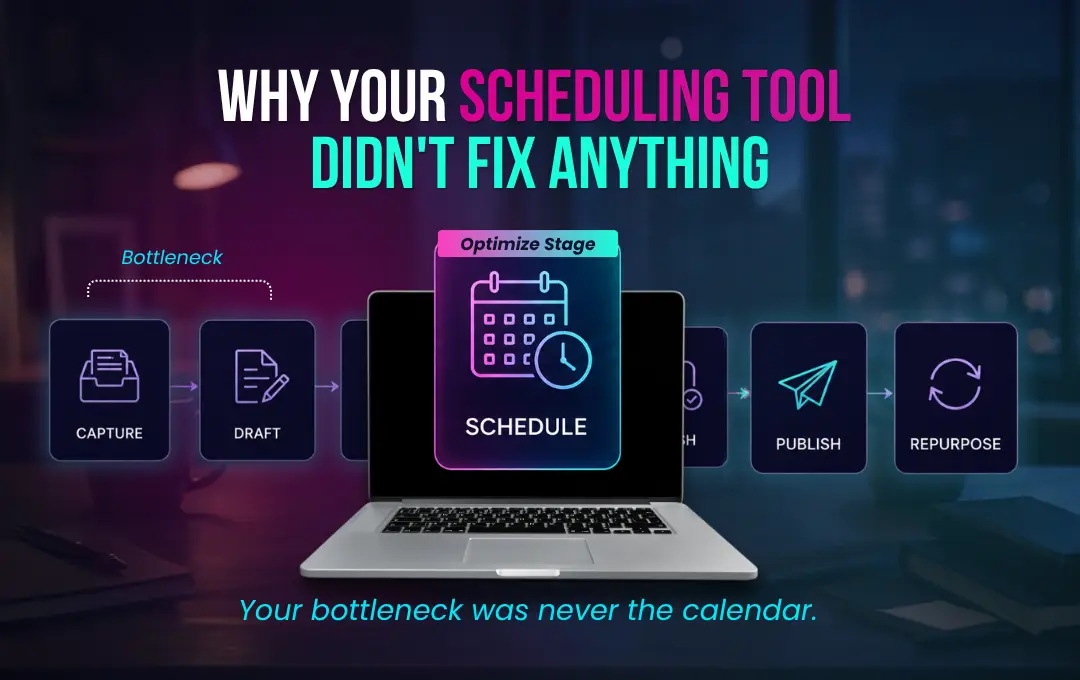
You bought the scheduler. Maybe two. You set up the queue, connected your accounts, and waited for your publishing to become consistent. It didn’t. Content still goes out in bursts followed by silence, except now you are paying a monthly fee for a more organized version of the same problem.
The tool did not fail. It was assigned the wrong job. A scheduling tool automates exactly one stage of a six-stage pipeline, and that stage was never your bottleneck.
- A scheduling tool automates the queue. The queue was never the reason your publishing is inconsistent.
- Your content stalls in the judgment stages, drafting, polishing, adapting, deciding what to recycle, which software cannot own.
- AI has the same limit: it can generate and sort, but it cannot hold your quality standard or decide what ships under your name.
- Scheduling tools aren’t enough because the gap is ownership of judgment, not automation of the queue.
- The fix is a person who owns the judgment stages against a documented standard, not another subscription.
What the tool actually automates
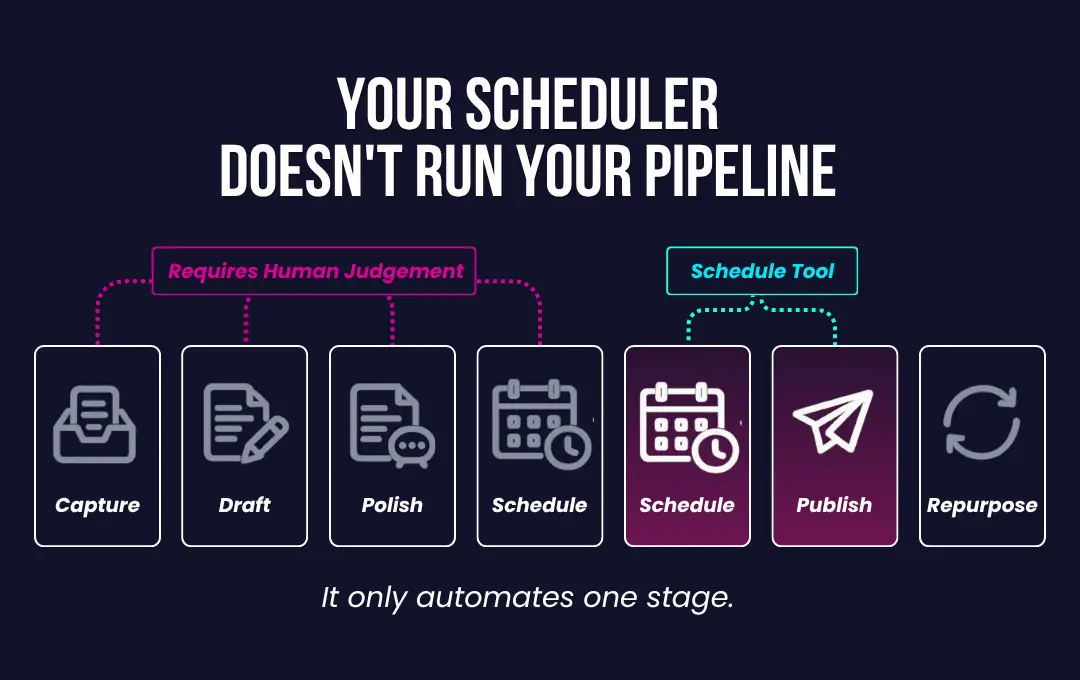
A scheduling tool does one thing well. It takes a finished piece of content and publishes it at a chosen time, across one or more platforms, without you being present. That is the queue. It is genuinely useful, and it is also a small fraction of the work.
Look at the full pipeline: capture, draft, polish, schedule, publish, repurpose. The scheduler covers schedule and publish. That is two stages, and the second one is trivial. The other four, the ones where the actual time and judgment live, are untouched. The tool automated the easy part and left the hard part exactly where it was: on you.
The judgment gap
The stages that stall your pipeline all have one thing in common. They require judgment, and judgment cannot be queued.
Polishing a rough draft into something publishable is a judgment call. Adapting one piece into a version that works on a different platform is a judgment call. Deciding which older piece is worth recycling, and when, is a judgment call. None of these can be scheduled in advance, because none of them are mechanical. This is why the calendar fills with empty slots: the slots were never the problem. Producing the content that goes in them is the problem, and the scheduler does not produce anything.
The same mistake, now with AI
The AI version of this error is worth naming, because it is the one founders are making right now. AI can generate drafts and sort content quickly, which feels like it should close the gap. It does not.
Generation was never the bottleneck either. The bottleneck is ownership: someone has to hold the quality standard, decide whether a given piece actually meets it, and take responsibility for what ships under your name. AI can produce ten drafts in a minute and cannot tell you which one is right, because it does not own your standard. Adding an AI tool to an unowned pipeline gives you more raw material and the same gap. You still have to be the one who decides, formats, checks, and approves, which means you are still the bottleneck.
What actually fills the gap
The gap is filled by a person who owns the judgment stages, working against a documented standard. Not a tool that queues, and not an AI that generates. An owner.
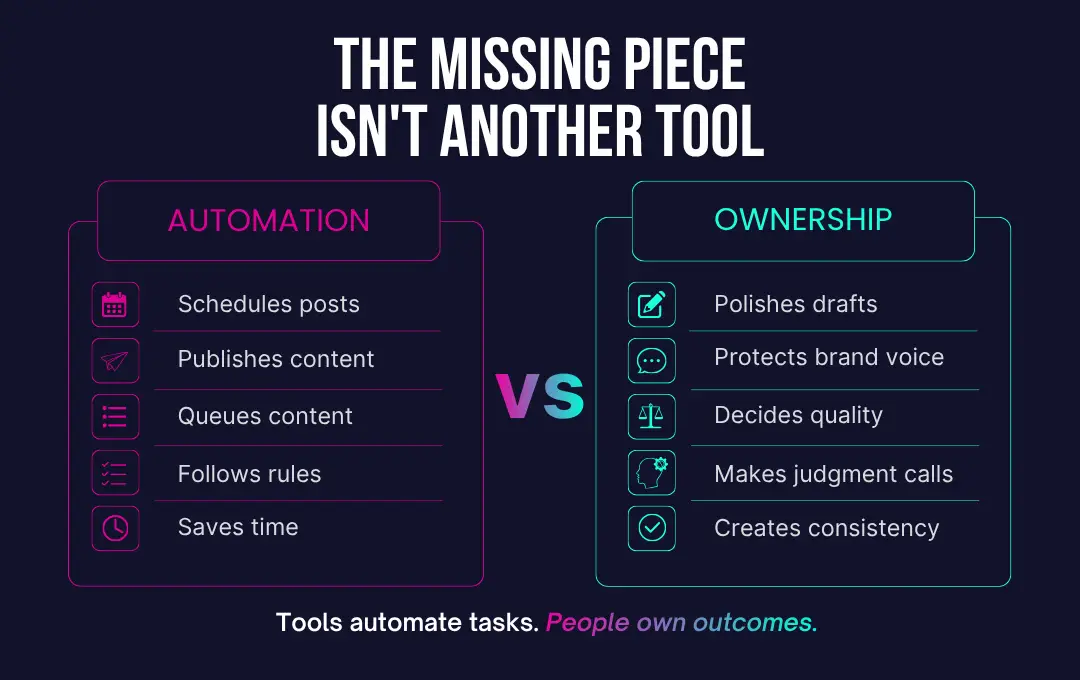
In practice, this is a Distant Assistant who takes the pipeline from your rough draft to published. They polish against your documented voice standard, adapt the piece across platforms, decide what gets recycled and when, and load the finished work into the scheduler, which is where the tool you already bought finally does its one job well. The scheduler is not wrong. It is the last step of a process that needs an owner for the four steps before it.
If you’re leading a nonprofit…
The nonprofit version of this is the donor CRM that was supposed to fix communications and instead became one more system the executive director personally maintains. Tools route and store work. They do not own the judgment of what to say, to whom, and when. Until a person owns the judgment stages of your donor pipeline, every new platform adds administration without adding capacity, and the mission gets no louder for the money spent.
Where your pipeline actually stalls
Run these five checks against your current setup.
- When your content stalls, is it stuck at scheduling, or upstream at drafting and polishing?
- How many tools have you bought that automated a step you were not actually stuck on?
- Is there a person, other than you, who owns the decision of whether a piece is good enough to ship?
- When you add an AI tool, do you end up with more drafts and the same amount of your own review time?
- Does your scheduler sit full of slots you cannot fill fast enough?
If your content stalls upstream of the queue, no scheduler will fix it, because the scheduler was never touching the stalled stages. The gap is ownership of judgment, and that requires a person.
The bottom line
Scheduling tools aren’t enough because they automate the one stage that was already easy. The stages that stall your publishing require judgment, and judgment needs an owner, not a queue. Buy the tool for what it is good at, and give the four judgment stages to someone whose job is to own them.
Next step
A Strategy Call with Avy maps where your pipeline actually stalls, which stages need an owner, and what to hand off first. You leave with a Decision Map within 72 hours, so you stop buying tools for problems you do not have.
When you are ready to install the ownership the tools cannot provide, an Alisto Team runs the judgment stages for you. The Mini Team pairs a dedicated Distant Assistant with two specialists to own drafting-to-published against your standard. For a single project or a lighter start, the Hourly Bank is the flexible entry point.