

You have tried to hand off content before. You gave someone a few posts to write; they came back sounding wrong. You rewrote them and concluded that nobody can do this but you. So you took it back. Now you are the bottleneck again, and delegation has been filed under “doesn’t work for my business.”
The handoff did not fail because your voice is too special to replicate. It failed for a structural reason: the quality standard lives in your head, where no one else can reach it. Delegation without a documented standard is not delegation. It is a longer review cycle.
- Learning how to delegate content without losing your voice is not about finding a better writer. It is about documenting the standard.
- When the quality standard lives only in your head, every delegated piece comes back for your review, and you stay the bottleneck.
- A documented voice standard is an operational control. It is what lets a team produce in your voice without you checking every word.
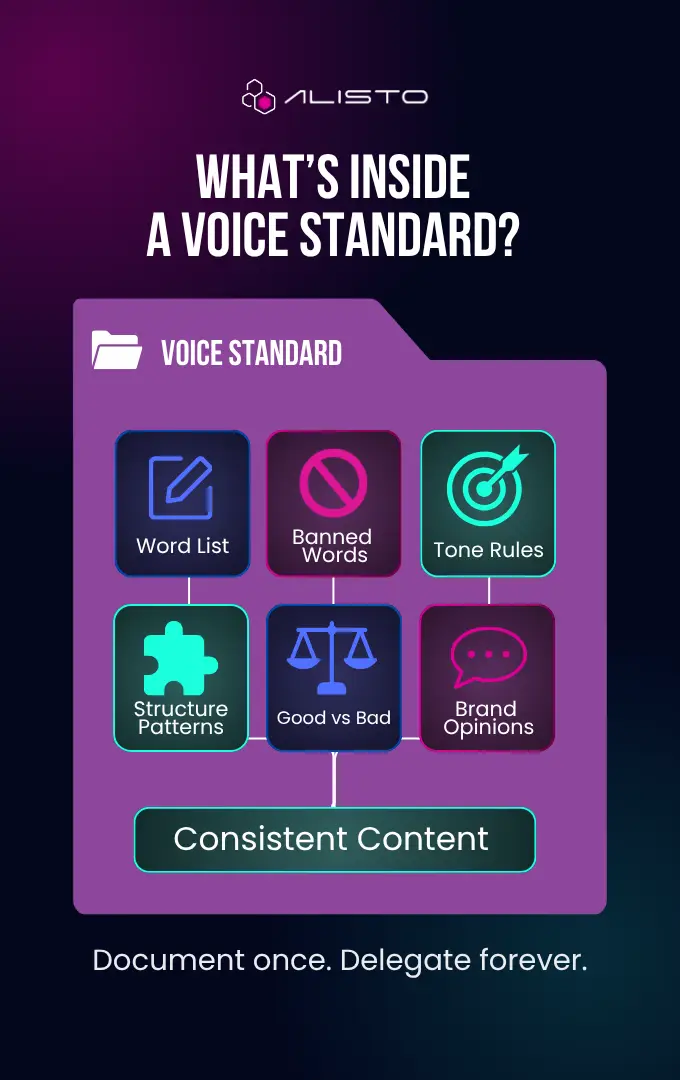
- The document has specific contents: word list, banned list, tone rules, structure patterns, side-by-side examples, and on-record opinions.
- With the standard written down, your role shrinks to origination and final approval. Everything else has an owner.

Why content delegation usually fails
Most founders who try to delegate content experience the same failure. They hand off the writing, the drafts come back not-quite-right, and they end up rewriting each one. The conclusion they draw is that their voice cannot be delegated. The actual cause is different: there was no standard for the writer to work against, so the writer guessed, and guessing produces not-quite-right.
Without a documented standard, every delegated piece routes back through the founder, because the founder is the only person who knows whether it is correct. That is not delegation. The founder has become the quality-control department, and the handoff added a management layer instead of removing a workload. This is why delegation feels like more work, not less. Structurally, it is.
The voice doc is an operational control, not a branding exercise
A documented voice standard is often mistaken for a branding deliverable, a nice-to-have for the marketing folder. In an operational context, it is something more specific: it is the control that makes content delegation possible at all. Written down, a voice standard is a checkable specification. It gives a writer something to produce against and a reviewer something to verify against, so the standard, not the founder, becomes the arbiter of whether a piece is correct.
What actually goes in the document
“Document your voice” is useless advice without specifics, so here is exactly what a working voice standard contains. Each item is a concrete input a writer can apply, not an abstract trait.
- Word list. The actual words and phrases the brand uses. Not “we sound friendly,” but the real vocabulary: the terms for the customer, the recurring phrases, the way the brand opens and signs off. Real strings a writer can reach for.
- Banned list. The words the brand never uses. Corporate filler like leverage, synergy, and seamlessly, the off-brand phrasings, and the mechanical rules such as which punctuation is not allowed. “Never do this” is easier to check than “capture the vibe,” so this list does more work than founders expect.
- Tone rules by context. How the one voice flexes across situations. Teaching tone, calling-something-out tone, and answering-a-question tone are different settings of the same voice, and the document specifies each.
- Structure and hook patterns. The openings and shapes that recur. If the brand always opens on the reader’s lived experience rather than a thesis, that is a documented pattern a writer can follow rather than reinvent.
- On-brand and off-brand examples, side by side. The single most important element. A short passage written correctly, placed next to the same passage written wrong. Examples teach what rules cannot, because a writer can pattern-match against a real sample in a way no abstract instruction allows.
- On-record opinions. The positions the brand actually holds, so a writer knows the substance, not just the sound. Voice without stance produces content that is on-tone and says nothing.
Once those six exist on paper, the standard is checkable, and a person who is not the founder can produce against it.
How the Distant Assistant uses the standard
With the standard in place, a Distant Assistant produces or polishes a draft against it, checks it against the on-brand and off-brand examples, and escalates only genuine judgment calls. Formatting, platform adaptation, scheduling, and repurposing all run against the same specification rather than against the founder’s availability. The founder’s involvement contracts to two points: origination, where the idea and the point of view come from, and final approval, a confirmation rather than a rewrite. The standard, updated over time as new phrasings and banned terms surface in approved work, absorbs the judgment that used to live only in the founder’s head, so each correction is made once and then encoded rather than repeated forever.
If you’re leading a nonprofit…
A documented voice standard is succession infrastructure. When communications quality depends on the executive director’s personal review, every staff transition and every busy season degrades the organization’s public voice. A written standard means the grant writer, the communications coordinator, and the board chair drafting a newsletter all produce against the same specification, and all sound like the same organization. The ED stops being the bottleneck on every word that leaves the building, and the voice survives turnover.
Can you actually delegate right now?
Run these five checks against your current setup.
- Is your voice and quality standard written down anywhere, or does it live only in your head?
- When you hand off content, does it come back for a full rewrite, or a light approval?
- Are you functioning as the quality-control department for every piece that ships?
- Could a competent writer who is not you produce a passable draft from your current documentation?
- When you correct a piece, does the correction get encoded anywhere, or do you make the same fix again next time?
If your standard is undocumented and every piece comes back for a rewrite, you cannot delegate yet, no matter who you hire. The first thing to build is the standard, because that is the control that makes every future handoff work.
The bottom line
You do not lose your voice by delegating content. You lose it by never documenting it, which forces you to review everything personally and guarantees you stay the bottleneck. Write the standard down, with real content a writer can apply, and delegation becomes a reliable process instead of a hopeful one. The voice doc is the operational control that makes the handoff safe.
Next step
A Strategy Call with Avy maps what your voice standard needs to contain and which stages to hand off first, so delegation actually removes work instead of adding a review cycle. You leave with a Decision Map within 72 hours.
When you are ready to install it, an Alisto Team produces against your standard for you. The Mini Team pairs a dedicated Distant Assistant with two specialists who draft, adapt, and quality-check every piece against your documented voice before it ships. For a single project or a lighter start, the Hourly Bank is the flexible entry point.