

The business is growing. More clients, more revenue, more coming in than last year. That part is working. The problem is that every new piece of it lands on you. More growth has meant more hours, more decisions waiting on your answer, more work that only moves when you touch it. The business is getting bigger, and so is your plate.
If you’ve been asking how to grow my business without doing everything myself, you’ve already spotted the real issue. Growth is not the problem. The problem is that the business is built to run through you, so every increase in output becomes an increase in your workload. You can’t grow your way out of that. You can only out-structure it.
This is a structure problem, not a stamina problem. Here is what has to be in place so the business can take on more without all of it coming back to you.
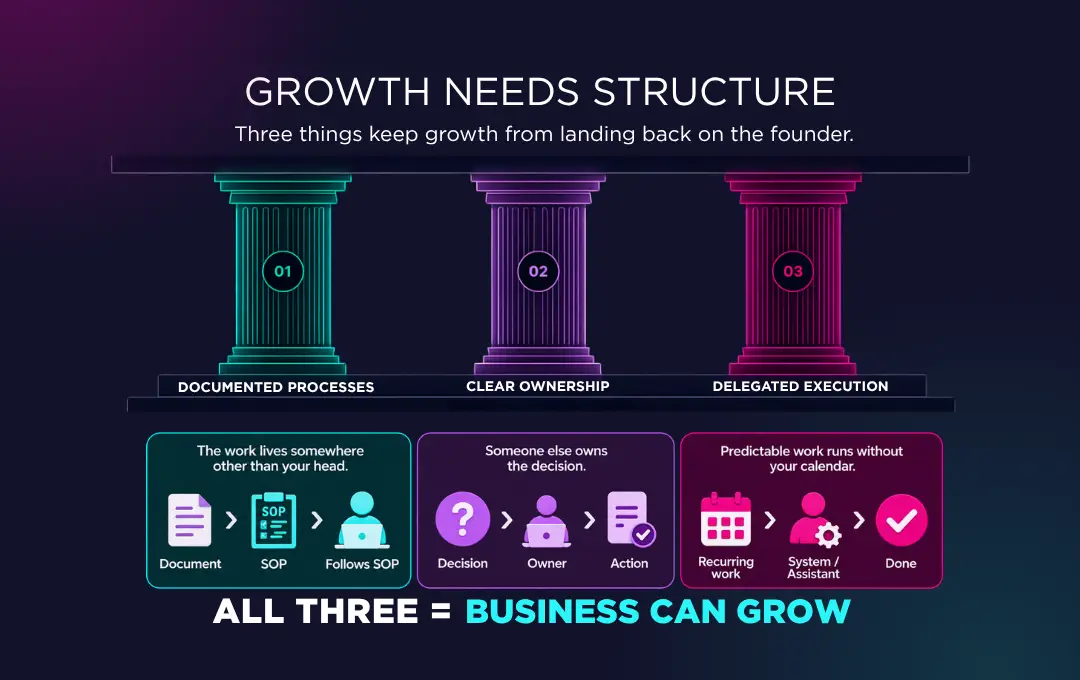
- When a business grows but everything still runs through the founder, more growth just means more work for the founder.
- You can’t out-work that. The fix is structural, not more hours.
- Three things let a business grow without the founder doing everything: documented processes, clear ownership, and predictable work running off the founder’s plate.
- Missing any one of the three sends the extra work straight back to you, no matter how capable the team is.
- Diagnose which of the three is your constraint, then fix that one first. Order matters.
Output growth and structural growth are not the same thing
There are two kinds of growth, and founders almost always track only one. Output growth is the visible kind: more clients, more revenue, more volume moving through the business. Structural growth is the quieter kind: the business’s capacity to carry that volume without you in the middle of every piece of it.
Most founders push output and assume the structure keeps up on its own. It doesn’t. When output rises faster than structure, the gap shows up as you, absorbing the difference. The business grows, and you become the part of it doing the extra carrying. That works right up until you run out of hours, which is a limit no amount of effort moves.
Why growth keeps turning into more work for you
When things are going well, this trap is easy to miss, because the numbers look right. But look at what each new client or project adds: tasks, follow-ups, decisions, handoffs. If those route through you, then every win quietly adds to your workload. Growth and your to-do list rise together.
That is the part that surprises founders. You expect a bigger business to feel like more leverage. Instead it feels like more of the same, because the business is designed to need you for everything, so “more business” always translates to “more of you.” A business that only runs when you run it does not get easier as it grows. It gets heavier.
What growing without doing everything yourself requires
Three things determine whether a business can take on more without routing it all back through you.
- Documented processes. The work lives somewhere other than your head, so someone else can run it the way you would.
- Clear ownership. Decisions have an owner who is not you, operating inside defined limits, so work does not stop to wait for your answer.
- Delegated execution. The predictable, recurring work (scheduling, client follow-up, inbox triage, reporting) runs on a system or a Distant Assistant instead of on your calendar.
Each of these is a full topic on its own. For now, the point is that together they are what let a business grow past the founder, and apart they don’t hold.
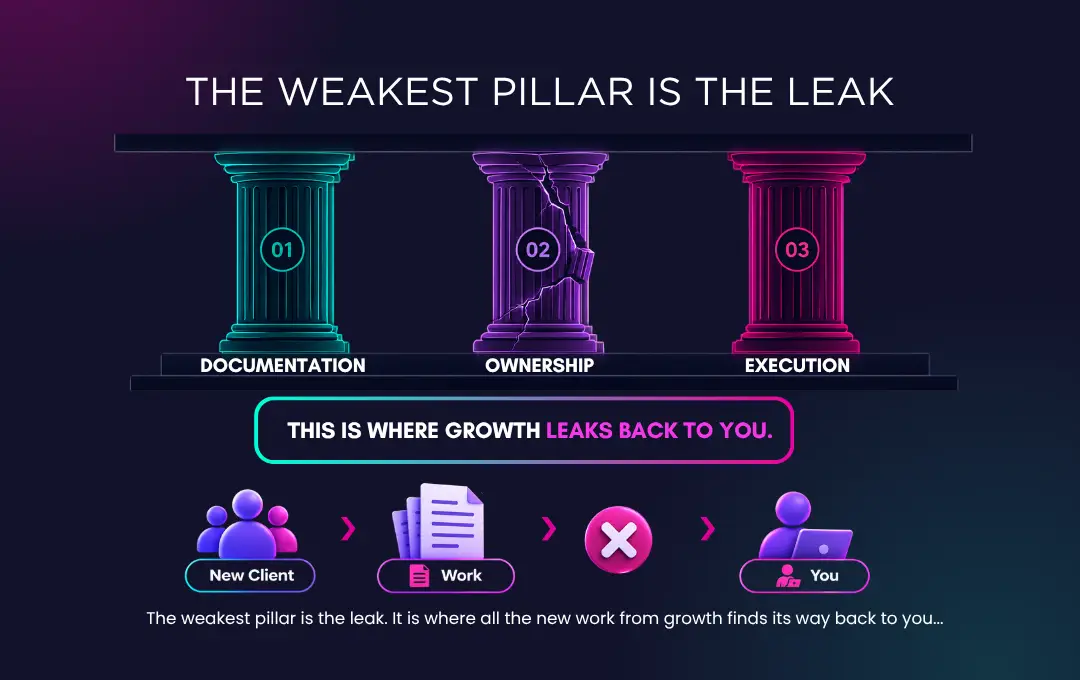
How one missing pillar sends the work back to you
The three are not independent, which is why having two of them is not enough.
Documentation without ownership gives you written processes no one is responsible for running. Ownership without documentation gives you people accountable for work they have to reinvent every time they touch it. Delegated execution without the other two gives you a Distant Assistant who has to ask you about everything, which adds management to your plate instead of removing work from it. That last one is the common trap: help gets hired, growth keeps coming, and the founder somehow gets busier.
The weakest pillar is the leak. It is where all the new work from growth finds its way back to you, no matter how strong the other two are.
Figuring out which pillar is your constraint
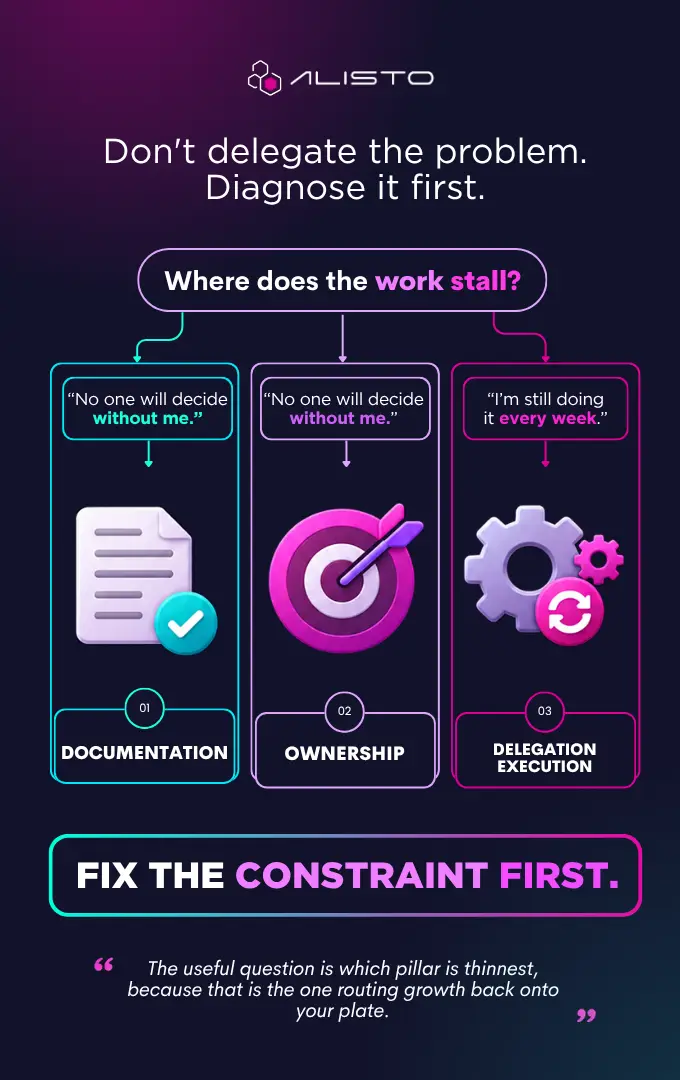
Not every growing business is stuck in the same place. The useful question is which pillar is thinnest, because that is the one routing growth back onto your plate.
A fast way to find it: look at where the new work piles up and where everything waits on you specifically. If work stalls because no one knows the steps, your constraint is documentation. If work stalls because no one will decide without you, it is ownership. If you are the one personally doing the recurring work week after week, it is delegated execution. The pillar you keep landing on is the one capping how much the business can grow without you.
Fixing it in the right order
Order matters more than speed. You don’t fix all three at once, and you don’t start with whichever is easiest or most satisfying. You start with the constraint.
Fixing a pillar that isn’t your bottleneck feels productive and changes nothing, because the leak is still open. This is why delegation so often backfires: work gets handed off before the business has been diagnosed, so it bounces straight back as questions and corrections. Diagnosis comes first. The fix is only as good as the order you do it in.
A growing business that runs through its founder is not a success story with a stamina problem. It is a structure that hasn’t caught up to its own growth. Build the structure, and growth stops costing you more of yourself.
If you’re leading a nonprofit…
The same pattern shows up when programs and funding grow faster than the operation behind them. Every new grant, program, or partnership adds work, and if it all routes through the ED, growth just produces a more overloaded leader. Documentation, clear ownership, and delegated execution are what let a mission expand without one person carrying all of it. That infrastructure is not a drain on mission resources. It is what lets the organization take on more good work without burning out the person holding it together.
A quick read on why growth keeps landing on you:
- When a new client or project comes in, how much of the added work ends up on your plate specifically?
- What in the business can take on more volume without you touching it?
- Is the recurring work (scheduling, follow-up, inbox, reporting) running on a system, or on your calendar?
- If you handed a core process to someone today, could they run it from what is written down, or only by asking you?
The question you stall on points straight at the pillar sending growth back to you.
Your next step
The Strategy Call is where you find out which pillar is your constraint and the order to fix it in. Sixty minutes, followed by a written Decision Brief within 72 hours, so you leave with a plan for growing the business without growing your workload. Start at Work With Alisto.
Not ready for the call? The free Scaling Readiness Scorecard is a four-minute read on how much of the business still depends on you right now. It won’t build the plan for you, but it will show you where the work keeps routing back.