
You hired help and handed off the tasks, and somehow you are not any less busy. The work comes back with questions. The output needs correcting. You spend about as long explaining and fixing as you would have spent doing it yourself, so you take it back, and you are right where you started, except now you are also managing a person.
If you’re trying to delegate but it’s not working, the instinct is to blame the hire, or your own trouble letting go. Usually it is neither. The work came back because of the way it was handed off. In most cases the person was capable enough; the handoff was the weak link. Delegation done at random, grab the most annoying tasks, throw them over, and hope they stick, does not reduce your load. It reshuffles it and adds a layer of management on top.
This is a handoff problem. Here is why unscoped work bounces back, and how to hand it off so it stays gone.
- Delegation that doesn’t reduce your workload is almost always a handoff problem, not a hiring problem.
- Work handed off at random, without being scoped first, comes back as questions, corrections, and rework.
- A clean handoff defines the task, the inputs, the standard, and what “done” looks like before anyone else touches it.
- Scoped work leaves your plate for good; unscoped work comes back and brings a management job with it.
- The fix is order: diagnose what should leave first, scope it, then assign it.
The reactive delegation trap
Reactive delegation is when you offload work because you’re buried, not because you planned to. You’re not handing it off because the timing is right or the task is ready. You’re handing it off to get it off your chest right now. And because it’s a panic move, you skip the part where you set the person up to do it, so it doesn’t stick.
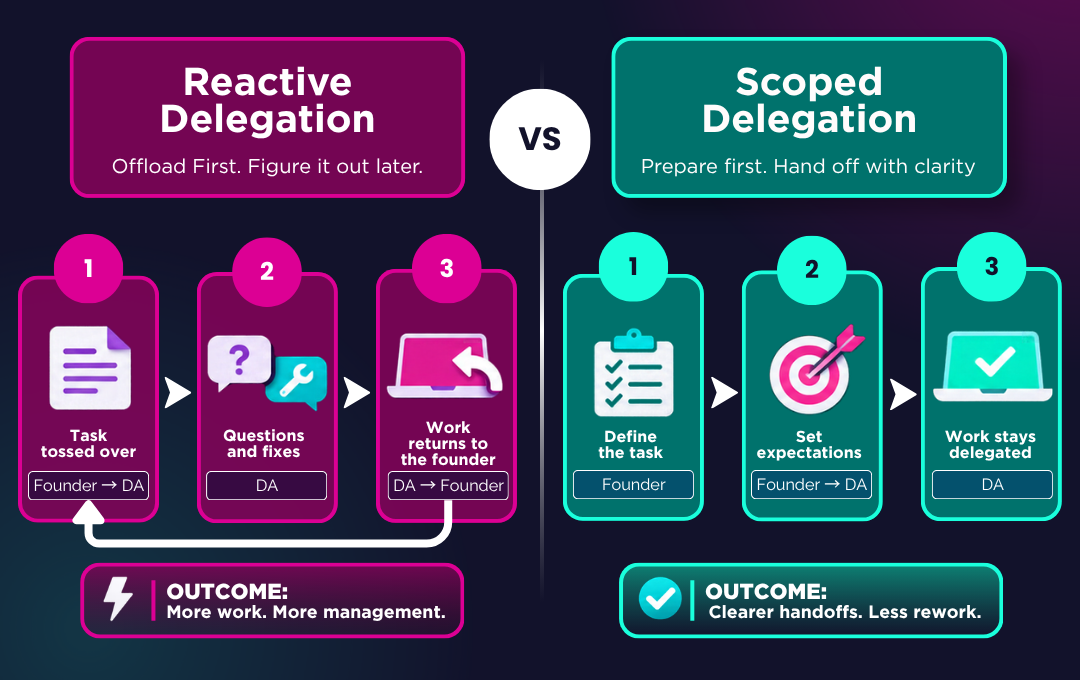
It feels like progress, but relief rarely follows. A rushed handoff carries none of the information the other person needs to run the task without you, so you pass along the task itself while keeping everything that makes it possible to run.
Why delegating isn’t working the way you expected
A task in your head is a stack of small decisions you make on autopilot: who to contact, in what order, what a good result looks like, what to do when something is off-script. When you hand off the task but not those decisions, the person hits the first unknown and comes back to you.
That is reverse delegation: work you assigned climbing back onto your plate. And it usually isn’t because you withheld anything. Those decisions have become so automatic that you no longer notice you’re making them, so it never occurs to you to pass them on. You can’t hand off a step you don’t know is a step.
This is also where written process starts to matter, which is a topic large enough to stand on its own.
Scoping work so it leaves your plate cleanly
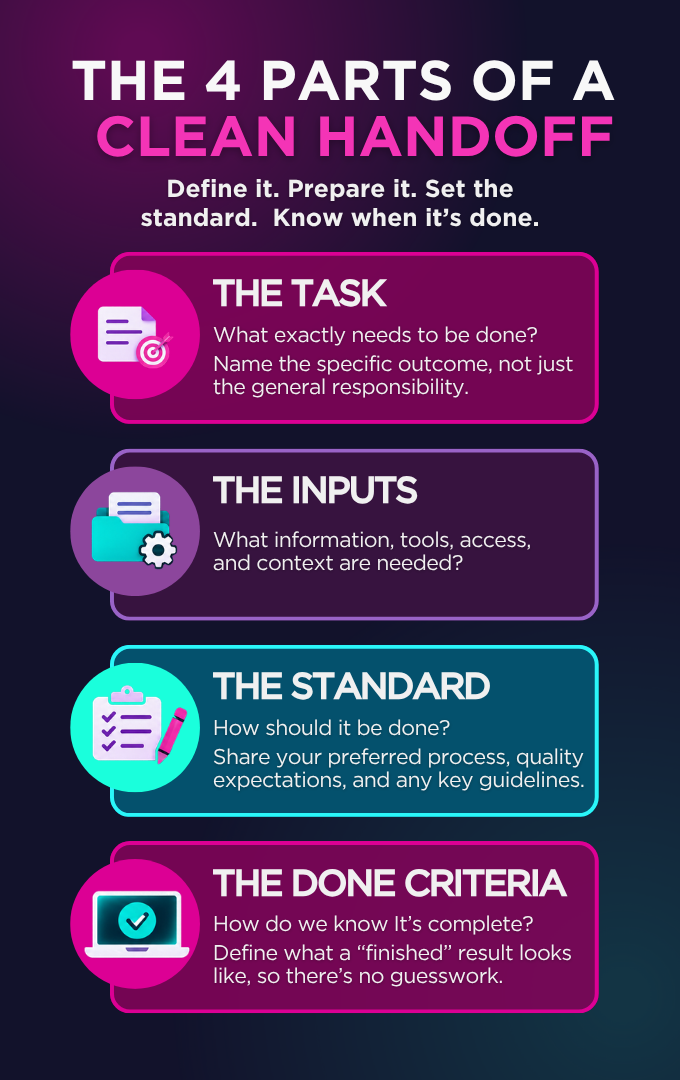
The fix is scoping the work before you assign it. A clean handoff defines four things: the task itself, the inputs the person needs to do it, the standard the output has to meet, and what “done” looks like, so they know when to stop and when to flag something. With those in place, the person can run the task and handle the normal variations without routing back to you.
In practice, the gap is obvious once you see it. “Handle client follow-up” is not a scoped task. “Send the follow-up within 24 hours of a discovery call using the saved template, and flag anything outside these three situations” is. The first version bounces back within a day. The second runs on its own, because it was scoped before it was assigned.
What most advice skips: scoping is real work, and it is hardest to do when you are the one at capacity. It is also hard to do alone, for the reason above. You cannot write down the steps you no longer notice you are taking. This is where a second set of eyes matters before the handoff, not after. Someone outside your head can catch the automatic decisions you have gone blind to and shape them into something assignable, which removes a large piece of the overwhelm and is often the difference between delegation that sticks and delegation that boomerangs.
It is also why Alisto runs in a fixed order: strategy, then operations, then execution. The work gets scoped in the strategy and operations stages, before a Distant Assistant (execution) ever touches it. By the time the DA receives the task, the inputs, standard, and done-state are already defined, so the work runs instead of returning.
Diagnose what to hand off before you hand off anything
Before you scope a single task, there is a prior question: which work should leave your plate first. Reactive delegation skips this and offloads whatever is loudest, which is often not the thing capping your week.
The reliable order is to diagnose first. Find the predictable, recurring work that is eating your time, then scope and hand that off. Getting this order right is what most determines whether delegation gives you anything back, and it is the work the Strategy Call is built to do. For now, the point is simple: diagnosis comes before delegation.
A DA that removes work vs. a DA that adds management
What separates those two outcomes is not the Distant Assistant at all. It comes down to whether the work was scoped before it reached them.
Hand a DA unscoped work and you get a capable person who has to check with you on everything, which adds a management job to your plate. Hand a DA scoped work, with the inputs, standard, and done-state defined, and the work runs without you.
A Distant Assistant is built to carry the recurring load: calendar and scheduling, client follow-ups, inbox sorting, routine reporting, the predictable work that clogs your week. What a DA cannot do is define that work for you. That scoping has to happen before the work reaches them. Our DA training reinforces the same discipline from the other side: assistants are trained to hold the scope and flag drift, rather than hand problems back up to you.
Delegation that fails is rarely a people problem. It is a handoff problem. Scope the work first, with help if you need it, and it leaves for good; skip that step, and no hire, however good, will give you your time back.
If you’re leading a nonprofit…
The same pattern shows up with staff and volunteers. Work gets passed off in a rush, usually the most draining tasks, without the context someone needs to run them, so it lands back on the ED or the program lead. The fix is identical: scope the work before assigning it, define what done looks like, and hand off the predictable, recurring load first. That is how a lean team builds real capacity instead of moving the same overwhelm from one desk to another.
A quick read on why your delegation keeps coming back:
- When you hand off a task, do you define what “done” looks like, or just name the task?
- How often does delegated work return as a question before it returns as a result?
- Are you handing off the loudest tasks, or the most predictable and repeatable ones?
- Could the person run the task from what you gave them, or only by checking with you?
If the work keeps coming back, the handoff is the first place to look.
Your next step
The Strategy Call is where you sort out which work should leave your plate first and how to scope it so it stays gone, and you are not doing that scoping alone. Sixty minutes, plus a written Decision Brief within 72 hours, so you have the order of operations before you hand anything off. Start at Work With Alisto.
Not ready for the call? The free Scaling Readiness Scorecard is a four-minute read on how much of the business still runs through you. It won’t scope the work for you, but it will show you where delegation keeps breaking down.