You publish a strong piece. It goes out once, gets its day of attention, and then it is gone. So you open a blank document and start the next one from nothing. Then you do it again, and again, four times a week, until content feels like a machine that only runs when you feed it.
At some point you ask whether you are simply making too much. It is the right question with the wrong unit. Too much content is not a number of posts. It is a ratio, and once you see the ratio, the fix stops being “make less” and becomes something you can actually build.
- The question “how much content is too much” has no absolute number. Too much is a ratio, not a volume.
- You are creating too much content when your production rate outruns your reuse rate: new pieces made faster than existing ones get reused.
- Single-use content is the real problem. You pay full creation cost for one exposure, then start over.
- The fix is not making less. It is originating less and reusing more, which lowers the workload without lowering the output.
- A treadmill exhausts the founder and expires daily. A library compounds. The difference is a repurposing system with an owner.
Too much is a ratio, not a number
There is no magic figure where content tips from healthy to excessive. Two brands can both publish twelve pieces a week, and one is thriving while the other is drowning. The difference is not the twelve. It is where those pieces came from.
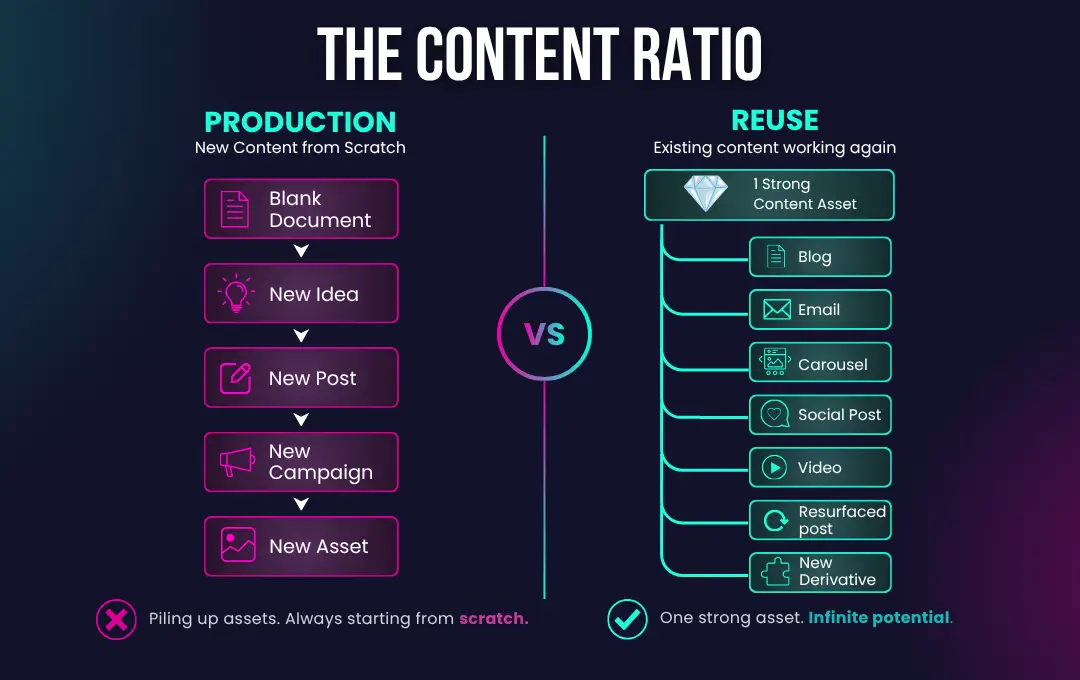
The real measure is your production rate against your reuse rate. Production is how much brand-new content you originate from scratch. Reuse is how much of your output comes from material you already made. When production outruns reuse, every piece is a fresh act of creation, and the volume becomes a treadmill. When reuse carries most of the load, the same visible output costs a fraction of the work. So you are not making too much content. You are originating too much and reusing too little.
The real cost of single-use content
Single-use content is the specific failure hiding inside “too much.” A piece is single-use when it is created, published once, and never touched again. You paid the full cost of making it, and you collected a single exposure in return.
That is a terrible trade, and it repeats every week. The strong long-form piece that could have become a month of derivatives instead ran once and died. The insight that deserved five formats got one. Meanwhile the blank document waits for the next origination, because nothing is being reused to fill the calendar. This is why high output can feel like zero leverage: you are working at full production cost for minimum return, and the treadmill never slows because it is the only thing generating your content.
The library model

The alternative is to treat content as an asset that keeps working, not an event that happens once. That is the difference between a treadmill and a library.
In a library model, one origination becomes many pieces on purpose. A single strong idea is drafted into a long-form piece, then adapted into social cuts, an email, and a carousel, then resurfaced weeks later, then cut into new derivatives from the same source. The founder originates far less, because most of the output is leverage on what already exists. The visible volume can stay exactly the same, or grow, while the creation work drops sharply. The library compounds: every strong piece keeps producing long after the day it published, instead of expiring by evening.
Why the treadmill persists
If the library model is better, why does almost everyone stay on the treadmill? Because reuse is a stage that requires an owner, and when the founder owns every stage, reuse is the first thing that gets dropped.
By the time a piece is published, the founder is out of capacity and already owes the next origination. Repurposing, resurfacing, and recycling all sit at the end of the line, so they are perpetually skipped in favor of making the next new thing. The treadmill is not a discipline failure. It is what happens structurally when no one owns the reuse stage, so the only lever left is producing more. Assign that stage to someone, and the library starts to build itself.
If you’re leading a nonprofit…
Nonprofits sit on more reusable content than almost anyone and reuse the least of it. The impact story from last year’s report, the testimonial from a program graduate, the explainer of how your model works: these are evergreen assets that get used once and filed. An executive director running the communications treadmill originates a fresh appeal every time, when most of what is needed already exists in past material. A library of mission stories, owned and resurfaced on a schedule, means the organization stays visible without the ED writing every piece from scratch.
Check your ratio
Answer these five honestly against your current output.
- Of the content you published last month, how much started from scratch versus from something you already had?
- How many of your strong pieces have been used exactly once and never again?
- When you sit down to create, is it because you have something new to say, or because the calendar is empty?
- If you stopped originating new content for a month, could you keep publishing from what you already own?
- Is there a named owner for reuse, or does repurposing only happen when you personally get to it?
If most of your content is new and single-use, and no one owns reuse, you are on the treadmill. The problem was never the volume. It is that nothing is compounding, so every piece has to be built from nothing.
The bottom line
How much content is too much? However much you have to originate from scratch because nothing is being reused. The fix is not to make less and hope for the same reach. It is to build a library, assign an owner to reuse, and let existing content carry the volume so origination drops. A treadmill burns you out and expires daily. A library works while you do other things.
Next step
A Strategy Call with Avy audits your production-to-reuse ratio, identifies the content already sitting unused, and maps the repurposing system that turns your treadmill into a library. You leave with a Decision Map within 72 hours.
When you are ready to install it, an Alisto Team owns the reuse stage for you. The Mini Team pairs a dedicated Distant Assistant with two specialists who adapt, resurface, and recycle your strongest content on a schedule, so your output stops depending on constant origination. For a single project or a lighter start, the Hourly Bank is the flexible entry point.