

The first boundary layer in your business should not be you.
It should be a system. Or a person.
Right now, in most growing businesses, it’s neither. It’s the founder. Answering emails. Fielding client questions. Clarifying tasks. Coordinating schedules. Making small decisions that have no business being on the founder’s plate.
It feels like leadership. It’s actually a structural problem. And it compounds fast.
- Most founders unintentionally become the first response layer in their business
- Constant communication creates attention fragmentation and decision fatigue
- A boundary layer filters and routes information before it reaches the founder
- Distant Assistants are the most effective way to install that layer
- Protecting attention is what allows founders to focus on strategy and leadership
Open your inbox on a typical morning.
Messages from clients. Internal questions from your team. Calendar requests. Small operational issues that need clarification.
None of them are hard. But each one requires attention. Individually they take minutes. Collectively they consume the entire morning.
By the time you’re done responding, the work that actually moves the business forward hasn’t started.
That’s not a time management problem. That’s a missing boundary layer.
Why Founders Become the First Response Layer
In the early stage it makes sense. The founder handles everything — client communication, operations, coordination. The company is small. It works.
Then the business grows.
Messages multiply. Channels multiply. Clients, team members, vendors — everyone finds the fastest path to an answer. And the fastest path is always the founder.
Nobody decided this should happen. The founder just kept answering. So the business kept asking.
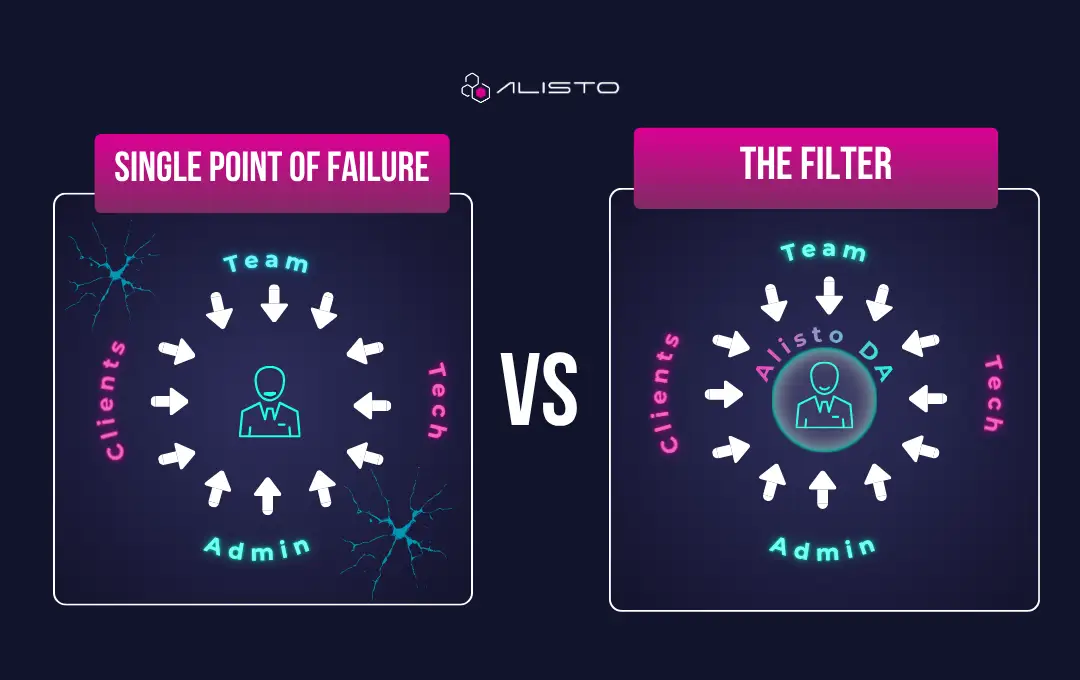
Over time the founder becomes the operational inbox of the entire company. Every message is a micro-decision. Every micro-decision is a focus reset. And focus resets are expensive — especially when your brain doesn’t context-switch cheaply.
What a Boundary Layer Actually Does
A boundary layer sits between the founder and incoming communication.
Its job is simple: filter, organize, and route information before it reaches you.
Instead of every message landing on your desk, the boundary layer evaluates what requires founder attention, what the team can handle, what needs clarification, and what can wait.
When this layer exists, you only see what actually requires your leadership. Everything else gets resolved inside the system.
Not blocking communication. Structuring it.
What a Distant Assistant Actually Does
The most effective way to install a boundary layer is a Distant Assistant.
A Distant Assistant isn’t an admin. They’re an operational filter. Their job isn’t to handle tasks. It’s to protect your attention.
Here’s what that looks like in practice.
Inbox triage. Every incoming message gets categorized — urgent, informational, internally handleable, or founder decision required. Only the last category reaches you.
Client follow-ups. Project updates, timeline confirmations, missing information collection, response relaying. Routine client communication handled without you in the middle of it.
Task routing. Most misdirected questions aren’t for the founder — they’re for operations, project managers, or team specialists. A Distant Assistant routes them correctly instead of letting them pile up on your desk.
Scheduling. Calendar coordination, meeting confirmations, adjustments, reminders. Your calendar stays structured without you touching it. 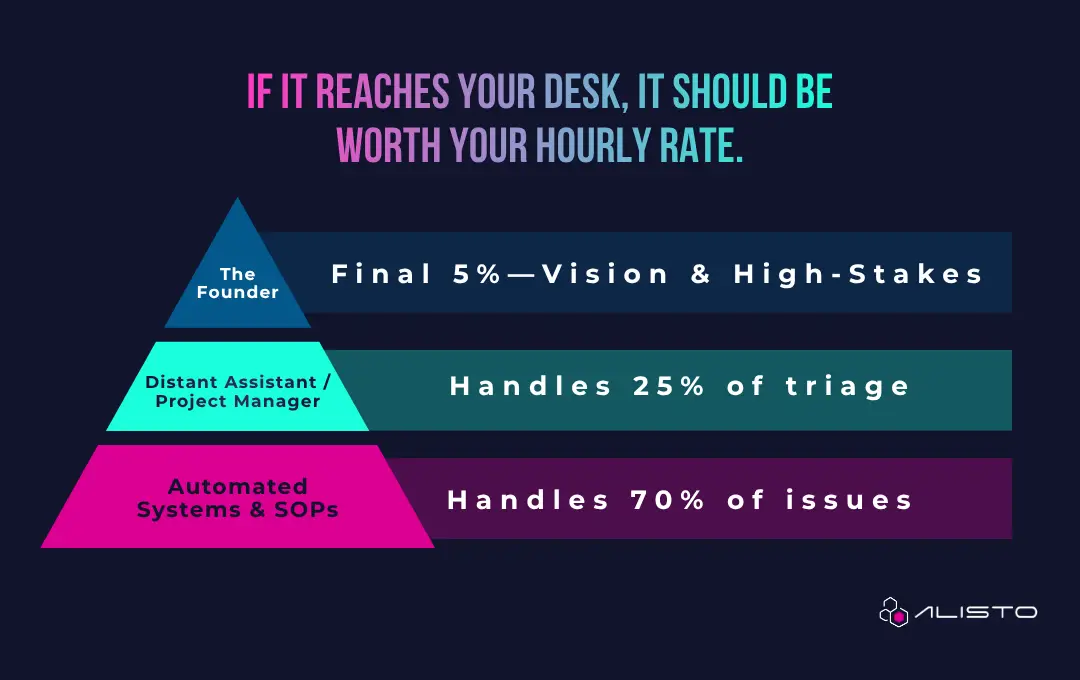
What Changes When the Layer Exists
When communication stops flowing directly to you all day, something shifts.
Messages get filtered. Decisions get grouped. Information arrives in structured batches instead of constant interruptions.
Strategic thinking becomes possible again. Not because you suddenly have more discipline — because the environment finally supports focus.
For ADHD entrepreneurs especially, this isn’t a convenience upgrade. It’s a fundamental change in how the workday functions. Every interruption removed is a focus reset that doesn’t happen. And focus resets that don’t happen are how deep work actually gets done.
Why AI Can’t Replace This Layer
A reasonable question at this point: can’t an AI tool just manage the inbox?
AI can absolutely help organize information. Summarize threads. Label messages. Suggest responses. Flag urgent emails.
But inbox chaos isn’t an information problem. It’s a responsibility problem.
AI can sort messages. It cannot decide who should own the issue. It cannot read a client message and recognize that the tone signals a relationship problem brewing. It cannot determine whether a question is a genuine escalation or something a team member should handle independently. It cannot know that this particular client needs a human response today, not a templated one.
Those decisions require context, judgment, and an understanding of how your specific business operates.
Which means someone still has to own the routing of communication. Someone has to know your clients, your team, your priorities, and your thresholds.
That’s not a tool. That’s a person.
And that’s exactly what a Distant Assistant is built to do.
Quick Diagnostic
- Do most client messages come directly to you?
- Do team members regularly ask you where tasks should go?
- Do emails and scheduling requests interrupt your day constantly?
- Do you struggle to find uninterrupted time for strategic thinking?
If several of these land — your business is missing its first boundary layer. And you’ve become the default system holding everything together.
Final Insight
The founder should not be the first point of contact for the business. That’s not leadership. That’s a support role nobody hired you for.
When a boundary layer exists, your attention returns to where it actually belongs — strategy, vision, growth.
The business becomes more stable. And you become significantly less overwhelmed.