
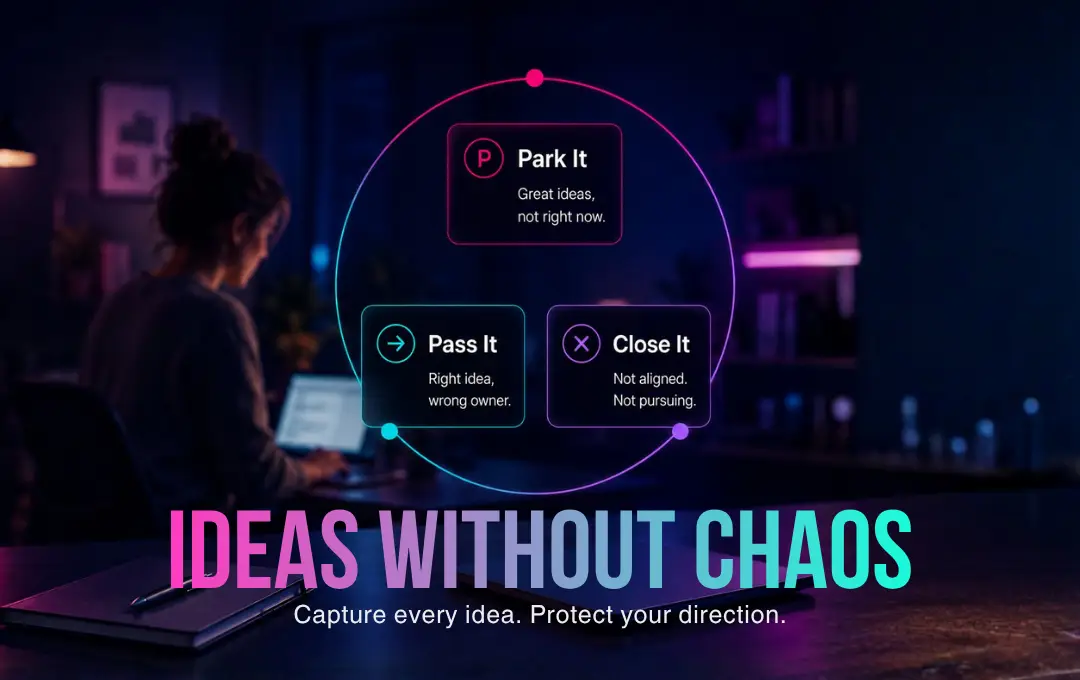
The problem with telling a high-generating founder to stop having new ideas is that it does not work. The ideas arrive whether the founder wants them to or not. Telling a founder to stop generating options is approximately as useful as telling them to stop breathing — technically possible for short periods, unsustainable as an operational strategy.
The question is not how to stop the ideas. The question is what the operational system does with them when they show up. Without a Holding System, every new idea competes directly with the committed direction for the founder’s attention and execution resources. With one, a new idea has a managed entry point — a place to go that removes it from active competition without losing it.
That distinction is the difference between a committed direction that holds through a 90-day cycle and one that quietly fragments by week four.
What a Holding System Is and What It Is Not
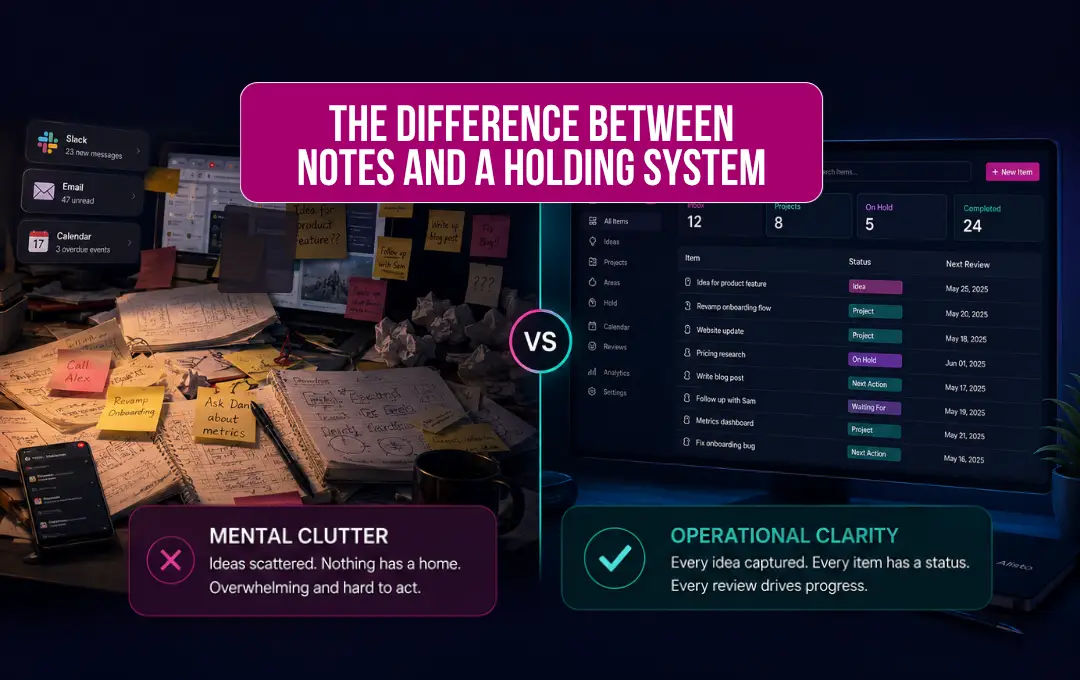
A Holding System is a structured, actively managed repository for ideas, directions, and opportunities that have been evaluated and are not being acted on in the current cycle.
It is not a notes app. A notes app is a capture tool — it collects things but does not process them, does not assign them status, and does not have a mechanism for bringing them back at the right time. Ideas in a notes app are still running as open loops in the founder’s cognitive background, because they have been written down but not resolved.
It is not a backlog. A backlog is a task queue — a list of things to do eventually. The Holding System is not a task queue. It is a status-assigned repository of options that have been formally evaluated, designated, and scheduled for review. The distinction matters operationally because it changes how the brain relates to what is in it.
It is not an archive. An archive is where things go to be forgotten. The Holding System is where things go to wait. The difference is the review date — every item in the Holding System has a specific date on which it will be looked at again, which is what allows the loop to be genuinely closed rather than just suppressed.
A functional Holding System has three components: a capture mechanism, a designation process, and a review schedule. All three are required. A system with capture and designation but no review schedule is a more organized version of the notes app problem. A system with review dates but no designation process produces review meetings where nothing gets decided. All three components working together is what produces the operational outcome the system is designed for.
The Three Designations
Every item that enters the Holding System receives one of three designations. The designation is assigned at intake, not at review.
Park It is for ideas and directions with genuine potential that are not right for the current season. The item has merit. The business simply does not have the capacity, the market position, or the strategic alignment to act on it right now. Parked items stay in the Holding System with a review date 90 days from the date of intake. At the review date, the designation gets reassessed — the item either moves to active consideration for the next direction cycle, gets re-parked with a new review date, or gets closed.
Pass It is for ideas that are good but do not belong to this business or this founder to execute. A referral opportunity for a complementary service provider, a content collaboration that fits someone else’s audience better than yours, a product idea that belongs in a different vertical. Pass It items get routed to whoever they belong to — a referral, a recommendation, a handoff — and removed from the Holding System. They do not accumulate.
Close It is for items that are not going to happen. Not because the idea is bad, but because the honest assessment is that the window for this idea has passed, the capacity will never exist, or the founder’s interest in it is not strong enough to survive an evaluation process. Formally closing an item produces a specific cognitive outcome — the loop is actually finished, not just postponed. The relief that comes from a formally closed item is not trivial, and it is qualitatively different from the relief that comes from parking something.
The designation decision is made by the founder. The DA’s role at intake is to present the item with enough context for the founder to make a fast decision — typically a one-sentence summary and a recommendation based on the DA’s read of the current operational situation. The founder decides. The DA implements and routes.
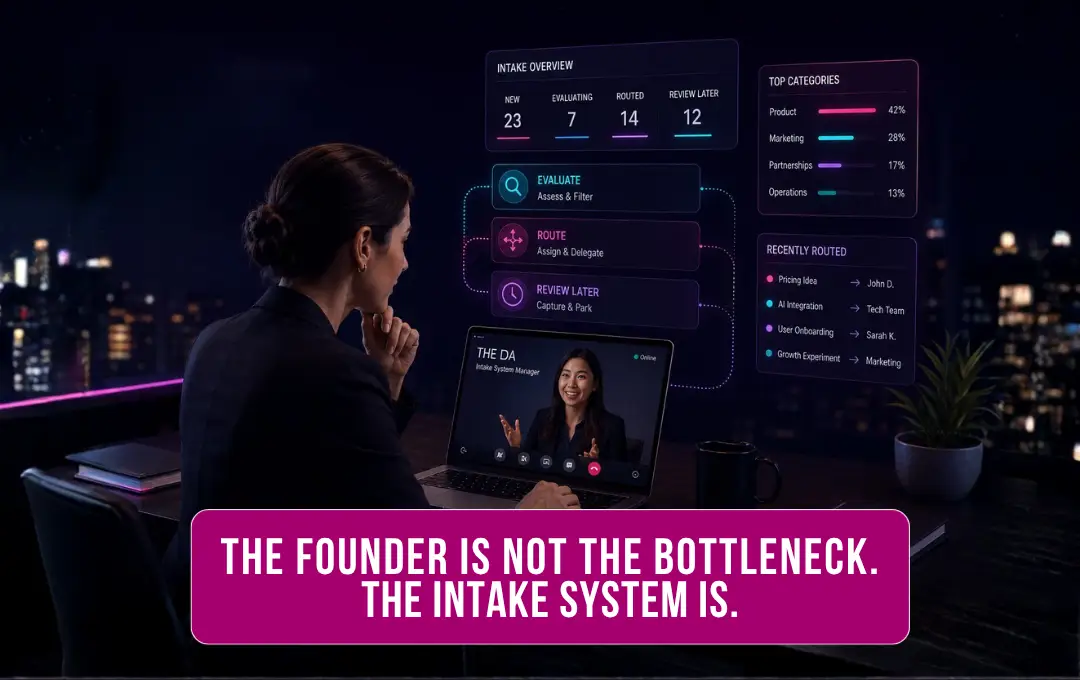
How the DA Builds the Holding System
The initial build happens in week one of the direction cycle and consists of four steps.
First, the DA conducts a full capture across every location where the founder currently stores ideas — notes apps, voice memos, email drafts, project management tools, physical notebooks if applicable. The goal is a complete extraction: every idea that is currently living somewhere outside the committed direction gets surfaced and collected in one place before the Holding System is built.
Second, the DA organizes the captured items into a working document and presents them to the founder in a single review session. The session runs on a timer — typically 60 to 90 minutes — and moves through every item with the sole objective of assigning a designation. The founder does not problem-solve, research, or elaborate during this session. They designate. The DA records the outcome.
Third, the DA builds the Holding System in whatever tool fits the team’s existing workflow. A shared Notion database, an Airtable base, a dedicated section of the project management board — the specific tool matters less than the structure. Each item needs at minimum: a title, a one-sentence description, the designation, the date of intake, and the review date if applicable.
Fourth, the DA sets up the review schedule — calendar reminders for every parked item’s review date, plus a standing recurring review cadence (typically monthly) for the founder and DA to process any new items that have accumulated since the last session.
From that point forward, the DA owns the Holding System. The founder’s only required interactions with it are the intake decisions and the scheduled reviews.
The Review Date Protocol
Review dates are the operational mechanism that transforms the Holding System from a storage tool into a decision tool.
Every parked item has a review date. The default is 90 days from intake, which aligns with standard direction cycle length. Items that were parked because of a specific seasonal constraint — a launch timing issue, a capacity constraint that is expected to resolve in a specific timeframe — can have a shorter review window. Items that are longer-horizon ideas with no near-term relevance can have a longer one, up to 180 days.
At the review date, the DA surfaces the item to the founder with a brief update: has anything changed in the business, the market, or the team’s capacity since this was parked that would affect the evaluation? The founder answers two questions: does this still have potential, and is this the right season for it? If yes to both, the item moves to active consideration for the next direction cycle. If yes to the first and no to the second, it gets re-parked with a new review date. If no to the first, it gets closed.
The review date protocol matters for a specific operational reason: it is what allows the founder to close the loop at intake. When an idea gets parked with a review date, the brain registers it as resolved — not abandoned, but scheduled. That registration is what eliminates the background processing that open loops produce. The cognitive relief is a direct result of the review date existing, not just the item being written down.
What the Holding System Does for Operational Throughput
The operational outcome of a functioning Holding System is not just reduced cognitive load for the founder — though that is real and significant. It is an increase in execution quality across the entire team.
When the DA is managing the Holding System and new ideas have a managed entry point, the number of direction-shifting interruptions that reach the team drops significantly. A team that was previously receiving informal direction updates via Slack at irregular intervals — each one requiring them to mentally recalibrate what they were working toward — is now executing against a stable brief between formally scheduled reviews. The work they produce is better because they are not rebuilding their mental model of the priority every few days.
The founder’s own execution improves for the same reason. Hours that were previously spent in informal re-evaluation mode — mentally revisiting parked ideas, comparing new arrivals against the current direction, negotiating internally about whether something is worth acting on — are returned to execution against the committed direction.
How to Hand Off Holding System Management to a DA
The handoff process has four components.
The DA needs access to every location where the founder currently captures ideas. This is often a longer list than founders expect — a specific notes app, a voice memo folder, a dedicated email label, a channel in Slack, a physical notebook. All of it needs to be visible to the DA.
The DA needs a clear brief on what the current committed direction is and what the operational priorities are for the current cycle. Without this, the DA cannot make accurate intake recommendations — they cannot distinguish between an idea that serves the current direction and one that belongs in the Holding System if they do not have a clear picture of what the current direction is.
The founder and DA need a standing review cadence — a recurring 30-to-60-minute meeting, typically monthly, where accumulated items get processed and existing parked items with upcoming review dates get evaluated. This meeting does not replace the day-30 and day-60 milestone reviews. It is specifically for Holding System maintenance.
The founder needs to commit to routing new ideas through the DA rather than acting on them directly. This is the behavioral component of the handoff and the most common point of failure. If the founder continues to respond to new ideas by opening new work streams without routing them through the intake process, the Holding System cannot function as designed. The routing commitment is the condition that makes everything else work.
For nonprofit organizations: boards and leadership teams generate ideas continuously, and without a structured holding system, those ideas either get acted on immediately — overloading the program team — or get lost entirely, which erodes board engagement over time. A DA-managed Holding System with clear review dates gives nonprofit leadership a mechanism for honoring every idea without acting on all of them at once. Items that cannot be pursued in the current cycle stay visible, stay scheduled, and stay available for consideration when capacity shifts.