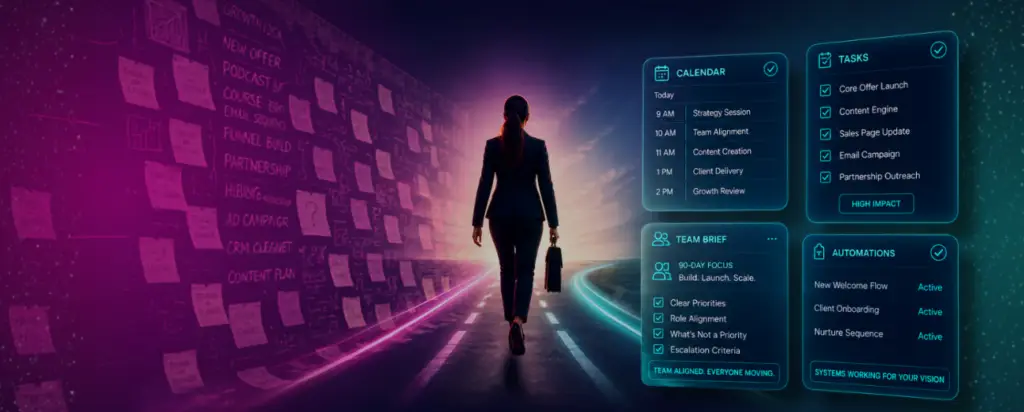

When a founder commits to a direction, the most common operational failure is not that they change their mind. It is that their systems, calendar, and task list never catch up to the decision.
The committed direction exists in the founder’s head — and on the day they make it, that feels like enough. But the calendar is still configured for the previous state of the business. The team is still executing against the previous priorities. The content plan, the automations, the communication templates — all of it is still pointed somewhere else. And the gap between the decision and the operational reality is exactly where momentum dies.
This is the DA’s first job during a VISION frame: close that gap before it becomes a problem.
The Gap Between a Committed Direction and Operational Reality
A direction becomes operationally real when four things are true: the team has a written brief, the calendar reflects the commitment, the task list is reorganized around the new priority, and the systems that supported the previous direction have been updated or decommissioned.
Until all four are true, the committed direction is competing with the operational infrastructure of the previous one. The founder is mentally in the new direction while the business is structurally executing against the old one. That misalignment does not resolve itself. It accumulates — in missed alignment between content and offer, in team members executing against outdated priorities, in automations firing for a direction the founder is no longer building.
The window between the commitment and the operational catch-up is the highest-risk period of any direction cycle. It is also the period when most founders are at peak motivation and least likely to notice the infrastructure lag. The DA’s role is to close that window as quickly and completely as possible, before the motivation peak passes and the lag starts producing visible problems.
The Four DA Deliverables in Week One
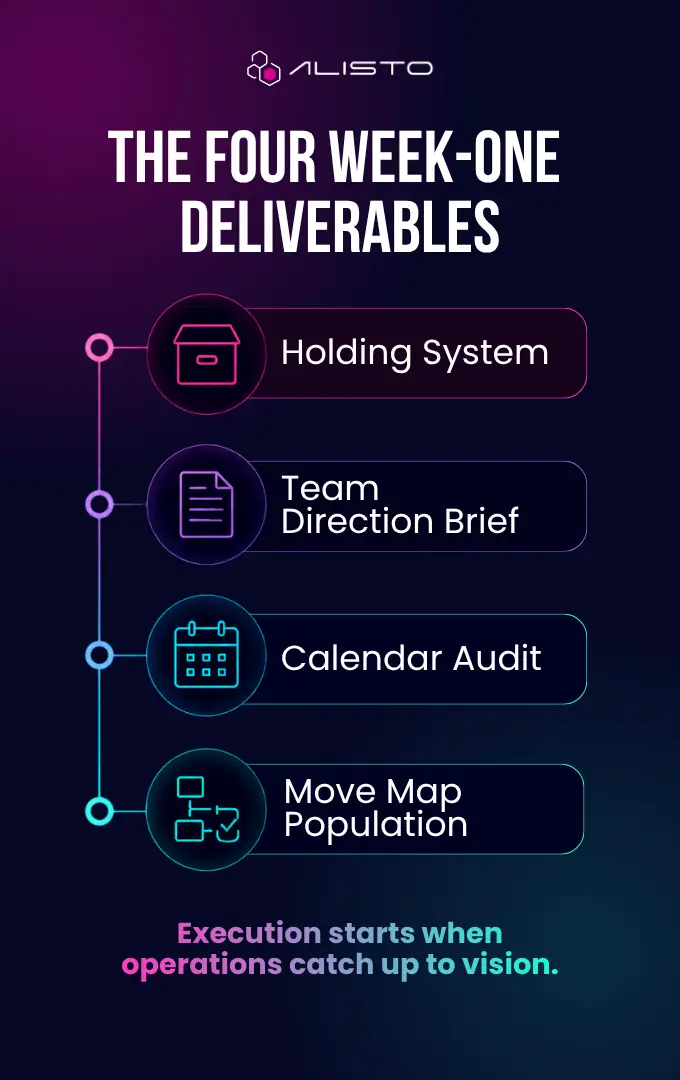
The first week of a committed direction has four specific DA deliverables. Each one addresses a different layer of the operational gap.
The Holding System. Every idea, project, and direction that did not make the cut gets captured, designated, and given a formal status. Park It, Pass It, or Close It. Every parked item gets a 90-day review date. The system gets built in a format that the DA can manage without ongoing founder input — a shared document, a project management board, or whatever tool the team already uses. By the end of week one, the founder’s cognitive queue is clear. Nothing that belongs to a deprioritized direction is still running in active competition with the committed one.
The Team Direction Brief. A one-page document drafted from a 20-minute founder input session and distributed to every contractor, collaborator, and DA working in the business. It states the committed direction, the 90-day focus, what each role is executing against, what is explicitly not a priority, and the escalation criteria. Confirmed as received by every recipient before the end of week one. Not optional, not informal — documented and confirmed.
The Calendar Audit. Every recurring meeting, commitment, and scheduled task evaluated against the committed direction. Items that do not serve it are flagged with a recommendation: remove, hand off, or keep with a documented rationale. The founder makes the final call on each flagged item. The DA implements the changes. By the end of week one, the calendar is a working reflection of the committed direction, not the previous one.
The Move Map Population. The 90-Day Move Map — the sequenced task list that translates the committed direction into execution — gets organized into three columns: founder tasks, DA tasks, and deferred tasks. The DA column gets loaded into whatever task management system the team uses, with due dates, priority levels, and any dependencies noted. The founder column is reviewed for items that do not actually require the founder and moved accordingly. By the end of week one, execution against the committed direction can begin without the founder having to manage the operational setup.
How the DA Manages the Holding System
The Holding System is not a one-time setup. It is an ongoing operational function.
New ideas will arrive throughout the direction cycle — that is not a failure of the framework, it is an expected feature of how high-generating founders work. The DA’s job is to give those ideas a managed entry point that does not require founder attention every time something comes in.
In practice, this means the DA maintains a standing process for capturing new ideas: a shared inbox, a dedicated channel, a form, or whatever mechanism fits the team’s existing workflow. When a new idea arrives, the DA does an initial triage — does this clearly belong to the current committed direction, or is it a new option that needs to go through the Holding System? Items that clearly serve the current direction get added to the appropriate task list. Items that are new directions or expansions go into the Holding System with a preliminary designation and get reviewed with the founder on a scheduled cadence, typically weekly or biweekly.
The key operational outcome of a DA-managed Holding System is that the founder never has to interrupt their execution to triage an incoming idea. The idea has a place to go. The loop gets closed. The DA handles the routing. The committed direction stays intact.
Communication Management During a Direction Commitment
The operational layer of communication management is one of the most frequently under delegated functions during a direction commitment — and one of the most consequential when it is handled inconsistently.
Every communication that goes out from the founder’s business during a direction cycle is an implicit statement about what the business is building. An email to a previous client referencing a deprioritized offer, a social post pointing toward an audience that belongs to the old direction, a partnership response that opens a conversation about something the founder has already decided not to pursue — each one is a small operational misalignment that compounds over time into an audience and team that does not know what the business actually is right now.
The DA’s communication management role during a VISION frame has three components. First, auditing existing communication templates and sequences against the committed direction and flagging anything that belongs to a previous one. Second, drafting new communication templates that reflect the current direction for the most common communication types — inquiry responses, collaboration requests, client updates. Third, handling the routine communication volume that does not require the founder — confirmations, follow-ups, standard responses — so the founder’s direct communication is reserved for relationships and decisions that actually require them.
The result is a communications layer that is consistently aligned with the committed direction, without requiring the founder to personally review and approve every outgoing message.
Milestone Tracking and the 90-Day Move Map
The Move Map is only as useful as the system tracking progress against it. A 90-day task list that gets built in week one and reviewed at day 90 is not a tracking system. It is a list with an expiration date.
The DA’s milestone tracking function runs throughout the direction cycle. On a weekly basis, the DA reviews the Move Map against actual completion: which tasks were completed, which are in progress, which are behind schedule, and which have dependencies that are blocking progress. A brief written update — not a meeting, a document — goes to the founder weekly with this information. Red flags are surfaced immediately rather than held for the weekly update.
The first proof point review happens at day 30. This is a structured check-in where the DA compiles progress against the milestones that were expected to be hit in the first month, flags any patterns in what is and is not getting done, and surfaces any operational adjustments that would improve execution in the second month. The founder uses this review to confirm the direction is on track or make intentional adjustments — not because something went wrong, but because 30 days of real execution data is more useful than 90 days of theoretical planning.
The process repeats at day 60 with the additional context of what the day 30 adjustments produced.
What Operational Success Looks Like at Day 30, 60, and 90
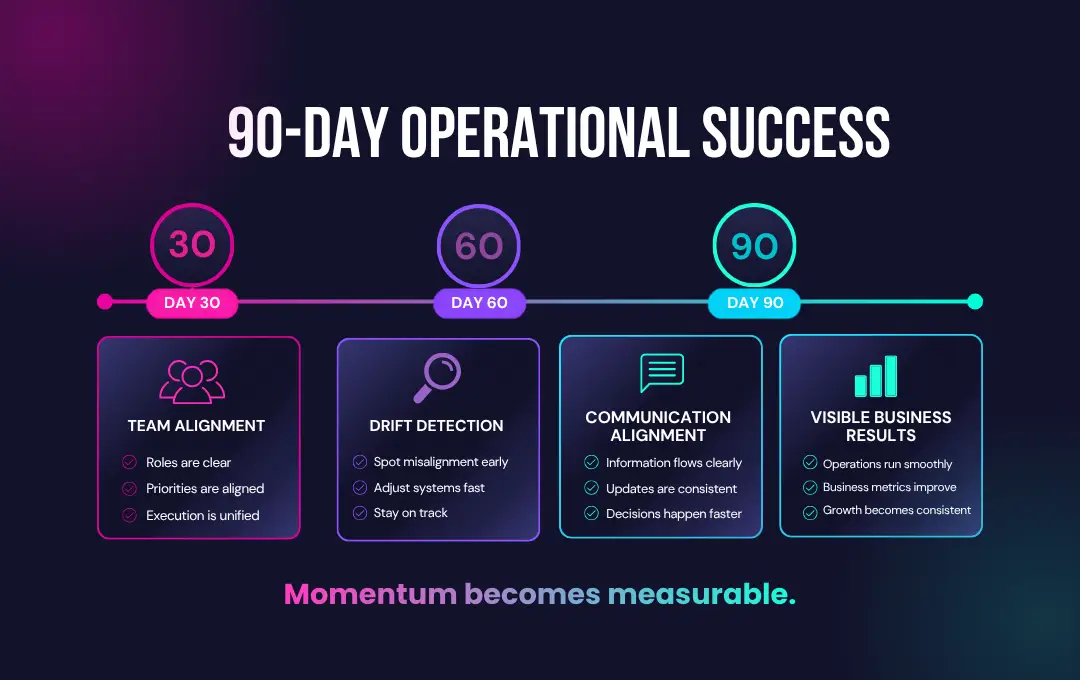
Operational success during a VISION frame is measurable at each milestone.
At day 30: the Holding System is active and managed, with zero items from it bleeding back into the founder’s active attention without going through the review process. The Team Direction Brief has been distributed, confirmed, and referenced at least once in a team decision. The calendar reflects the committed direction. The Move Map is at or ahead of expected completion on DA-column tasks.
At day 60: the communication layer is consistently aligned with the committed direction across all channels. The DA has handled at least one instance of drift detection — catching an execution item that was moving away from the committed direction before it became a problem. The founder is spending the majority of their working hours on tasks in the founder column of the Move Map, not on tasks that should have been delegated.
At day 90: the committed direction has produced a visible first result — a published piece of cornerstone content, a completed offer, a delivered client engagement, a closed pipeline stage. The Move Map has a completion rate of at least 70% on DA-column tasks. The Holding System has been reviewed and cleared, with parked items either advanced to the next direction cycle or formally closed. The brief for the next direction cycle is ready to be drafted.
These are not aspirational benchmarks. They are the operational outcomes that result from a DA working from a clear brief with adequate hours to execute against it.
For nonprofit executive directors: the DA function in the nonprofit context maps directly to the operations coordinator or program manager role. The same four week-one deliverables apply at the organizational level — a direction brief for staff, a program calendar audit, a task restructuring across the team, and a 90-day workplan organized by role. The milestone tracking function is what keeps program execution aligned with strategic direction between board meetings, when drift is most likely to accumulate unnoticed.
The Hourly Bank provides the DA hours to execute all of this — the Holding System, the Team Direction Brief, the calendar audit, the Move Map, the milestone tracking — without a retainer or long-term commitment. Starting at $250 for 10 hours.