

If you’ve ever ended your day wondering why you’re exhausted even though you didn’t do anything especially difficult, you’re not alone, and you’re not lazy.
You’re likely running your life on the wrong operating system: memory.
At Alisto, we’ve worked with dozens of high-performing founders who feel like they’re constantly moving but still not gaining momentum. The problem isn’t effort. It’s design.
Your calendar may be full. Your to-do list may be long. But your capacity is leaking through micro-decisions that pile up invisibly throughout the day.
And when your life runs on memory instead of systems, every task becomes friction.
Friction Isn’t Always Loud, But It’s Always Expensive
Friction doesn’t just come from difficult projects, messy teams, or endless meetings.
It comes from:
- Deciding what to eat for lunch
- Wondering if you followed up on that message
- Remembering when your next appointment is
- Re-checking if the household bills were paid
Every time you ask yourself:
- “Did I already do that?”
- “What am I forgetting?”
- “Where’s that note again?”
—you are burning energy on recall, not execution.
Cognitive psychologists call this phenomenon context switching—and it’s more draining than most people realize. A psycology research found that task-switching can reduce productivity by up to 40%, largely due to mental friction and fatigue.
Founders often blame themselves for this drag. But the real culprit isn’t motivation—it’s unmanaged operational load.
Why Memory Is a Terrible Operating System
Memory feels efficient because it’s fast—until it fails.
When your personal life is run from memory, everything important depends on you remembering it at the right time. That creates:
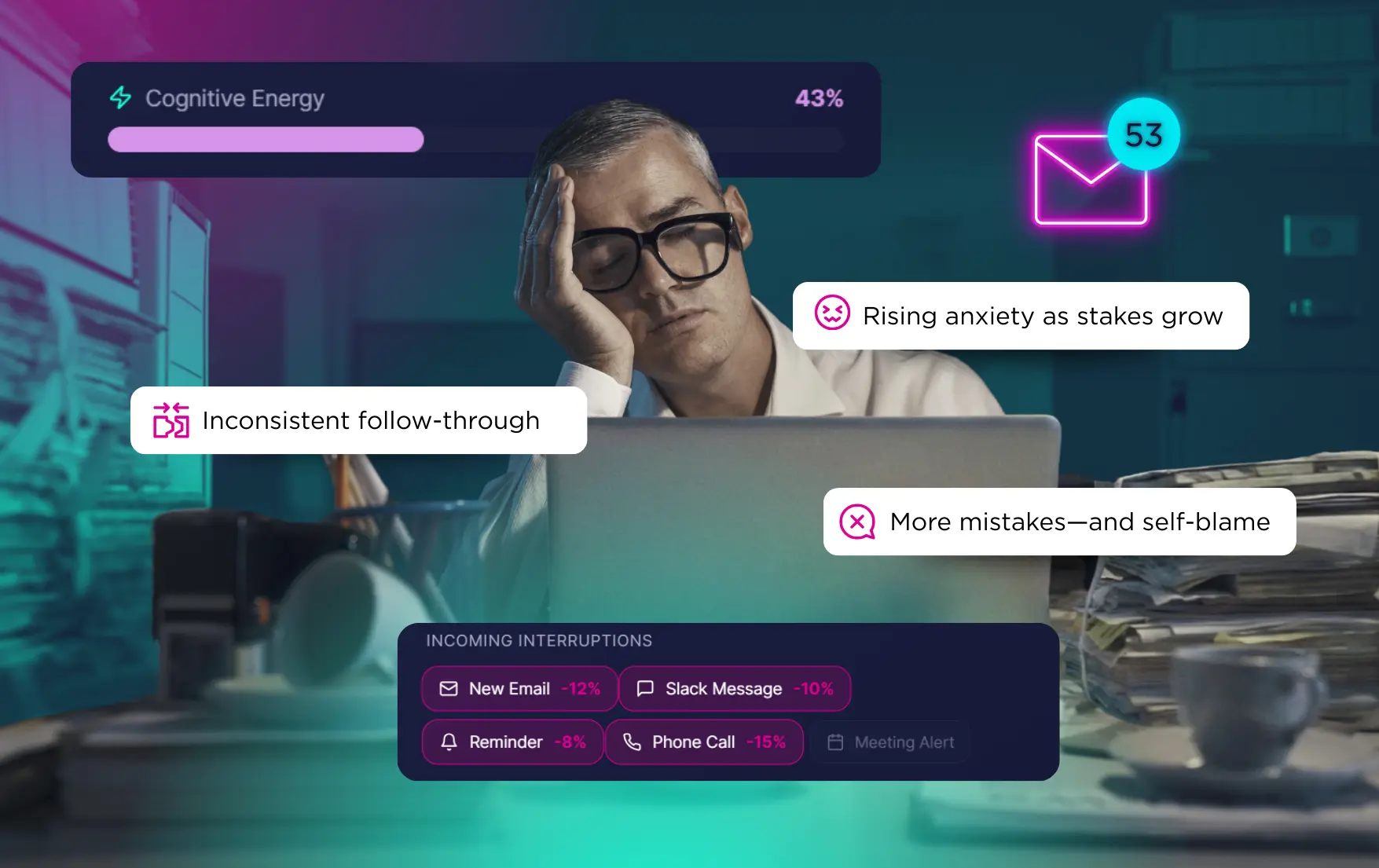
- Inconsistent follow-through
- Rising anxiety as stakes grow
- More mistakes—and self-blame
- A constant sense of being “behind,” even when you’re working hard
Research into decision fatigue shows that the brain has a limited pool of daily decision-making energy. Once it’s depleted, performance degrades—and stress spikes.
Leaders don’t avoid relying on memory because it’s weak.
They avoid it because it’s fragile.
What to Systemize vs. What to Delegate (Key Distinctions)
Not every task needs to be outsourced. Not every detail needs a system.
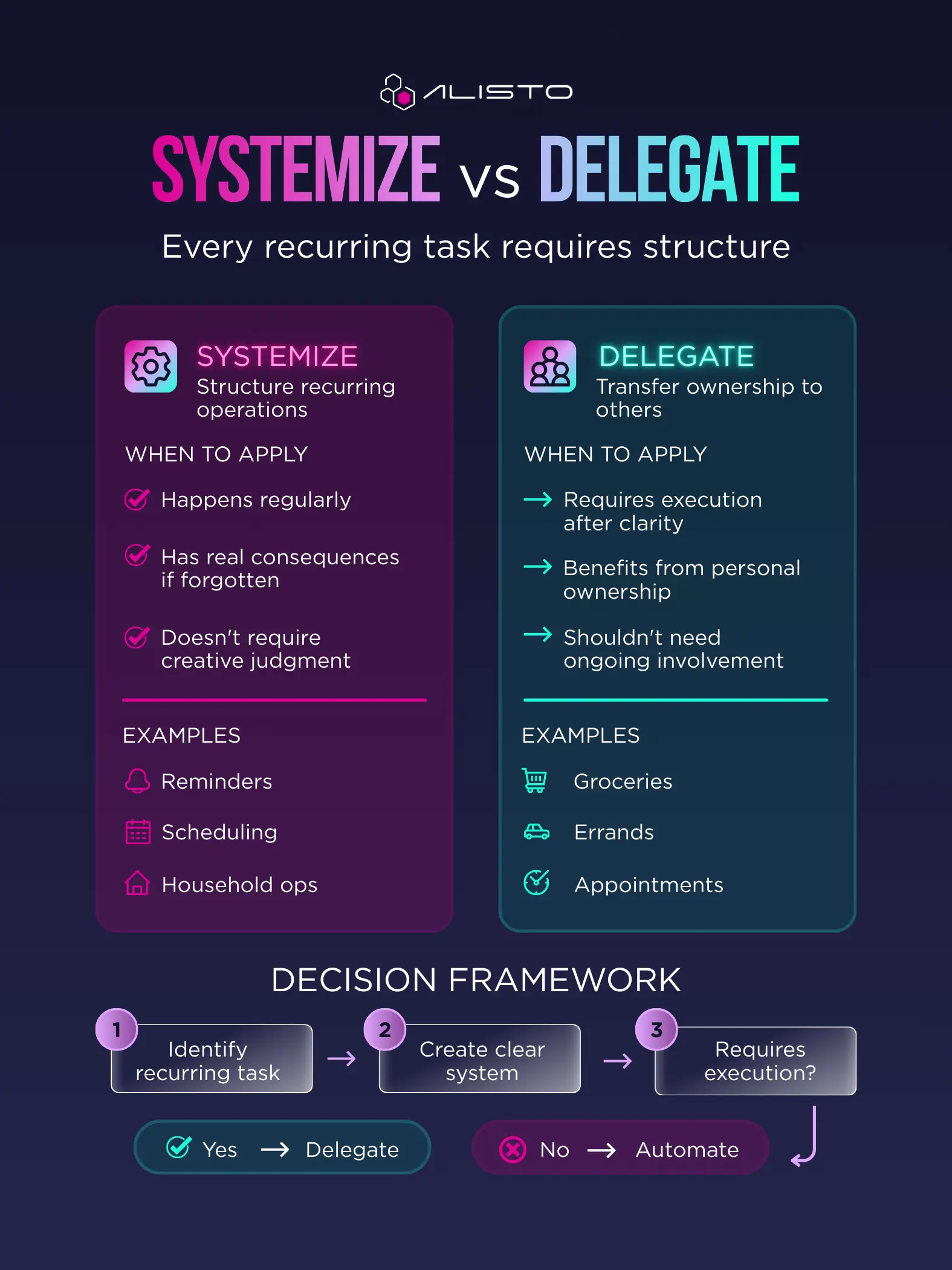
But every recurring task requires structure.
Here’s a rule of thumb:
✅ Systemize when something:
- Happens regularly
- Has real consequences if forgotten
- Doesn’t require creative judgment
Examples:
Reminders, routines, scheduling workflows, household operations
✅ Delegate when something:
- Still requires execution after clarity
- Benefits from personal ownership
- Should not need your ongoing involvement
Examples:
Grocery shopping, appointment booking, errand execution
🛑 Don’t delegate what hasn’t been systemized.
Delegation without structure creates confusion.
Systems before delegation reduce friction.
Why Trained Support Works Better Than “Help”
Many founders say: “I tried getting help. It didn’t work.”
But in our experience, the issue usually isn’t the helper—it’s the lack of a system to plug them into.
Support works when:
- Expectations are clear
- Processes are documented
- Ownership is defined
Otherwise, the leader becomes the bottleneck again—this time with more people involved.
That’s why trained support—people who understand life operations, not just task execution—matters more than ever. Great support doesn’t just do more. It protects your energy.
How Capacity-Aware Leaders Remove Friction
High-performing leaders aren’t just more productive. They’re more strategic about what their energy is spent on.
Here’s what they do differently:
- Design for low-energy days, not ideal ones
- Remove decisions before trying to optimize performance
- Apply systems thinking to life, not just business
- Clarify needs before adding tools or people
This isn’t about control or perfectionism. It’s about removing resistance from daily life so your energy goes where it matters most.
Clarity Always Comes Before Tools
Most founders chase the next app, planner, or productivity hack.
But without clarity, tools just add noise.
Before you add anything, ask:
- What is actually draining my energy?
- What am I personally responsible for that shouldn’t be?
- What keeps falling through the cracks—and why?
Only after answering these questions will systems—and the right kind of support—become obvious.
Otherwise, you’re just systemizing confusion.
What To Do Next
If this article feels familiar, the answer isn’t another to-do list or a more disciplined morning routine.
It’s structure. It’s clarity. It’s support that fits into a system.
1. Download the S.E.L.F. Systems Planner
This planner helps you:
- Spot hidden friction points
- Identify what to systemize vs. delegate
- See where you’re relying too much on memory
👉 Download the planner
(No pressure. Just clarity.)
2. Book a Capacity Audit with Avy
This is not coaching. It’s not productivity advice.
It’s a clear, strategic review of your life and business operations together—with the goal of showing you:
- What’s quietly draining capacity
- What decisions can be automated or removed
- What kind of support you actually need
👉 Schedule your Capacity Audit
Don’t wait until burnout forces a systems overhaul.
Build the structure now—so you don’t have to rebuild later.