
If your inbox feels overwhelming, the problem is rarely email volume.
The real problem is something much simpler.
No one knows who is responsible for responding.
So the messages default to the founder. Client questions. Internal clarifications. Scheduling requests. Operational issues.
And slowly your inbox stops being a communication tool.
It becomes a graveyard of unfinished decisions.
Unread counts climb into the hundreds. Then thousands. Search becomes a survival skill. And sometimes you avoid opening the inbox altogether, because you already know what you’ll find.
- Inbox overwhelm usually comes from unclear ownership, not message volume
- When response responsibility is undefined, communication defaults to the founder
- Inbox triage systems route messages to the correct person before they reach you
- Distant Assistants filter and categorize communication before it reaches leadership
- Protecting inbox boundaries protects founder attention
Picture opening your inbox on a typical morning.
The unread count says 2,148. Or worse. 10,372.
Some messages are important. Some are outdated. Some contain information you’ll need later. But now they’re buried inside a digital avalanche.
So you scan quickly. Answer the obvious ones. Mark a few as unread so you don’t forget them. And the rest sit there.
The inbox slowly becomes a place you avoid rather than rely on. And when you actually need something — a contract, a decision, a client note — you’re stuck digging through threads hoping you didn’t miss the message that mattered.
This isn’t just annoying. It’s mentally exhausting.
Because every time you open the inbox, your brain has to answer the same question: “What am I supposed to do with all of this?”
For neurodivergent founders especially, that question isn’t rhetorical. It’s a full cognitive load that hits before the workday has even started.
The Founder Inbox Trap
In the early stages, founders handle most communication themselves. They answer client emails. They coordinate with the team. They keep conversations moving.
At first this works.
But as the business grows, communication volume multiplies. More clients. More projects. More people asking questions. Without a communication system, every message still flows to the same place.
The founder’s inbox.
What used to be a communication tool slowly becomes the operational control center of the company. Every clarification. Every scheduling change. Every decision. The inbox becomes a running list of unresolved issues — and the founder becomes the only person who can resolve them.
The Communication Routing Problem
Inbox chaos usually has nothing to do with email itself.
It’s a routing problem.
When people don’t know who owns a question, they choose the safest option. They email the founder. So the founder becomes the default communication hub.
Every message requires a micro-decision: Should I answer this? Should someone else? Who do I forward this to?
Individually these decisions take seconds. Collectively they drain enormous amounts of cognitive energy. Instead of leading the business, the founder spends hours acting as a human message router.
For ADHD founders, this is where the day unravels fastest. It’s not the volume of messages that breaks focus — it’s the constant low-grade decision-making that comes with every single one. By the time you’ve triaged fifty emails, you’ve made fifty micro-decisions. And your brain is done before the real work starts.
The Inbox Triage System
The solution isn’t checking email less.
The solution is triage.
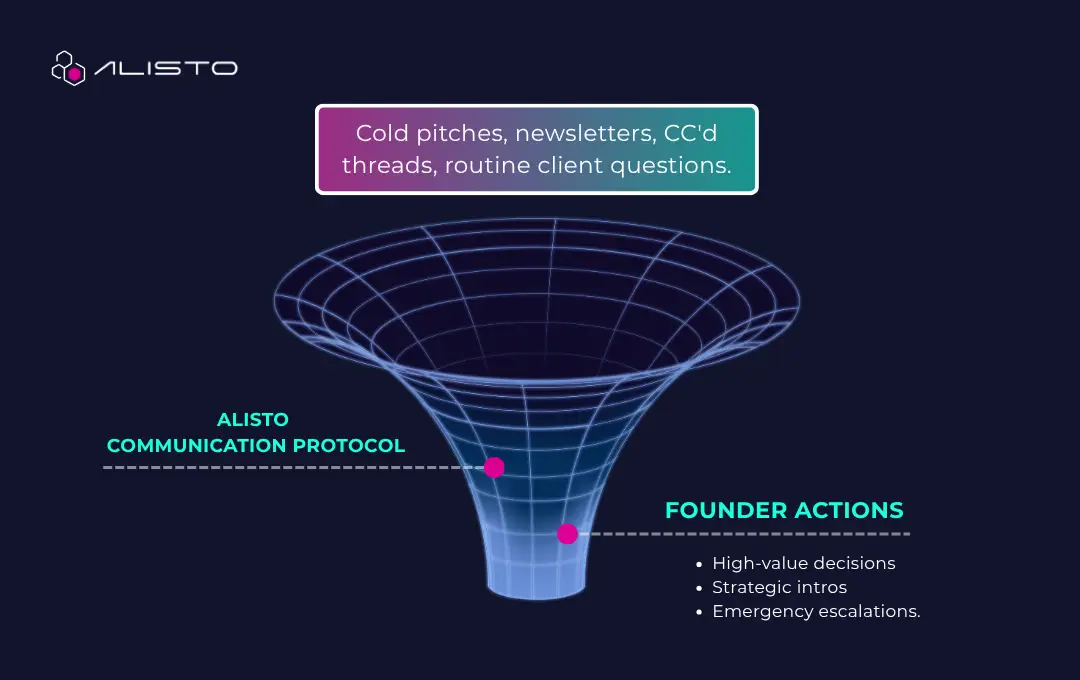
Inbox triage means messages are filtered before they reach the founder. Instead of every email landing directly in your attention, communication moves through a structured process.
For example:
Incoming messages → reviewed by assistant → categorized by priority
From there:
Routine questions → handled by the team Operational issues → routed to the correct owner Strategic decisions → escalated to the founder
You only see what requires leadership attention. Everything else gets resolved inside the system.
Why AI Alone Doesn’t Solve This
A reasonable question at this point: can’t an AI tool just manage the inbox?
AI can absolutely help organize information. Summarize threads. Label messages. Suggest responses. Flag urgent emails.
But inbox chaos isn’t an information problem. It’s a responsibility problem.
AI can sort messages. It cannot decide who should own the issue. It cannot read a client message and recognize that the tone signals a relationship problem brewing. It cannot determine whether a question is a genuine escalation or something a team member should handle independently. It cannot know that this particular client needs a human response today, not a templated one.
Those decisions require context, judgment, and an understanding of how your specific business operates.
Which means someone still has to own the routing of communication. Someone has to know your clients, your team, your priorities, and your thresholds.
That’s not a tool. That’s a person.
The Role of Distant Assistants in Inbox Triage
Inbox triage systems work best when someone actively manages the flow of communication.
A Distant Assistant can:
- Review incoming messages
- Categorize communication by urgency
- Route requests to the correct team member
- Gather missing information before escalation
- Maintain organized inbox systems
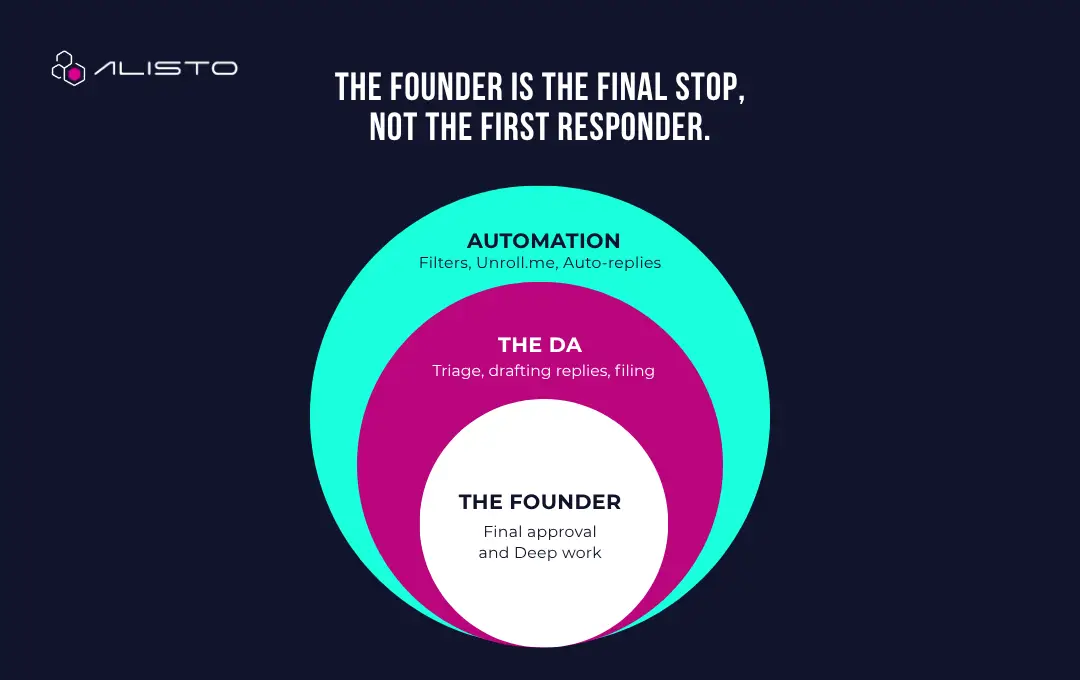
Instead of hundreds of messages hitting your attention, communication arrives filtered and organized. The assistant becomes the first response layer — which prevents inbox chaos from ever reaching leadership.
Protecting Founder Focus
When inbox triage exists, something important changes.
The inbox stops feeling threatening. Unread counts shrink. Important messages are easy to find. Communication arrives in organized batches instead of constant interruptions.
And most importantly, you stop starting your day inside a flood of unresolved decisions.
Your inbox should not be the first thing that touches your brain in the morning. It should be the last filter, not the first point of contact.
Because when attention is no longer trapped inside email, it’s available for what actually matters. Strategy. Planning. Leadership.
Quick Diagnostic
- Do unread email counts regularly reach into the hundreds or thousands?
- Do you sometimes avoid opening your inbox because it feels overwhelming?
- Do team members email you questions that someone else could answer?
- Do you spend time forwarding messages to the correct person?
If several of these land — your inbox is acting as the communication routing system for your entire business.
Final Insight
Inbox overwhelm isn’t about email.
It’s about structure.
When communication ownership is unclear, messages accumulate faster than they can be processed. The founder ends up carrying the cognitive weight of the entire system.
When triage systems exist, communication distributes across the organization. The inbox becomes manageable again. And leadership attention returns to the work that actually moves the business forward.