
Many founders believe assistants exist to handle tasks.
Scheduling meetings. Organizing documents. Managing small administrative work.
Those things matter. But they’re not the real reason Distant Assistants become powerful inside growing businesses.
The real value is something much bigger.
They protect founder capacity.
Because the biggest constraint in most companies isn’t revenue. It isn’t marketing. It isn’t even hiring.
It’s the founder’s attention.
- Founder capacity is limited by interruptions, decisions, and operational noise
- Without support, founders become the center of communication and coordination
- Distant Assistants act as operational gatekeepers for the business
- They filter communication, manage workflows, and route tasks correctly
- Protecting founder capacity creates space for leadership and strategic work
Picture a typical founder day.
Emails arrive. Slack messages appear. Clients ask questions. Team members need clarification.
None of these issues are particularly difficult. But each one requires attention. And attention is the one resource you cannot scale.
Over time, small interruptions accumulate. Your day fills with coordination instead of leadership. And the business begins depending on you for nearly everything.
That’s the founder capacity problem. And it compounds quietly until the business can only move as fast as you can respond.
The Founder Capacity Problem
Most businesses grow faster than the founder’s ability to manage communication.
In the beginning, handling everything makes sense. Client conversations. Operational questions. Project coordination. The company is small. It works.
Then it doesn’t.
More clients. More team members. More decisions. And without a system, everything still flows to the same place — you.
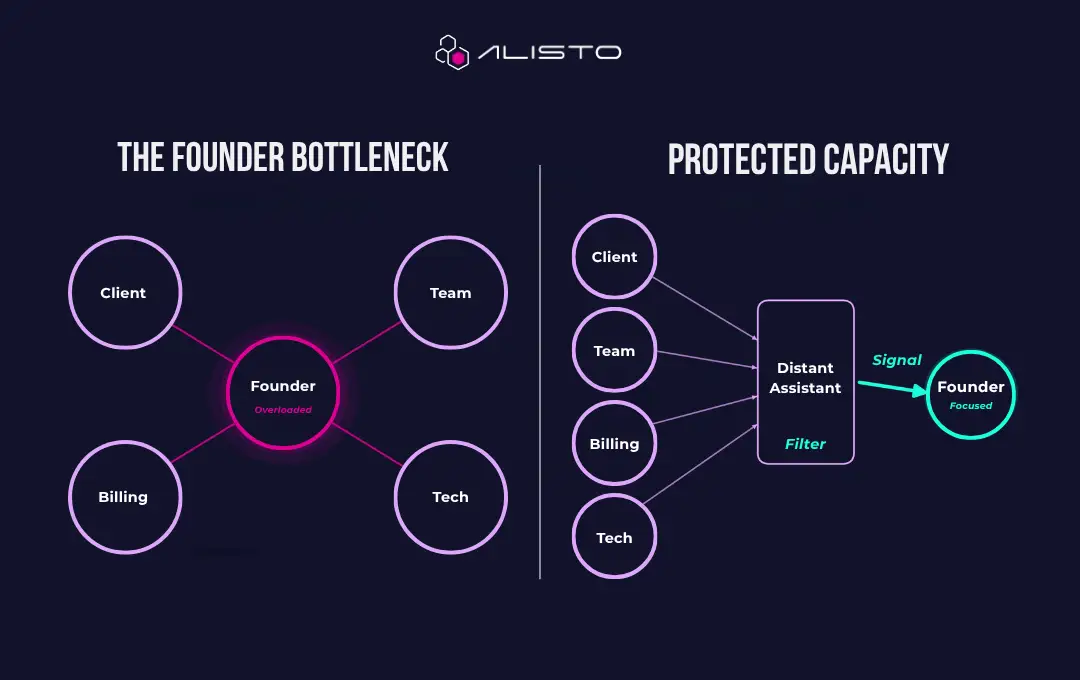
You become the default person for answering questions, clarifying instructions, routing tasks, and coordinating work. The founder slowly becomes the operational center of the company.
Once that happens, capacity becomes the biggest constraint on growth. Because the business can only move as fast as you can respond. And you are one person.
Assistants as Operational Gatekeepers
This is where Distant Assistants change the structure of the business.
Instead of the founder handling every operational interaction, the assistant becomes the first point of contact. Their role isn’t administrative. Their role is to protect your attention.
Here’s what that looks like in practice.
Filtering communication. Not every message requires you. Assistants review incoming communication and determine what requires leadership input, what the team can handle, what needs clarification, and what can wait. The interruptions that reach you drop dramatically. The ones that do reach you actually matter.
Managing workflows. Many operational questions exist because workflows are unclear. Assistants maintain structure by documenting processes, tracking task progress, and ensuring requests follow the correct workflow. Work keeps moving without you in the middle of every conversation.
Coordinating tasks. In growing companies, tasks frequently land in the wrong place. A Distant Assistant ensures requests get routed to the correct person — operations, project managers, specialists — instead of climbing back up to the founder. Small issues get resolved before they become your problem.
The Boundary Layer Concept
One of the most important functions a Distant Assistant serves is creating the first boundary layer in the business.
Without this layer, everything flows directly to you. Clients email you. Team members message you. Tasks escalate to you.
With a boundary layer in place, communication flows differently.
Requests arrive → assistant reviews → assistant routes appropriately.
Only the issues requiring leadership reach you. Everything else gets resolved inside the system.
For ADHD founders especially, this layer isn’t a convenience. It’s the difference between a day that stays functional and one that derails before 10am. Every request that gets filtered is a context switch that doesn’t happen. And context switches that don’t happen are how strategic thinking actually gets done.
What Changes When Capacity Is Protected
When operational noise decreases, something shifts.
You stop reacting. You start leading.
Instead of spending the day answering questions and routing tasks, your attention returns to the work that actually moves the business forward — strategy, growth, creative problem-solving, system design.
These aren’t luxury activities. They’re the job. But they require uninterrupted thinking time to happen. And uninterrupted thinking time doesn’t exist in a business without a boundary layer.
When a Distant Assistant handles communication routing and operational coordination, that space comes back. Founder capacity expands. And with it, so does the company’s ability to grow.
Quick Diagnostic
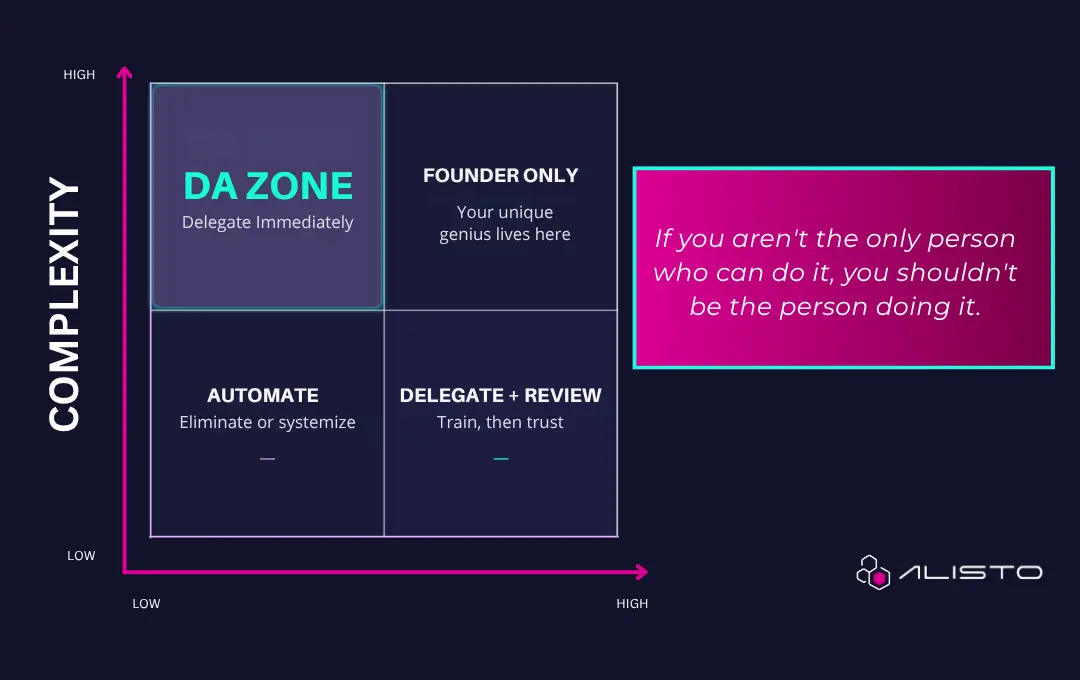
- Do most operational questions come directly to you?
- Do clients frequently contact you instead of the team?
- Do you spend time routing tasks to the correct person?
- Do interruptions make strategic work feel impossible?
If several of these land — your business is operating without a boundary layer. And your capacity is being consumed by work that should never reach you.
Final Insight
Most founders hire assistants to reduce workload.
But the real transformation happens when an assistant protects something deeper.
Attention.
When communication is filtered, workflows are maintained, and tasks are routed correctly, your attention returns to leadership. And when leadership attention is protected, the business becomes far easier to scale.
If operational noise is consuming your capacity, it’s time to install a boundary layer.