
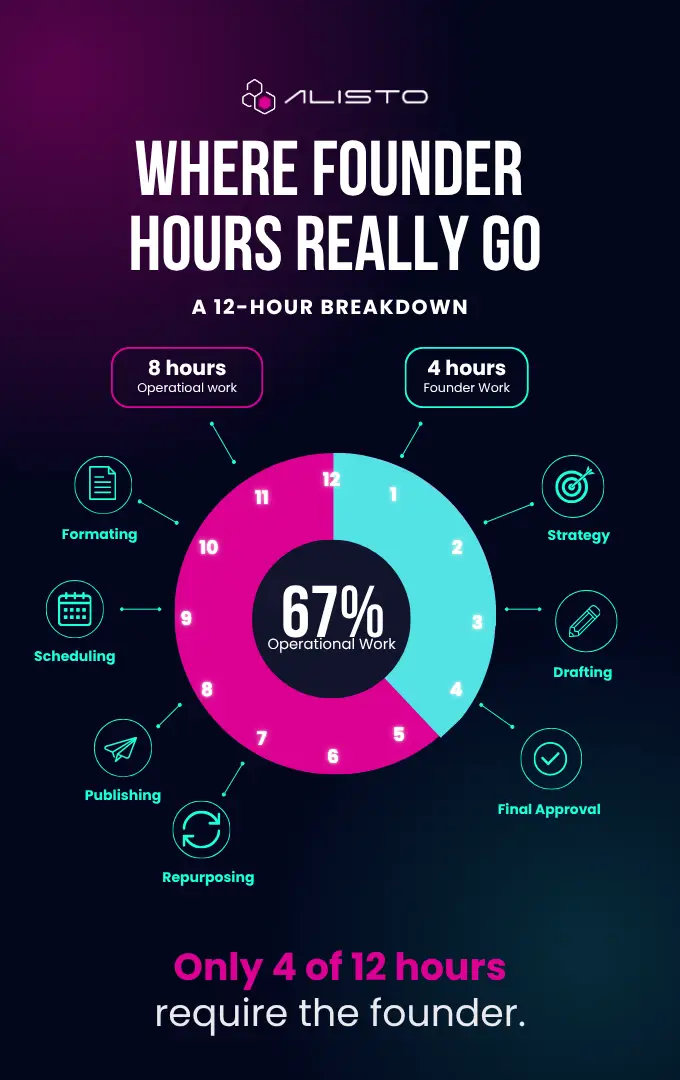
Four posts a week. Roughly three hours each once you count drafting, editing, formatting, scheduling, and publishing. That is twelve hours a week producing content. Now isolate the part that actually required you, specifically: the drafting and the final approval. That is about four hours. The other eight are operational work you are performing at founder cost.
This is the hidden cost of DIY marketing, and it is not the tool subscriptions or the boosted posts. It is the eight hours, coming out of your most valuable time, doing work that did not need you to do it.
- The hidden cost of DIY marketing is not the software fees. It is founder hours spent on work that does not require the founder.
- Producing content has three cost layers: the direct hours, the opportunity cost of those hours, and the failure cost of inconsistency.
- Of the hours a founder spends on content, only a fraction genuinely require the founder. The rest is operational work at founder cost.
- Those hours come out of your highest-value time, because content always does.
- Distributed ownership flips the math: founder hours drop, output continues through low weeks, and every piece gets reused instead of expiring.
Layer one: the direct hours
Start with the raw time. Most founders never actually count it, so it stays invisible. Break one piece of content into its real stages: capture, draft, polish, format for the platform, schedule, publish, and, if you are disciplined, repurpose. Time each stage honestly and the number is larger than you expect, because the stages you dismiss as quick are the ones that quietly consume the afternoon.
Then separate the stages by who they actually require. Drafting requires you, because the idea and the point of view are yours. Final approval requires you. The remaining stages, formatting, scheduling, publishing, and repurposing, do not require you at all. They require competence and a process. When you do them yourself, you are not doing founder work. You are doing operational work and paying for it with founder time.
Layer two: the opportunity cost
The direct hours are only the first layer, and not the most expensive one. The second layer is what those hours displace.
Content work does not come out of spare time, because founders do not have spare time. It comes out of your highest-value hours: the sales conversation you did not have, the client work you pushed to the evening, the strategic decision you made quickly because you were out of time to make it well. An hour spent formatting a carousel is not free just because you did not write a check for it. It is priced at whatever that hour would have produced in the part of the business only you can run. That is the real number, and it is almost always higher than the cost of handing the work off.
Layer three: the failure cost
The third layer is the one founders miss entirely, because it is a cost of the DIY model failing rather than running. When you own every stage, your output stops the moment your capacity does, and inconsistency follows automatically.
Inconsistency is not a neutral gap. Audiences and algorithms both reward continuity, so momentum compounds only across an unbroken run. Every silent stretch does not pause that compounding; it resets it, and you pay the startup cost of rebuilding momentum from cold the next time you appear. The DIY model produces these gaps structurally, because it depends on a single person’s availability. So the failure cost is not occasional. It is built in, and it recurs every time your capacity dips.
What the math looks like with distributed ownership
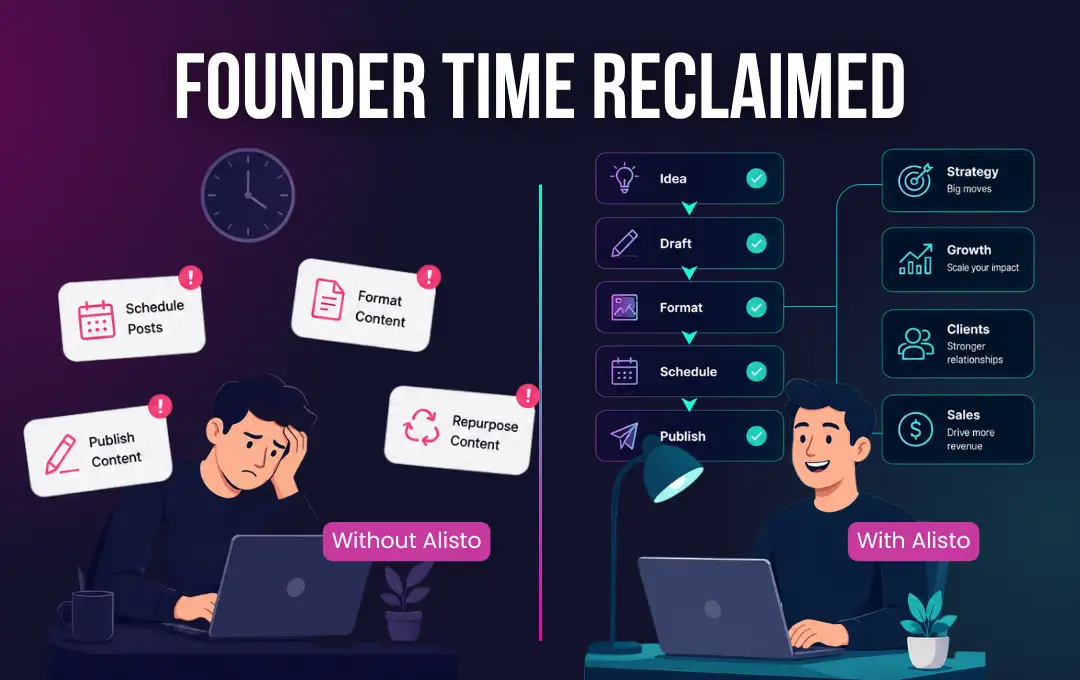
Distributed ownership changes all three layers at once. The direct hours drop, because you keep only origination and approval while a Distant Assistant owns the operational stages. The opportunity cost drops with them, because the hours returned to you are your highest-value hours. And the failure cost falls too, because output no longer depends on your availability, so the gaps that reset your momentum stop appearing.
Run the comparison directly. An Alisto Mini Team is $2,500 a month. Set that against roughly eight founder hours a week reclaimed from your most valuable time, plus continuous output that stops resetting your momentum. For most founders whose time produces real revenue, the operational hours alone justify the number before the failure cost is even counted. The system produces more while you produce less. That is not a slogan. It is the arithmetic of moving work off founder cost.
If you’re leading a nonprofit…
Price the executive director’s communication hours against their fundraising hours. Every hour the ED spends formatting a newsletter is an hour not spent on the major-donor relationships only the ED can hold, and at nonprofit stakes that trade compounds badly. Operational support is not overhead competing with the mission. It is what returns the ED’s hours to the work that actually funds the mission.
Run your own numbers
Answer these five honestly against your current setup.
- How many hours a week do you actually spend on content once every stage is counted?
- Of those hours, how many genuinely required you, versus required only a process?
- What would those operational hours have produced if spent on the part of the business only you can run?
- How often does your output stop entirely when your capacity dips, and what does restarting cost you?
- Have you ever compared the cost of a team against the founder hours it would return?
If you have never run that last comparison, that is the hidden cost staying hidden. The number is knowable, and it usually favors handing the operational stages off.
The bottom line
The hidden cost of DIY marketing is not what you pay for tools. It is the founder hours spent on operational work, the higher-value work those hours displace, and the compounding you lose every time output stops. Count all three layers, and doing it yourself is rarely the cheap option it appears to be.
Next step
A Strategy Call with Avy runs the founder-hour math on your real numbers and maps which stages to hand off first, so you stop paying founder cost for operational work. You leave with a Decision Map within 72 hours.
When you are ready to move those hours off your plate, an Alisto Team owns the operational stages for you. The Mini Team pairs a dedicated Distant Assistant with two specialists to run formatting, scheduling, publishing, and repurposing against your standard. For a single project or a lighter start, the Hourly Bank is the flexible entry point.