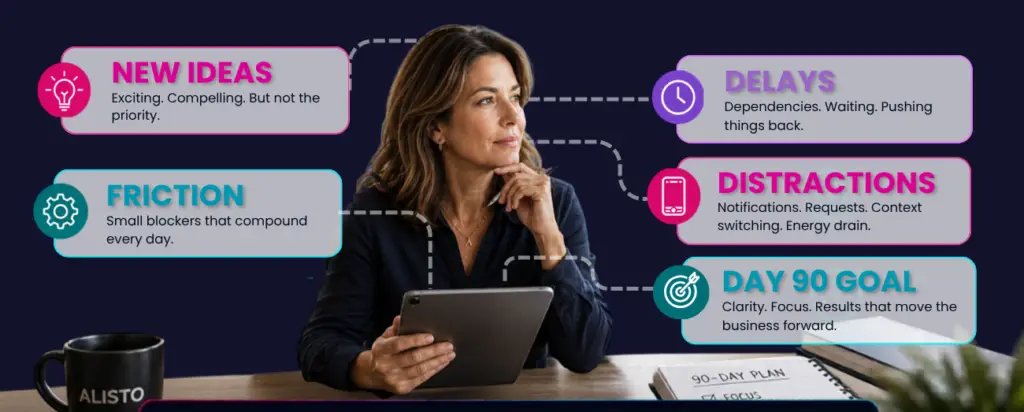
 The research on behavior change is consistent: the third week is where the gap opens.
Week one runs on the energy of the decision. The direction is new, the brief is clear, the team is aligned, and execution is clean. Week two runs on the momentum of early action — tasks are being completed, the system is working, the direction feels real. Week three is where the novelty wears off, the operational friction has accumulated, the early results have not yet produced visible outcomes, and the new ideas that have been patiently waiting for an opening start to look compelling again.
For founders without operational support, week three is where the committed direction quietly begins to lose ground. Not in one dramatic pivot. In a series of small detours that each seem reasonable in the moment and collectively add up to a direction that is technically still committed but operationally no longer protected.
The week-three collapse is not a motivation problem. It is a structural problem. And it has a structural solution.
The Specific Operational Conditions That Make Week Three Vulnerable
Week three’s vulnerability is the product of four operational conditions converging simultaneously.
The first is novelty depletion. The neurochemical response to a new committed direction — the clarity, the focus, the elevated engagement — is time-limited. By week three it has normalized. The direction is no longer new; it is just the work. For founders whose execution energy is partially driven by novelty, this normalization produces a detectable drop in the active protection of the direction.
The second is friction accumulation. Every operational system has friction — tasks that take longer than expected, dependencies that block progress, communications that require more back-and-forth than anticipated. In week one, friction is absorbed by the energy of the decision. By week three, it has stacked. The Move Map is behind in one or two categories. A dependency that was supposed to be resolved in week two is still open. The accumulated friction makes the committed direction feel harder than it felt on day one, which creates a psychological opening for alternatives.
The third is idea reactivation. Ideas that were designated and parked at the start of the cycle have had two weeks to develop in the founder’s background processing. Some arrive at week three feeling more refined and more urgent than they did when they were first logged. Without active monitoring of the Holding System, these ideas do not stay contained — they start appearing in founder communications, in informal team conversations, and in new task requests that belong to a direction the business is not currently building.
The fourth is team drift signal lag. When the founder’s attention starts to shift — even slightly, even informally — the team begins to register it through behavioral signals before it becomes a formal announcement. Questions start coming in about tasks that were previously clear. Execution pace on lower-visibility DA-column tasks slows. These signals indicate that the team has registered a shift in the founder’s commitment before the founder has consciously acknowledged it. By the time the signals are visible, the drift has been accumulating for days.
What the DA Does Differently in Weeks Two and Three
Week one DA work is primarily setup: the Holding System, the Team Direction Brief, the calendar audit, the Move Map population. These are build tasks with clear completion criteria.
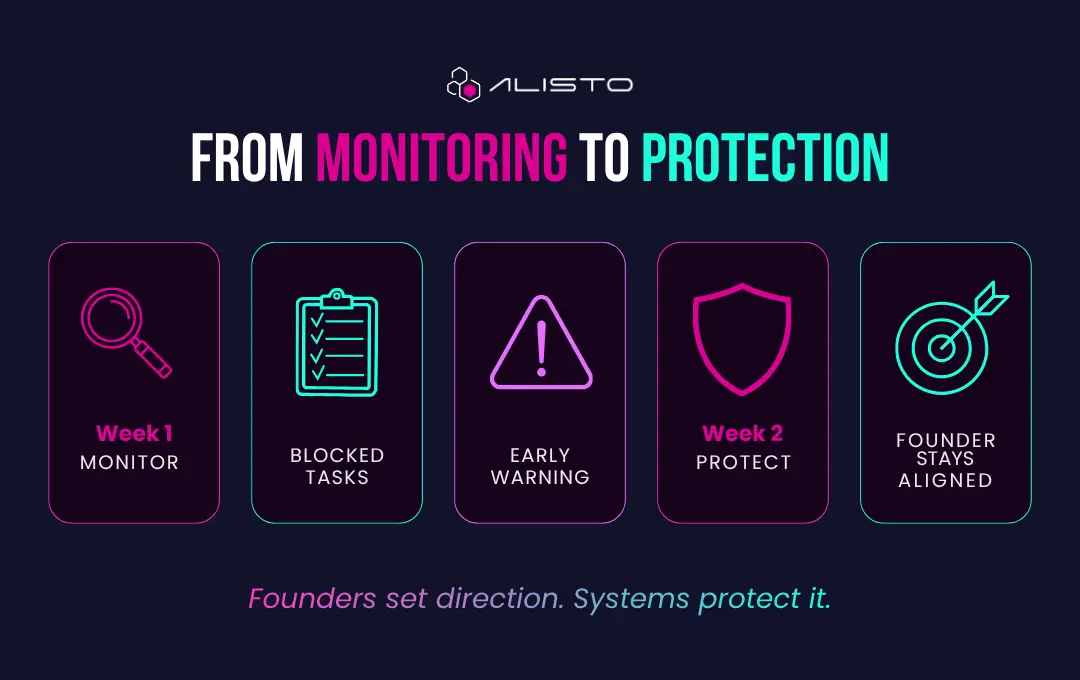
Week two and three DA work shifts to a different function: protection. The operational infrastructure is in place. The DA’s job is to ensure it continues to function as designed under the conditions that week three produces.
In week two, the DA begins active Move Map monitoring — tracking completion rates against expected pace, identifying which tasks are behind and why, and surfacing the information the founder needs for the week-three period before the friction has a chance to compound unmanaged. A DA who surfaces a blocked dependency in week two gives the founder time to resolve it cleanly. A DA who surfaces the same dependency in week three is reporting a problem that has already affected execution.
In week three, the DA’s primary function is drift detection and containment. This means monitoring three specific areas: the founder’s communication patterns for signals that attention is shifting, the Move Map for tasks that are being quietly deprioritized without formal acknowledgment, and the Holding System for evidence that parked ideas are escaping their designated status.
When a drift signal is detected, the DA does not wait for the weekly check-in to surface it. The flag goes to the founder immediately, with specific information: what the signal is, what it indicates operationally, and what the DA recommends as a response. The founder makes the call. The DA implements.
The Drift Detection Protocol
Drift detection is an active monitoring function, not a passive observation. A DA who notices drift only when it has become visible in deliverables has detected it too late. A DA who is monitoring for early signals can surface the problem while it is still containable.
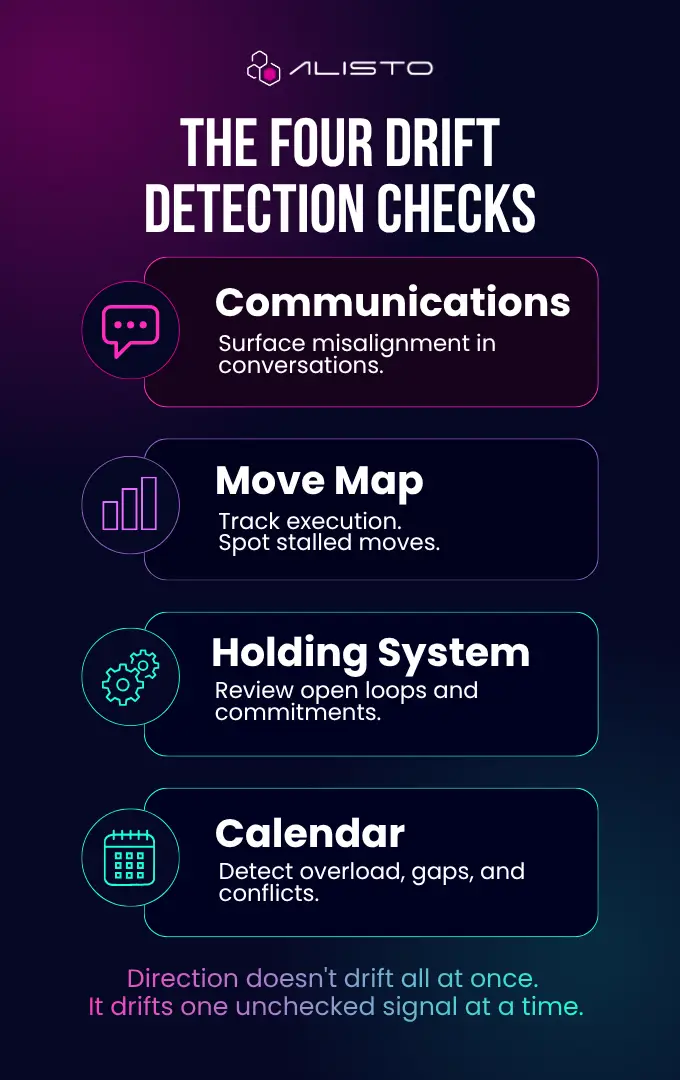
The drift detection protocol has four monitoring points.
Communication pattern monitoring. The DA reviews outgoing founder communications weekly — emails, Slack messages, social content — for references to directions or priorities that belong to a deprioritized category. A single reference is a data point. A pattern across multiple communications in a single week is a drift signal.
Move Map velocity tracking. The DA tracks the completion rate of DA-column tasks against the expected pace established at the Move Map build. A sudden drop in completion rate — not one task, but a category of tasks — indicates either a resource constraint or a direction shift. The DA investigates and reports which one before the next check-in.
Holding System boundary monitoring. The DA tracks whether parked ideas are staying in the system or bleeding out of it. The specific signals are: a parked item appearing in a new task request that bypassed the review cadence, a founder reference to something in the Holding System during a working session outside a scheduled review, or a parked item showing up in outgoing communications as if it were an active priority. Each of these signals that a parked idea has crossed back into active consideration without going through the filter. That boundary crossing is logged and surfaced — not as a performance issue, but as operational data the founder needs to make a deliberate decision about.
Calendar compliance monitoring. The DA reviews the founder’s calendar weekly against the committed direction and the calendar audit completed in week one. New commitments added without going through the audit process — meetings accepted, projects agreed to, collaborations initiated — get flagged for founder review. The question is not whether these commitments are bad. The question is whether they were evaluated against the committed direction before they were accepted.
The Re-Alignment Workflow
When drift is detected and surfaced, the response follows a defined workflow rather than an ad hoc conversation.
The DA documents the specific drift signals in writing before raising them with the founder. Not a verbal mention — a brief written summary of what was observed, what it indicates operationally, and what the DA recommends. This documentation serves two functions: it gives the founder a concrete object to respond to rather than an abstract concern, and it creates a record that can be referenced if the pattern continues.
The founder reviews the summary and makes one of three decisions. The drift is acknowledged as unintentional and the founder recommits to the established direction, with the DA implementing any operational adjustments needed to restore alignment. The drift reflects a genuine directional shift that warrants a formal direction change, which triggers the Team Direction Brief update process and a Move Map revision. Or the drift is within acceptable operational variance — the founder had a legitimate reason for the divergence and it does not indicate a pattern.
The DA documents the outcome of the conversation and, if the first or third decision was made, updates the operational monitoring to account for the response. If the second decision is made — a formal direction change — the re-alignment workflow becomes the direction transition workflow described in Blog 1.
The re-alignment workflow is not a corrective action against the founder. It is a standard operational process that exists because drift is a predictable feature of 90-day execution cycles, not an exceptional event. Founders who understand this use the workflow as a tool. Founders who treat it as a sign of failure tend to avoid surfacing drift signals until they have become visible problems — which is the outcome the workflow is designed to prevent.
The 30-Day Proof Point Review
The drift detection protocol and the re-alignment workflow are the week-three tools. The 30-day proof point review is the structural checkpoint that closes the first month of the cycle with a documented, data-informed assessment of whether execution is on track.
The review has a defined format. The DA prepares a written summary before the session: Move Map completion rates by column, proof point status, drift signals surfaced and their resolutions, and any operational adjustments made since the cycle started. The session runs 30 minutes. The founder and DA review the summary together and answer two questions: did we hit the proof point, and what does the data from the first 30 days tell us about what needs to adjust for the next 60?
The output of the review is a short written decision document — one page — that records what was decided and what changes, if any, are being made to the Move Map, the brief, or the operational protocols for the remainder of the cycle. The DA implements the changes. The cycle continues.
Founders who complete the 30-day proof point review consistently report the same operational outcome: the second half of the 90-day cycle produces more than the first half, because the review resolved the friction accumulation and realigned execution before the compounding effects of week three had a chance to become the defining pattern of the cycle.
That is the operational outcome DA support during a VISION frame is designed to produce. Not just completing the DA column tasks. Protecting the committed direction through the period when protection is hardest — and handing the founder a business that is still moving in the right direction at day 31.
For nonprofit organizations: the week-three dynamic plays out at the program level in a specific pattern — implementation energy drops, competing organizational priorities surface, and staff who were executing with clarity in week one are now managing ambiguity again. A DA or operations coordinator who is actively monitoring program execution against the direction brief and surfacing drift signals to the executive director before they compound provides the same protection at the organizational level that the drift detection protocol provides for individual founders. The 30-day proof point review maps directly to the program milestone check-in that most nonprofit funders require anyway — building it into the operational workflow means the data exists when it is needed, rather than being assembled under deadline pressure.