

“Build a content pipeline” is advice you have heard before, and it is useless without specifics. A pipeline is not a vibe or a mindset. It is a defined sequence of stages, each with a named owner and a clear handoff to the next. When people say they want a content pipeline that runs without them, this is the thing they are describing: a system where every stage has an owner who is not the founder, except the two stages that genuinely require one.
Here is what that system actually looks like, stage by stage and owner by owner. No abstraction. The real map.
- A content pipeline that runs without you is a defined sequence of six stages, each with a named owner and a clean handoff.
- Two stages require the founder: origination and final approval. The other four do not.
- The four non-founder stages, polish, adapt, schedule and publish, and repurpose, belong to a Distant Assistant and specialists.
- Handoffs are the part that makes it run. A stage with no defined next owner is where pipelines stall.
- Mapped this way, output no longer depends on the founder’s availability. The line keeps moving when the founder steps away.
Stage one: origination (founder)
The pipeline starts with the raw idea and the point of view, and this stage belongs to the founder. Not because the founder is precious, but because origination is where the actual perspective lives, the take that no one else can supply. In practice this is small: a voice note, a rough bullet, a captured thought. It does not require polish, and it should not wait for a good writing day. The only requirement is that the idea and the angle come from the founder. Everything downstream can be owned by someone else.
Stage two: polish (Distant Assistant)
The rough origination gets turned into a publishable draft, and this belongs to the Distant Assistant, working against the documented voice standard. This is the stage founders wrongly assume only they can do. With a written standard, the DA drafts to the specification, checks the result against the on-brand and off-brand examples, and produces a piece that sounds like the brand because the standard, not guesswork, is doing the work. The handoff into this stage is the founder’s raw capture. The handoff out is a clean draft ready for adaptation.
Stage three: adapt (Distant Assistant)
One clean draft is not one piece of content. It is the source for several. In this stage the DA adapts the draft into its platform variants: the long-form version, the short social version, the carousel, the email cut. Each format follows the same documented standard, so the voice holds across all of them. This is where a single origination multiplies into a week of output, and it happens without the founder, because adaptation is a process applied to an approved draft, not a new act of creation.
Stage four: schedule and publish (Distant Assistant)
The adapted pieces get loaded into the scheduler and published on the calendar. This is the stage the scheduling tool actually handles well, and it is trivial once the earlier stages have done their work. The DA owns the queue: loading, timing, and confirming each piece went out. The scheduler is a tool inside this stage, not the stage itself. The handoff in is a set of finished, on-brand pieces. The handoff out is published content and a record of what ran.
Stage five: repurpose (Distant Assistant)
Published is not finished. Strong pieces get reused rather than retired, and this stage owns that. The DA maintains a recycling calendar, resurfaces high-performing content on a schedule, and cuts new derivatives from proven material. This is the stage founders skip most often when they own the whole line, because by the time something is published they are out of capacity. Assigned to an owner, it runs by default, and it is where a library compounds instead of expiring.
Stage six: final approval (founder)
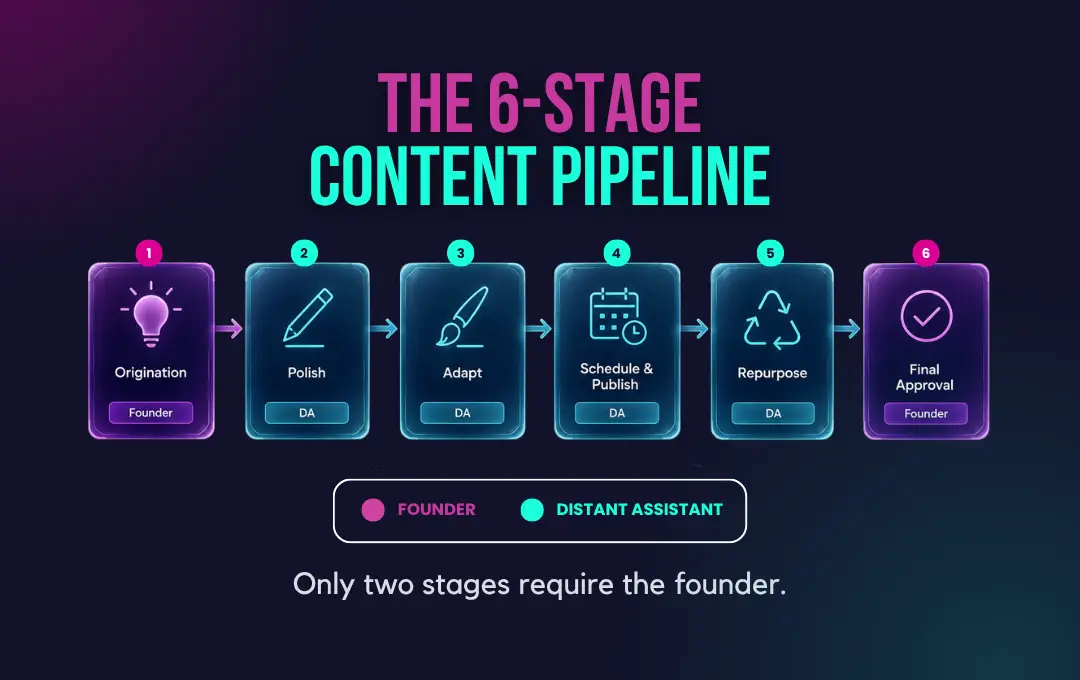
The second founder stage, and the smaller of the two. Before anything ships, the founder confirms it meets the standard. With a documented voice and a DA producing against it, this is a confirmation, not a rewrite: a quick yes, or an occasional correction that gets folded back into the standard so it is never needed twice. This stage is deliberately last and deliberately light. It keeps the founder in control of what goes out under their name without putting the founder back in the production line.
The handoffs are the system
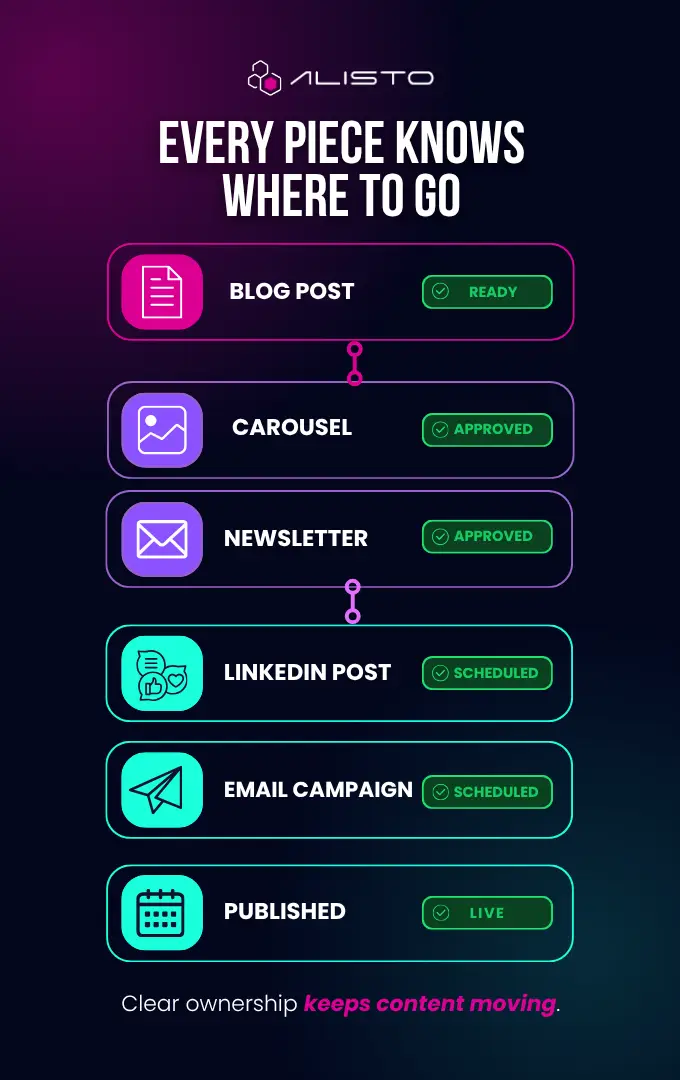
The stages are only half the design. What makes a pipeline run is the handoff between each one: a defined moment where work passes from one owner to the next, with no ambiguity about who holds it. A stage with no clear next owner is exactly where content stalls, sitting in a draft folder while everyone assumes someone else has it. A managed pipeline removes that ambiguity by naming the owner of every stage and the trigger for every handoff. That is the difference between a list of steps and a system that actually moves.
If you’re leading a nonprofit…
The same map applies to donor and mission communications, with the executive director holding only origination and final approval. The ED supplies the story and the stance and signs off before anything goes out, while a Distant Assistant owns drafting to the voice standard, adapting across the newsletter, the appeal, and the social post, scheduling, and resurfacing evergreen impact stories. The communications no longer stall every time the ED is consumed by a grant deadline, because the ED owns only two light stages and the pipeline carries the rest.
Map your own pipeline
Run these five checks against how your content moves today.
- Can you name all six stages your content passes through, or does it live as one undifferentiated blob of work?
- For each stage, is there a named owner, or does every stage default to you?
- Are your handoffs defined, or does work stall because no one knows who holds it next?
- Which of the four non-founder stages are you still personally doing?
- When you step away for a week, does the line keep moving, or does it stop at the first stage that only you own?
If you cannot name the stages or the owners, you do not have a pipeline. You have a pile of content work with your name on every part of it. The fix is to map the stages, assign the four that are not yours, and define the handoffs between them.
The bottom line
A content pipeline that runs without you is not complicated, but it is specific: six stages, two owned by you and four owned by a team, with a defined handoff between each. Mapped and assigned, the line keeps moving whether you are available that week or not. That is what managed actually means. Not a tool, not a mindset. Owners and handoffs.
Next step
A Strategy Call with Avy maps your six stages, identifies which you should keep and which to hand off, and defines the handoffs between them. You leave with a Decision Map within 72 hours.
When you are ready to install the pipeline, an Alisto Team runs the four non-founder stages for you. The Mini Team pairs a dedicated Distant Assistant with two specialists to own polish, adaptation, scheduling, and repurposing against your standard, so the line keeps moving while you hold only origination and approval. For a single project or a lighter start, the Hourly Bank is the flexible entry point.