

“I just need someone who can take this off my plate.”
A refrain nearly every founder or solo entrepreneur says at some point.
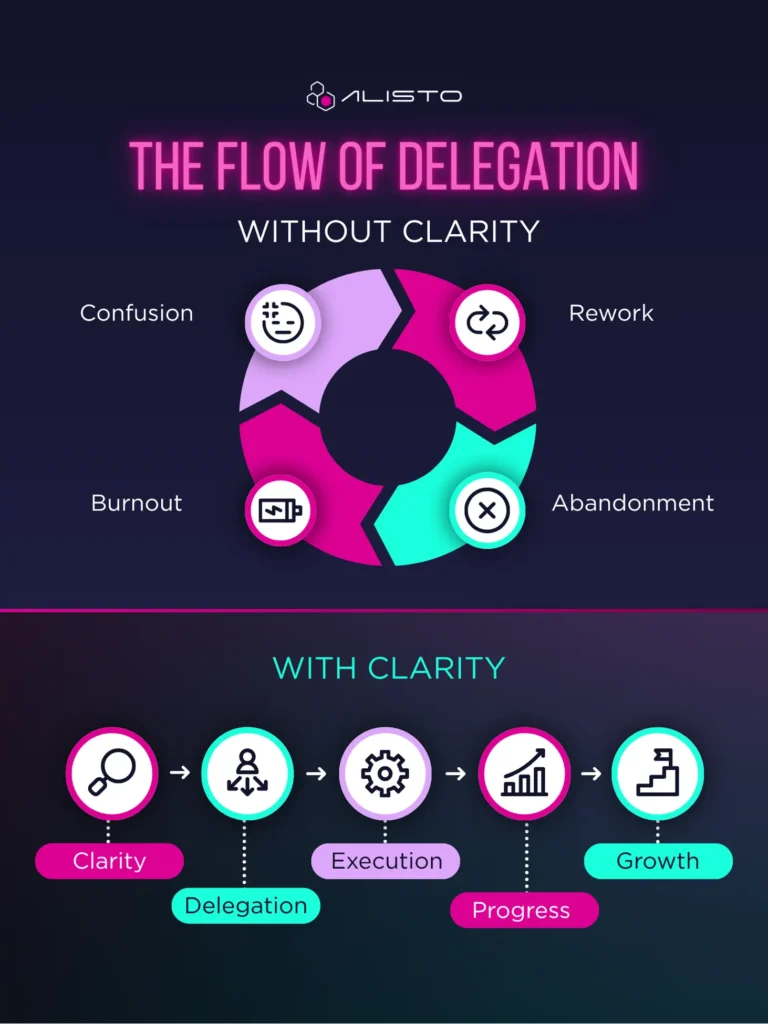
But here’s the unfiltered truth: you can’t outsource confusion. You can only delegate once clarity is in place.
If you’ve ever hired a VA, OBM, or team member — and still felt overwhelmed, confused, or like nothing got better (or worse, more chaotic) — this post is for you.
Why Delegating Without Clarity Backfires
Delegation, when done well, is a growth lever. But when done prematurely, it deepens dysfunction.
The core risk: delegation amplifies gaps, it doesn’t hide them
- A review in SCIRP emphasizes that clear, concise communication is foundational to successful delegation; unclear instructions routinely lead to confusion, frustration, and rework.
- Research on delegation success highlights that alignment (shared understanding between delegator and delegatee) is among the most critical success factors.
- Effective delegation — not just assigning tasks — contributes directly to job satisfaction, retention, and performance.
In other words: delegation doesn’t fix ambiguity — it magnifies it.
Why many entrepreneurs feel like “nothing changed” after hiring help
Especially for founders who are neurodivergent, juggling survival-mode operations, or mentally overburdened, the impulse to delegate often comes from a place of reactive desperation:
- “I’m drowning, someone rescue me.”
- “Please just figure it out for me.”
- “I hate admin, just take it.”
That mindset leads to common pitfalls:
- Role confusion – no one knows who owns what
- Excessive back‑and‑forth – because foundational expectations weren’t set
- Task abandonment or reversion – where the founder ends up doing it anyway
- “Easier if I just do it myself” syndrome
The paradox: without clarity, the more you delegate, the more tangled things become.
Build Clarity First: Systems That Ground Delegation
Clarity isn’t just a feeling — it’s a structure. Before you outsource, set up your foundational nervous system so your support can plug in meaningfully.
Here are four essential systems:
1. Visual workflows to externalize process logic
Use tools like ClickUp, Trello, or Notion to map your workflows visually (e.g. Kanban boards, swimlanes). When processes are externalized:
- You reduce cognitive load and brain clutter.
- You make bottlenecks, handoff points, and dependencies visible.
- You enable smoother, more consistent orchestration.
McKinsey reports that bringing visual performance boards into knowledge work leads to clearer work flow and better problem identification.
Lean/visual-management practitioners also show that visibility accelerates decision-making and reduces waste.
Plus, a recent systematic review finds that business process visualizations strongly correlate with improved operational performance.
Clarity concept: “Task visibility for executive function support.”
2. A “Do‑Not‑Do” list (boundary map)
Often we list what we should do — but what about what we shouldn’t do?
By articulating what you’re not willing to spend time or energy on, you:
- Signal your capacity limits
- Create guardrails around delegation (“I won’t delegate X because I want to keep it.”)
- Help your team understand your preferences and leeway
Clarity concept: “Boundary-based delegation strategy.”
3. Time blocking + margin buffer
A jam-packed calendar often disguises poor clarity. Instead:
- Schedule blocks for execution, decision-making, and oversight
- Leave buffer windows — white space to react or rethink
- Track actual vs. planned capacity regularly
This gives you real data on your bandwidth and shows when tasks should truly be delegated.
Clarity concept: “Energy-aware planning for solopreneurs.”
4. A weekly “systems audit” ritual
Before you delegate, carve out a 30-minute weekly review:
- What moved forward? What stalled?
- What felt heavy or vague?
- What could be templated or SOP’d?
- What are new delegation candidates or dependencies?
This ritual keeps you proactive (not reactive) and ensures clarity grows alongside your business.
Clarity concept: “Weekly business systems audit.”
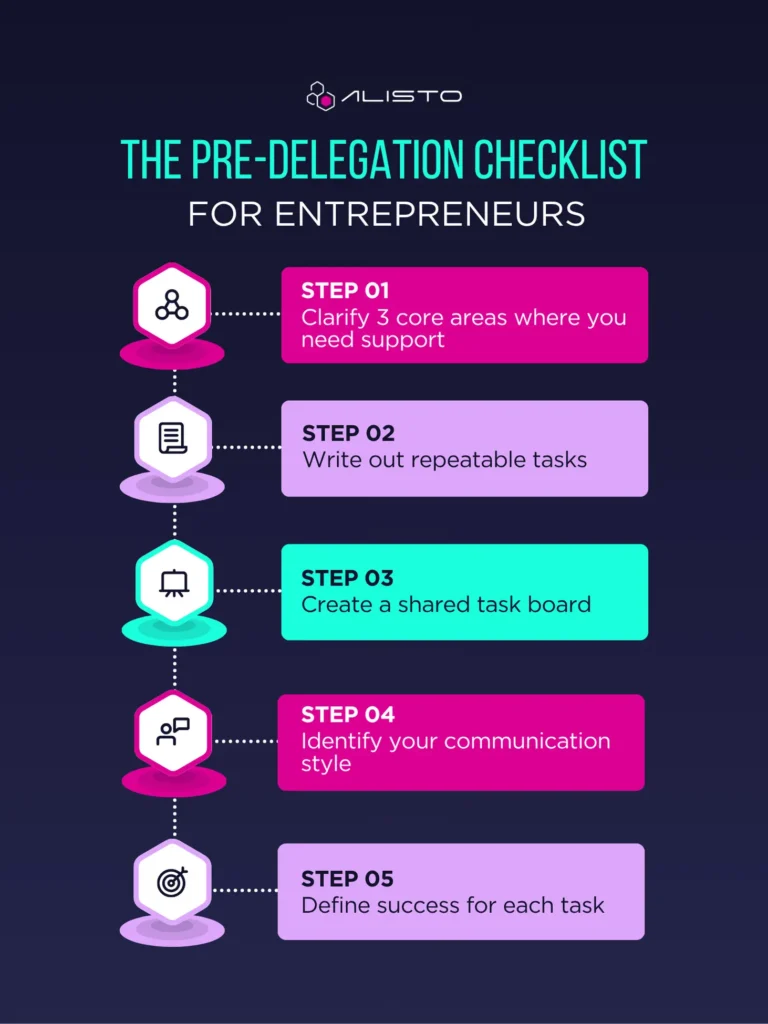
Pre‑Delegation Checklist: What to Have in Place Before You Hire Help
Download or adapt this checklist, complete it, and only then bring someone new into your ecosystem.
Step | What to Do | Why It Matters |
☑ Clarify 3 core support areas | Narrow focus for hiring (e.g. content ops, customer support, admin) | Avoids role creep and misalignment |
☑ List all repeatable tasks | Identify what can become an SOP | Foundation for hand‑off clarity |
☑ Create a shared task board | Use ClickUp, Trello, or equivalent | Promotes transparency and shared context |
☑ Define your communication style & preferences | E.g. frequency, channel, expectations | Prevents friction, miscommunication |
☑ Articulate success criteria for each task | What does “done” look like? What’s acceptable quality? | Enables autonomy + trust |
Clarity concept: “Pre-delegation checklist for entrepreneurs.”
What You Should Delegate (And What You Should Keep)
It’s tempting to outsource everything that feels “hard” or “tedious.” But think: clarity lives in the heart of decisions, vision, and system design.
You should consider delegating:
- Execution-level tasks (e.g. editing, data entry, formatting)
- Template implementation and follow-through
- Recurring tasks with well-defined SOPs
- Research gathering, draft creation, process drafting
You should not delegate (or at least retain strong oversight over):
- Strategic decisions without clarity
- Process design or system setup without your involvement
- Anything ambiguous or evolving
- Core brand, voice, or direction-defining work
Treat clarity as a leadership muscle — not a personality trait. You don’t need to be innately “organized” to build clarity but you do need a structure that reflects how you think, rest, and create.
Why This Matters
- Better outcomes, faster scaling
Effective delegation is among the top drivers of scale. Poor delegation is often cited as a primary reason businesses plateau. - Job satisfaction & retention
Delegation that includes clear authority and trust fosters ownership. That directly feeds performance and retention. - Stronger decision-making culture
Delegating decisions (when appropriate) empowers team members — but only if boundaries and clarity are built first. Research shows employees can view decision delegation as a burden if it’s poorly framed. - Reduced waste, sharper workflows
Visual management and clarity reduce duplicated effort, waste, ambiguity, and rework.
- Better outcomes, faster scaling
At Alisto: From Chaos to Calm Delegation
We help capacity-conscious founders shift from frazzled firefighting to clarity-based delegation systems. Our approach:
- Starts by insourcing clarity (mapping, rituals, capacity awareness)
- Builds templates, SOPs, and workflows that flex with real life
- Helps you bring in support on your terms, aligned with your vision
Free Resource: The CALM Planner
Created specifically for founders who juggle energy, clarity, and capacity, the CALM Planner helps you:
- Track and respect your energy cycles
- Build weekly plans with built-in buffers
- Integrate strategic clarity tasks (not just reactive to-dos)