
Productivity tools promise clarity and control.
Calendars, task managers, dashboards, planners—each one marketed as the answer to chaos, helping leaders “stay on top of things.” Yet many high‑performing founders still feel overwhelmed, burnt out, or stretched thin, even with a tech stack full of apps.
The problem isn’t that the tools are bad.
It’s that tools are often introduced before clarity exists.
At Alisto, we see this pattern repeatedly: founders adopt more tools to solve problems they haven’t fully identified. The result? More complexity, not less.
This is where a capacity audit makes all the difference.
Why Productivity Tools Can’t Diagnose the Real Problem
Productivity tools are excellent at managing tasks.
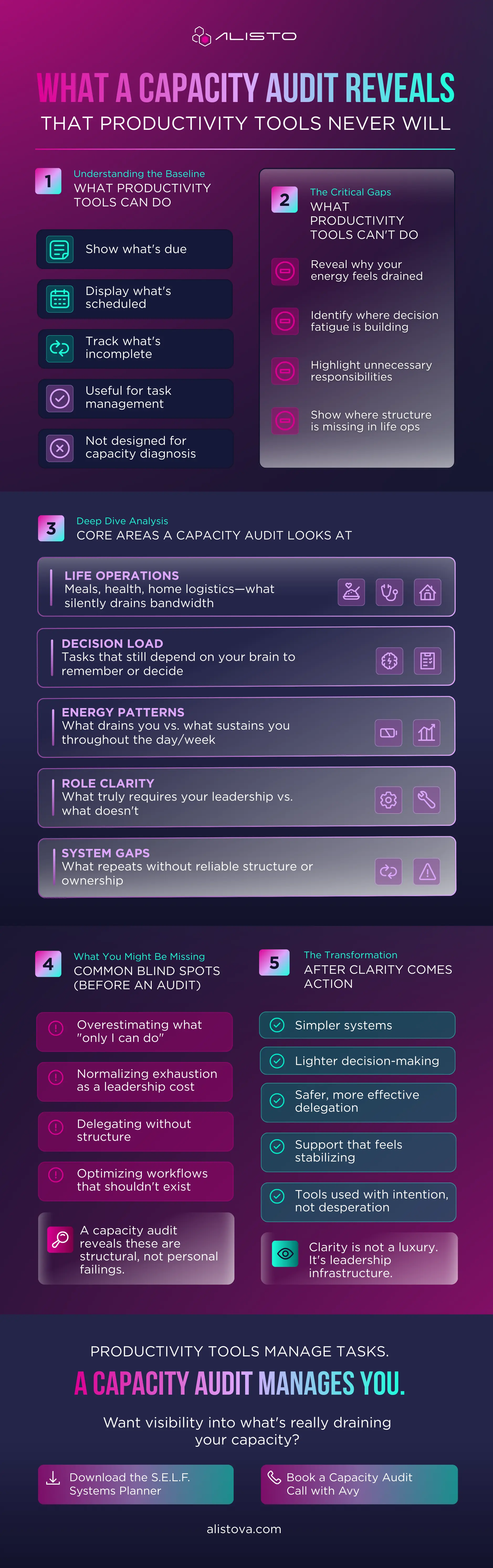
They can show you:
- What’s due
- What’s scheduled
- What’s incomplete
But they can’t tell you:
- Why everything feels heavy
- Where your energy is leaking
- What should not require your attention at all
That’s because tools manage outputs, not capacity.
Ironically, piling on more apps often fragments focus and increases cognitive burden. Research shows that tool overload and constant app switching are not just annoying—they fragment focus and drain productivity by forcing frequent context switches throughout the day. For example, workers toggle between apps an average of 33 times per day, and many report that tool overload negatively affects performance and increases frustration.
Without clarity, even the best tools end up managing symptoms instead of causes.
The Blind Spots Leaders Can’t See From the Inside
Founders are deeply embedded in their own workflows—or the lack thereof.
That proximity creates blind spots such as:
- Overestimating what only I can do
- Underestimating cumulative life admin
- Normalizing exhaustion as part of leadership
- Building systems around urgency instead of importance
None of these are personal failures. They are natural consequences of being inside the system you’re trying to fix.
A capacity audit provides distance—enough to see patterns that are otherwise invisible.
What a Capacity Audit Actually Looks At
A true capacity audit does not start with tools or tactics.
It examines:
Life operations
Meals, health, scheduling, household logistics—areas that quietly drain cognitive energy.
Decision load
What still depends on you remembering or deciding.
Energy patterns
What drains you versus what sustains you.
Role clarity
What tasks require your distinctive leadership versus mere execution. Clarity in roles enhances well‑being and performance; research shows role clarity reduces stress and increases job satisfaction.
System gaps
What repeats without structure and continues to live in your head.
The goal isn’t optimization.
The goal is visibility.
Once visibility exists, decisions become simpler and more humane.
Why Leaders Overbuild the Wrong Systems
Without clarity, leaders often:
- Systemize low‑impact tasks
- Delegate without structure
- Add tools to compensate for overload
- Optimize workflows that shouldn’t exist
This creates a false sense of progress while capacity continues to erode.
A capacity audit answers the critical first question:
What actually needs a system—and what needs to stop?
From Audit to Action: What Changes After Clarity
Once clarity arrives, several shifts happen quickly:
- Decision‑making becomes lighter
- Delegation becomes safer and more effective
- Systems become simpler, not more complex
- Support feels stabilizing instead of risky
Most importantly, leaders stop blaming themselves for problems that were structural all along.
Clarity restores trust—in both the systems and in themselves.
Why Capacity‑Aware Leaders Last Longer
Sustainable leaders design for real life, not ideals.
They:
- Build systems that work on low‑energy days
- Reduce decisions before increasing output
- Protect their role as leaders instead of becoming the bottleneck
- Invest in clarity before committing to tools, people, or programs
This isn’t slower leadership.
It’s leadership that lasts.
What to Do Next
If you’re feeling the urge to add another tool, pause.
That impulse is often a signal—not that you need more structure, but that you need clearer insight.
👉 Start With Visibility
The S.E.L.F. Systems Planner helps you map:
- What’s draining capacity
- What repeats without support
- What should be systemized, delegated, or removed
It’s designed to clarify, not overwhelm.
👉 Download the S.E.L.F. Systems Planner
👉 Get a Capacity Audit
If you want help seeing your life and business operations clearly, without guessing, the Strategy Call with Avy is the next step.
This session:
- Audits capacity across life and business
- Identifies system gaps and patterns of over‑responsibility
- Creates a clear, humane roadmap forward
👉 Book your Strategy Call with Avy here
Productivity tools manage tasks.
Clarity manages capacity.
Alisto exists to help leaders build systems from that truth.