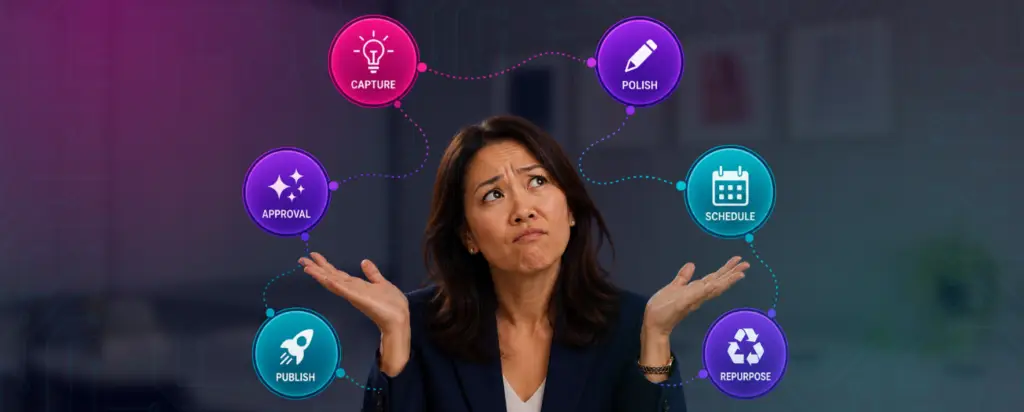
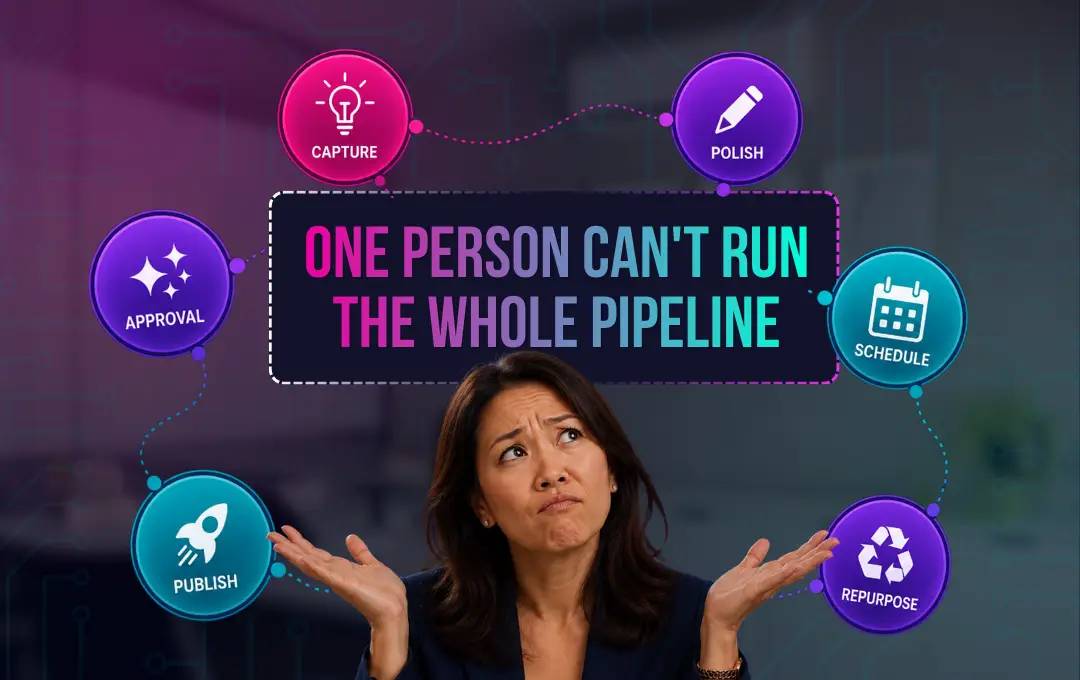
 Map your content pipeline. There are six stages: capture, draft, polish, schedule, publish, repurpose. Now write the name of the person who owns each stage.
If your own name is on all six, you have found the reason your publishing is inconsistent. It is not a motivation issue. It is a structural one. A pipeline with a single owner stops the moment that owner becomes unavailable, and your output is now capped at your worst week instead of your best.
- Inconsistent publishing is an operations gap. It is not a discipline problem, and discipline will not fix it.
- A content pipeline has six stages. When one person owns all six, output stops every time that person is unavailable.
- Scheduling tools automate one stage, the queue. The other five stages require judgment and cannot be automated away.
- A content workflow for a small business needs distributed ownership: the founder keeps two stages, and a team owns the rest.
- The fix is a defined pipeline with owners and handoffs, built once, so publishing continues regardless of the founder’s week.
The six-stage map most founders have never drawn
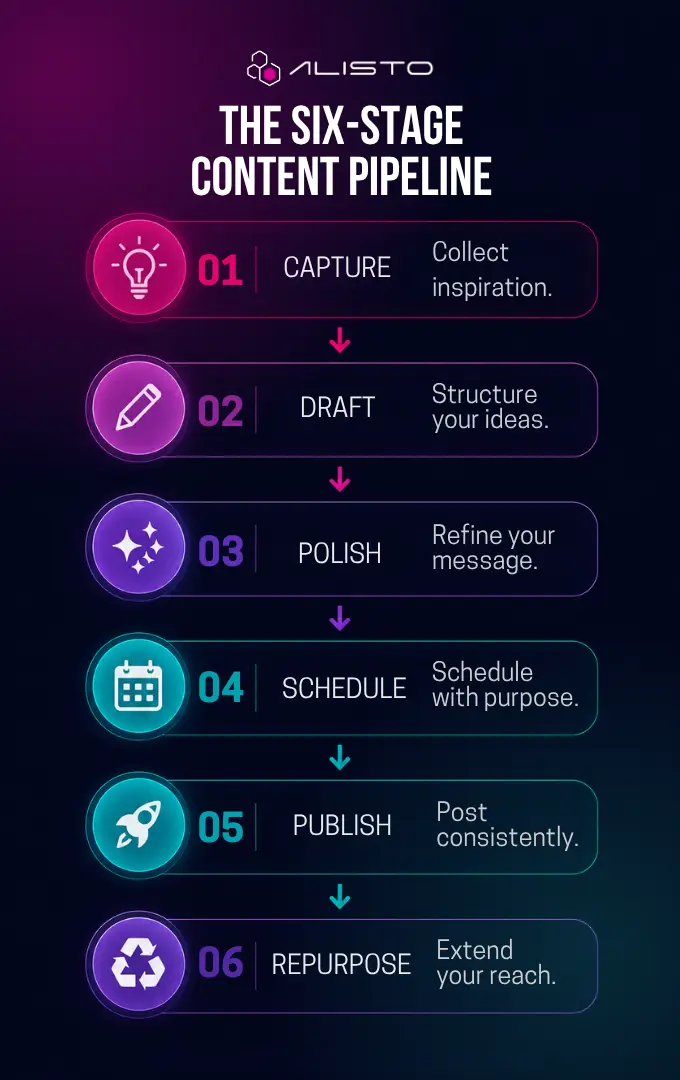
Most small businesses run content without ever mapping the process, which is why the process fails invisibly. Named plainly, the stages are: capture the idea, draft it, polish it, schedule it, publish it, and repurpose it into other formats. Six discrete steps, each requiring a different mode of work.
When those six stages have one owner, the pipeline has a single point of failure. Every stage waits on the same person. If that person is in a client deadline, traveling, sick, or simply out of capacity, the entire pipeline halts. Not one stage. All of them. This is why publishing arrives in bursts followed by silence: the pipeline is not broken during the bursts; it is running at full founder capacity, and it is not lazy during the silences; it is stalled at the single owner.
Why do the usual fixes not work
The standard responses to inconsistent publishing all share one flawed assumption: that the founder will remain available. A new content calendar assumes the founder shows up to execute it. A stricter posting schedule assumes the founder has steady capacity to meet it. Batching harder assumes the founder can front-load enough work to cover every future gap alone.
None of these address the structure. They optimize a pipeline that still has one owner and one point of failure. The calendar does not publish the post. The schedule does not format the carousel. The founder does, every time, which means every one of these fixes breaks the first week the founder’s capacity drops.
What distributed ownership actually means
The fix is to distribute ownership across the six stages so that no single person’s availability can stop the whole line. In practice, this means separating the stages that genuinely require the founder from the stages that do not.
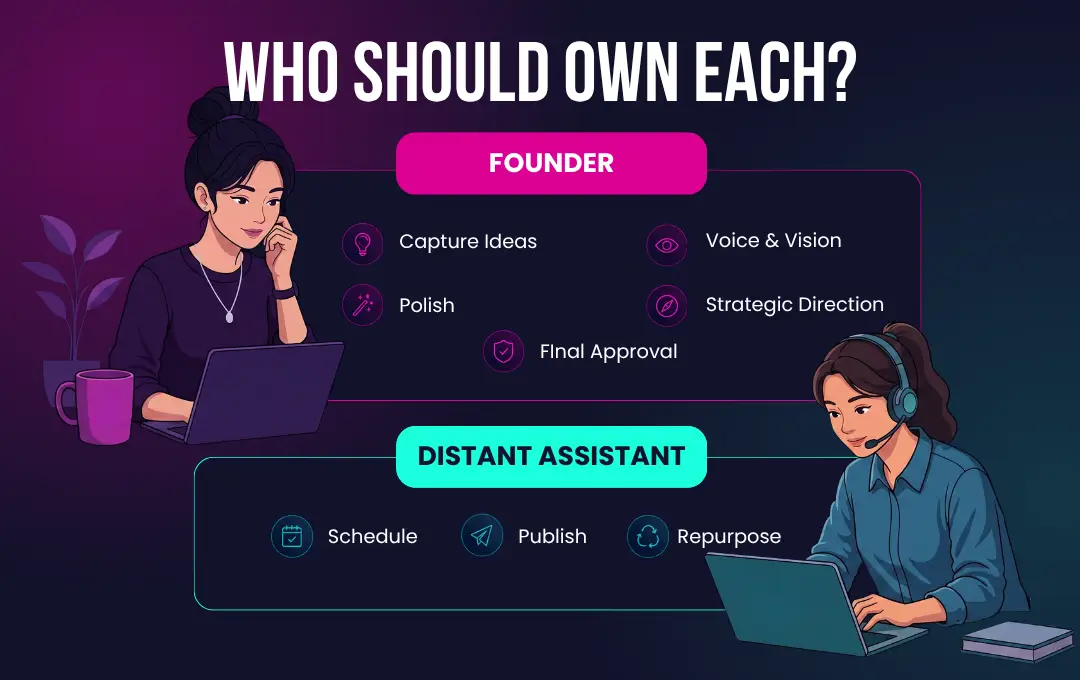
Two stages require the founder: origination, where the raw idea and the point of view come from, and final approval, where the founder confirms the piece meets the standard before it ships. The other four stages, polish, schedule, publish, and repurpose, do not require the founder at all. They require a defined process and an owner who is not the founder. Assign those four to a Distant Assistant and a specialist, and the pipeline gains the ability to run whether the founder is available that week or not.
What the Distant Assistant owns, specifically
Distributed ownership is not vague. It is a specific task list. In a content pipeline, a Distant Assistant owns the following: formatting each draft for its platform, scheduling and publishing on the calendar, adapting one piece into derivative formats such as a carousel, a short video caption, or an email, maintaining the recycling calendar so strong pieces run again instead of dying after one use, and quality-checking every piece against the documented voice standard before it ships.
That last task is what makes the handoff possible. When the quality standard is documented, a Distant Assistant can verify each piece against it, and the founder’s involvement shrinks to origination and a final yes. The work ships without the founder touching every stage.
If you’re leading a nonprofit…
Run the same six-stage map on your donor communications. If every appeal, update, and report routes through the executive director, the organization’s visibility is capped by the ED’s calendar. Funders read communication gaps as organizational instability, and instability suppresses giving. Distributing ownership of communications across a Distant Assistant and the program team is not a luxury hire. It is what keeps the mission visible between grant cycles, when the ED’s capacity is consumed by everything else.
Where is your pipeline actually stalling?
Run these five checks against your current process.
- Of the six stages, how many have an owner who is not you?
- When you go quiet, is it because you ran out of ideas, or because you ran out of capacity to execute?
- Does a piece of content only go out if you personally format, schedule, and post it?
- Is there a written process a team member could follow to take a draft to published without you?
- When you are unavailable for a week, does your publishing drop to zero?
If most of the ownership sits with you and publishing drops to zero when you step away, the bottleneck is structural. The pipeline has one owner, and that is the gap to close.
The bottom line
Publishing consistency is a property of the system, not a trait of the person. A pipeline with distributed ownership publishes consistently because it does not depend on any single person being available. A pipeline with one owner publishes inconsistently because it depends entirely on that owner’s week. The difference is the operations, not the discipline.
Next step
Designing the pipeline takes one session. On a Strategy Call with Avy, you map your current content load, tools, and ownership gaps, and you leave with a Decision Map within 72 hours that shows exactly which stages to hand off and in what order.
When you are ready to install it, an Alisto Team runs the pipeline for you. The Mini Team pairs a dedicated Distant Assistant with two specialists to own the four stages that do not require you, so your content ships whether or not you are available that week. For a single project or a lighter start, the Hourly Bank is the flexible entry point.