

Every time a founder changes direction — even slightly, even with good reasons — the operational cost is immediate and specific. Task lists built for the previous direction become partially or fully irrelevant. Systems configured around the old priority need to be reconfigured. Communications drafted for one audience angle need to be rewritten for another. The Distant Assistant or contractor who was executing against a clear brief is now waiting for a new one.
This is not a leadership failure. It is an operational pattern. And it has a structural solution.
The Operational Cost Breakdown of a Direction Change
Most founders experience a direction change as a strategic decision. Their operations team experiences it as a cascade.
The immediate costs are concrete. Every active task list has to be audited against the new direction — items that were in progress get paused, rerouted, or abandoned mid-execution. The time already invested in those tasks does not come back. The systems that were built or configured to support the previous direction — automations, workflows, communication templates, content calendars — need to be updated before they can serve the new one. Until they are, they actively work against it, producing outputs that belong to a direction the founder has already moved away from.
The less visible costs compound over time. Every collaborator, contractor, and DA working in the business has to rebuild their mental model of what they are executing against. That process takes longer than most founders realize and requires more communication than a single announcement. Until it is complete, execution quality drops — not because the team is less capable, but because they are working from incomplete information about what the priority actually is.
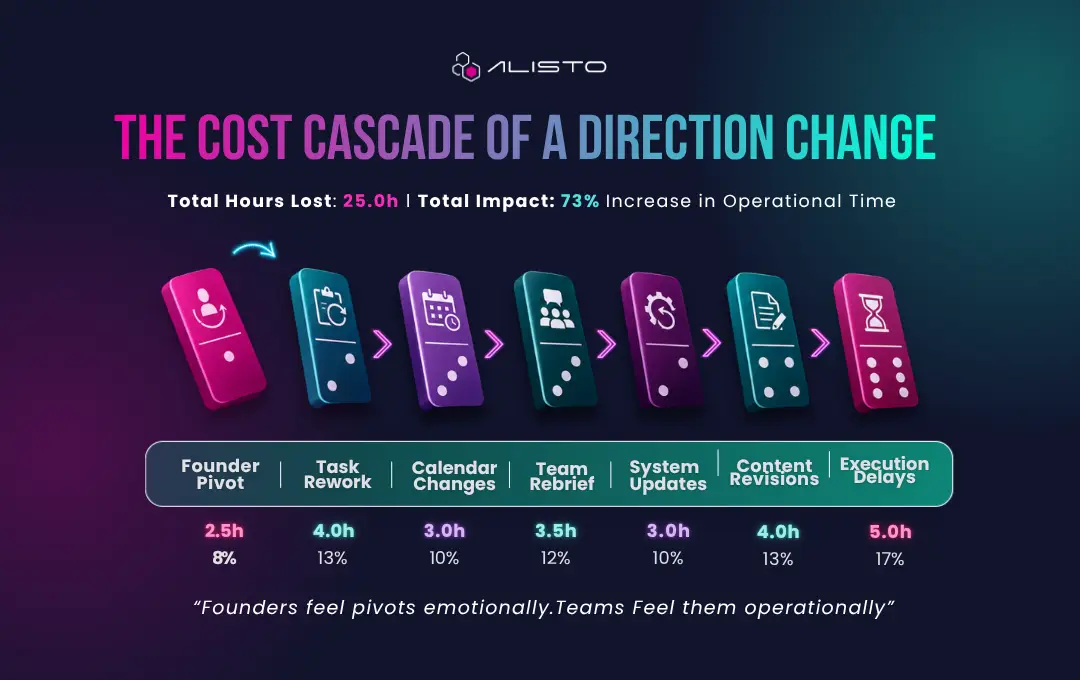
Across a six-week direction cycle, the total operational cost of an undocumented direction change typically runs between 12 and 20 hours of combined team time. That is before accounting for the rework that gets discovered weeks later when something built for the previous direction surfaces in a client deliverable or a published piece of content.
How Frequently Founders Change Direction vs. How Frequently They Realize They Have
There is a meaningful gap between the number of times a founder formally decides to change direction and the number of times the direction actually shifts.
Formal direction changes are deliberate. The founder announces a pivot, updates the content plan, briefs the team. These are visible and manageable.
Operational direction drift is different. It happens through accumulation — a series of small decisions, each of which seems reasonable in isolation. A new collaboration that pulls focus toward a different audience. A piece of content created for an opportunity that does not align with the current priority. A meeting accepted that is technically relevant but operationally belongs to a direction that was supposed to be deprioritized. None of these feel like direction changes. Together, they function as one.
By the time the drift becomes visible — when a team member asks which of two conflicting priorities should take precedence, or when a content audit reveals that the last six weeks of output is pointing in three different directions — the operational cost has already been accumulating for weeks.
The founders who manage this most effectively are not the ones who never drift. They are the ones whose operational systems catch the drift early, before it compounds.
What a DA Sees When the Direction Is Unclear
A Distant Assistant working inside a business without a documented, current direction brief is working from inference. They are making judgment calls about priority, tone, and resource allocation based on their best read of what the founder seems to want — without a written reference point to confirm whether that read is accurate.
This produces specific, observable problems. Tasks get completed in the wrong order because priority has not been formally established. Communications go out in a voice or toward an audience that belongs to a previous direction because the content calendar was not updated. The DA flags things for founder review that should be delegated decisions — because without a clear brief, they cannot confidently execute without confirmation.
None of this is a DA performance issue. It is a documentation issue. A DA with a current, specific direction brief executes with significantly more autonomy, accuracy, and speed than a DA operating on inference. The brief is not overhead. It is the tool that makes the DA’s work valuable.
The Operational Indicators That Signal a Direction Problem
Several observable signals indicate that direction clarity is breaking down before it becomes a full operational crisis.
The first is an increase in clarifying questions from operational support. When a DA or contractor who previously executed with minimal check-ins starts asking more frequently whether something is still the priority, the direction has shifted without being communicated.
The second is task accumulation in a specific category. When the same type of task — content revisions, audience repositioning, offer restructuring — keeps appearing on the weekly list, it often indicates that the work being produced is not aligned with a clear direction, requiring repeated correction.
The third is content inconsistency across channels. When a content audit reveals that different platforms are making different implicit promises to different audiences, the operational direction has fragmented even if no formal change was announced.
The fourth is founder re-entry into tasks that were previously delegated. When a founder starts taking back tasks that had been successfully handed off — “I’ll just handle this one myself” — it is frequently a sign that the brief the task was delegated under no longer reflects the current direction.
Any one of these signals warrants a direction check. More than one appearing simultaneously warrants a full direction brief audit.
The Team Direction Brief: What It Is and What It Prevents
The Team Direction Brief is a one-page document that communicates the committed direction to every operational stakeholder in the business. It is not a strategic plan and it is not a task list. It is a reference document — the written record of what the business is building, what each collaborator is executing against, and what has changed from the previous cycle.
A standard Team Direction Brief contains six elements: the committed direction stated in one sentence, the 90-day focus in two to three sentences, what each collaborator or functional role is executing against in the current cycle, what is explicitly not a priority in this cycle, what has changed from the previous direction, and the escalation criteria — the circumstances under which the founder wants to be consulted rather than the DA deciding independently.
Distributed at the start of each direction cycle and updated whenever a significant change occurs, the Team Direction Brief does two things simultaneously. It gives every person supporting the founder a written reference point that eliminates inference-based decision-making. And it creates a structural barrier to informal direction drift — because any change that has not been reflected in the brief is, by definition, not yet an operational change.
A DA builds the Team Direction Brief from a 20-minute founder input session. It takes approximately two hours to draft and format. The operational alignment it produces is not achievable through any number of Slack messages or verbal updates. 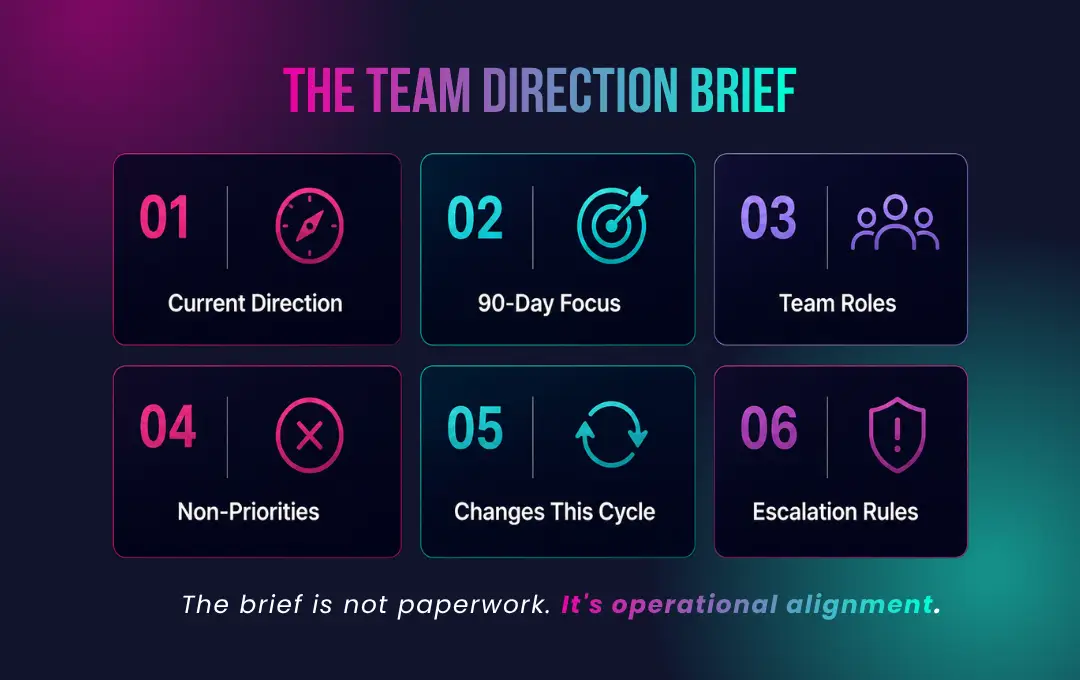
How to Restructure Operations Around a Committed Direction
When a direction is committed and needs to be operationalized, the restructuring process follows a specific sequence.
The first step is the brief. Before any tasks change, before any systems get updated, every operational stakeholder needs a written document that tells them what the direction is and what their role in it looks like. Without this, subsequent steps produce confusion rather than alignment.
The second step is the calendar audit. Every recurring commitment, meeting, and scheduled task gets evaluated against the committed direction. Items that do not serve it get flagged — not automatically removed, but surfaced for a founder decision about whether they stay, get handed off, or get eliminated.
The third step is the task list restructuring. The current active task list gets reviewed against the committed direction and reorganized into three columns: tasks that directly serve the direction, tasks that are operationally necessary but direction-neutral, and tasks that belong to a previous or deprioritized direction. The third column gets resolved — completed, closed, or formally parked.
The fourth step is the systems update. Automations, workflows, and communication templates that were built for a previous direction get identified and updated or decommissioned. This step is often skipped because it is not immediately visible. It produces the category of problems that surfaces weeks later.
The Hourly Bank is specifically structured for this kind of operational restructuring work. A DA drawing from pre-purchased hours can complete all four steps without requiring a retainer or a long-term commitment — which makes it the right tool for a direction transition that needs to happen quickly and cleanly.
For nonprofit leaders: direction changes at the leadership level produce cascading rework across programs, communications, and fundraising in ways that are often invisible to the executive director until the cost has already been paid. A grant proposal written for one strategic priority becomes partially obsolete when that priority shifts. A program team that was briefed on one organizational direction has to be re-briefed, with all the clarification conversations and rebuilding that requires. The operational cost of unclear direction compounds across the team, not just one person — which makes the Team Direction Brief a tool for organizational effectiveness, not just individual operational management.