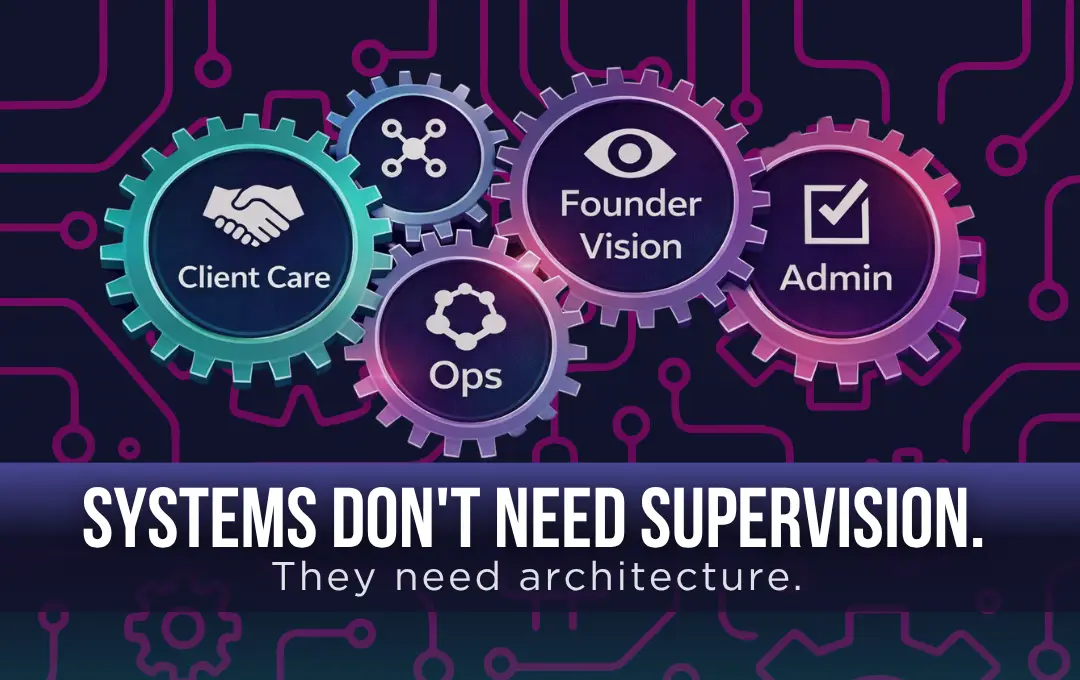
Many founders believe they have a delegation problem.
When you look closely, the issue usually isn’t delegation. It’s structure.
Tasks get assigned. Work begins. Questions appear. Soon the founder is answering clarifications, approving small decisions, and fixing things that were supposedly delegated.
That’s when founders say: “Delegation just doesn’t work.”
But most of the time, delegation didn’t fail. The system around it never existed.
- Delegation fails when tasks are assigned without structure
- Task dumping creates confusion and decision escalation
- Clear workflows and documentation stabilize delegation
- Communication channels prevent constant interruptions
- Distant Assistants route tasks so work stays off the founder’s desk
You delegate a task. At first it seems simple.
Then the questions start.
“Where should this go?” “Who should approve this?” “What happens if the client asks for changes?”
The task was delegated. The decisions were not.
So the work flows back to the founder. Every time. This is how founders accidentally become the operational center of their own company.
Delegation vs Task Dumping
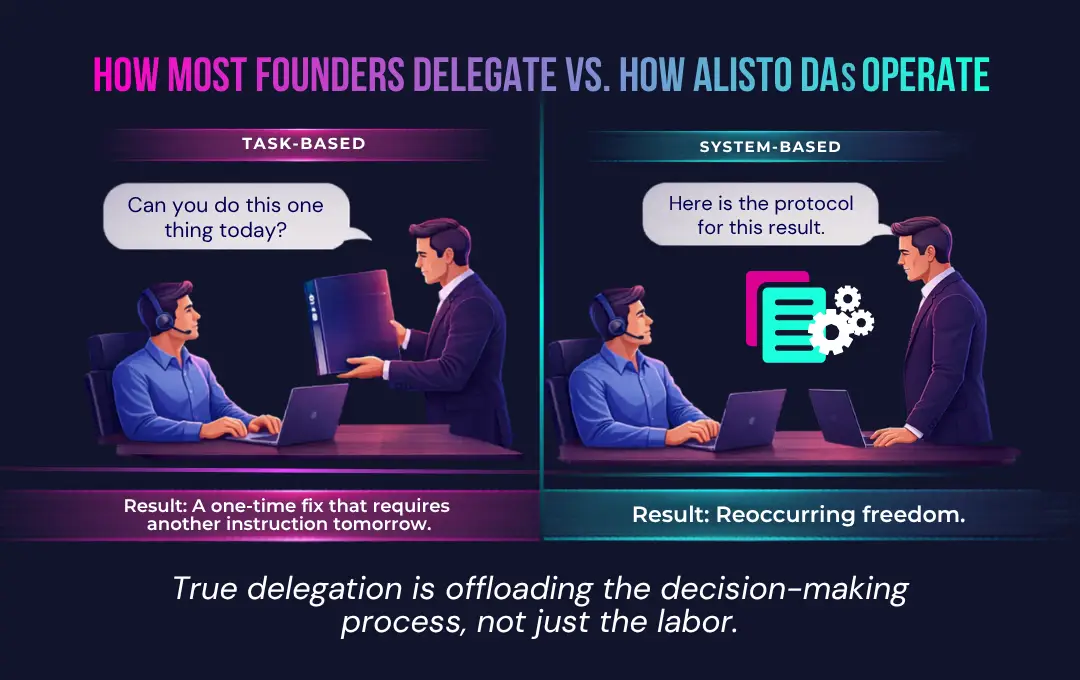
Most founders think they’re delegating when they’re actually task dumping.
Task dumping looks like this: “Can you handle this?”
The task gets passed along. But nothing else is defined. No workflow. No authority. No escalation path. Every unexpected situation requires clarification from the founder — which means the founder is still running the process.
True delegation transfers three things.
The task. What needs to get done. This is the only part most founders actually hand over.
The process. How the work moves from start to finish. Without this, every step becomes a question. And every question lands on the founder.
The decision boundaries. What the team member is allowed to decide without escalating. This is the most important element and the one almost nobody defines. Without it, the founder stays in the loop forever — not because they want to be, but because the system requires it.
Without all three, the founder remains the default decision-maker. And the bottleneck continues.
Workflow Documentation
Delegation becomes sustainable when workflows exist.
A workflow answers one simple question: how does this work move through the business?
Take a simple client deliverable as an example.
Without a workflow: the team member completes the work, isn’t sure if it needs review, messages the founder, waits for a response, sends it late, and the client follows up directly — with the founder.
With a workflow: request received → task documented → assigned to owner → draft reviewed internally → delivered to client → update logged.
Nobody asks what happens next. They follow the structure. The founder sees the outcome, not every step along the way.
Documentation removes guesswork. And guesswork is one of the main reasons delegation breaks down — not people.
For neurodivergent founders especially, guesswork isn’t just inefficient — it’s a cognitive tax that compounds every single time someone asks a question that a documented workflow should have already answered. When the answer lives in a document instead of your brain, your brain gets to do something more useful.
Communication Channels
Unclear communication is the other reason delegation quietly collapses.
When teams don’t know where questions belong, they default to the founder. Slack message. Quick email. Text. Each one interrupts focus. Each one pulls the founder back into execution.
For ADHD founders, this is where delegation most visibly falls apart. It’s not that you can’t delegate — it’s that every interruption is a context switch, and context switches are expensive. When communication channels are undefined, you’re not just answering questions. You’re paying a cognitive toll every single time.
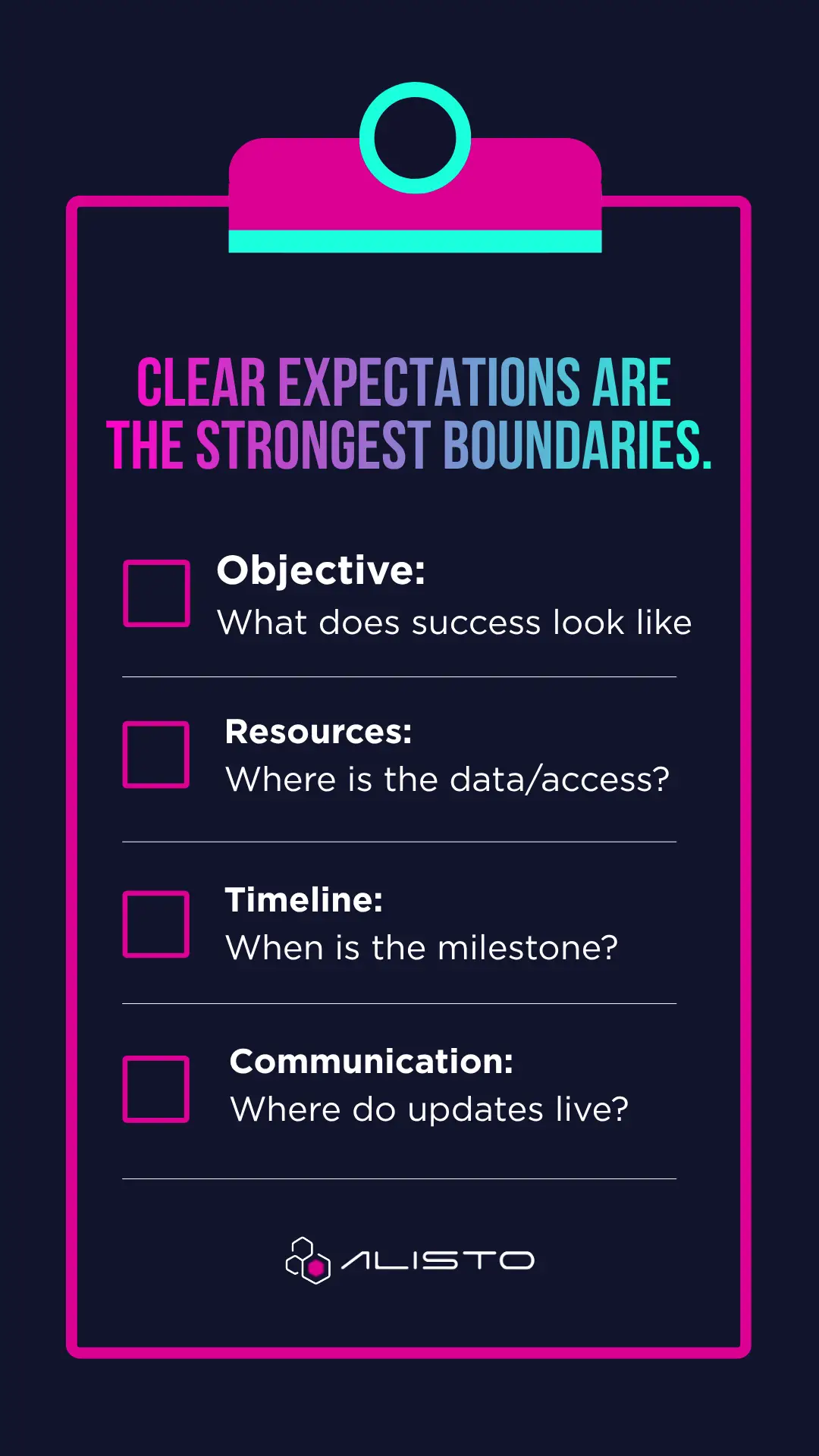
Strong delegation systems define:
- Where task questions go
- When updates are provided
- When escalation is actually appropriate
When communication follows predictable channels, interruptions drop. The founder stops being the answer to every question. And work moves without them in the middle of it.
Distant Assistant Task Routing
Even well-designed systems need someone to maintain them.
This is where a Distant Assistant becomes critical — not as an extra set of hands, but as the operational traffic controller of the business.
Here’s what that actually looks like.
Incoming request management. Instead of messages landing randomly across channels and defaulting to the founder, the assistant reviews what comes in, categorizes it, and routes it to the correct person. The founder sees what requires leadership. Everything else moves without them.
Workflow enforcement. Systems only work when people follow them. A Distant Assistant monitors whether tasks are moving through the correct stages, flags anything that’s stalled, and resolves bottlenecks before they escalate upward.
Clarification handling. Most escalations happen because information is missing. Instead of incomplete requests reaching the founder, the assistant identifies what’s needed, collects it, and keeps the work moving.
Escalation filtering. Not everything that feels urgent actually is. A Distant Assistant distinguishes between genuine escalations that require founder input and operational noise that doesn’t — and routes accordingly.
The assistant becomes the first response layer — so the founder doesn’t have to be. And for founders whose focus is hard-won and easily lost, that layer isn’t a luxury. It’s infrastructure.
What Changes When Delegation Actually Works
When delegation systems exist, the business starts to feel different.
Work moves without the founder in the middle of every conversation. Team members make decisions independently because they know what they’re authorized to decide. Clients get responses without waiting for the founder to resurface. Projects reach completion without a trail of clarification requests along the way.
The founder stops being the operational center. And starts being the strategic one.
That’s not a small shift. For most founders it’s the difference between a business that scales and one that plateaus at the ceiling of their personal capacity.
Final Insight
Delegation is not about assigning tasks.
It’s about designing a system where work moves forward without the founder’s constant involvement.
Without that structure, delegation collapses into supervision. With it, the business scales.
If your delegation still depends on constant oversight, the issue probably isn’t your team. It’s the system.