

Most founders try to protect their time with discipline.
They block hours on the calendar. They turn off notifications. They try to focus harder.
And then a team member asks where a task should go. A client messages asking for an update. Someone needs clarification before they can move forward.
The time was blocked. The work still didn’t happen.
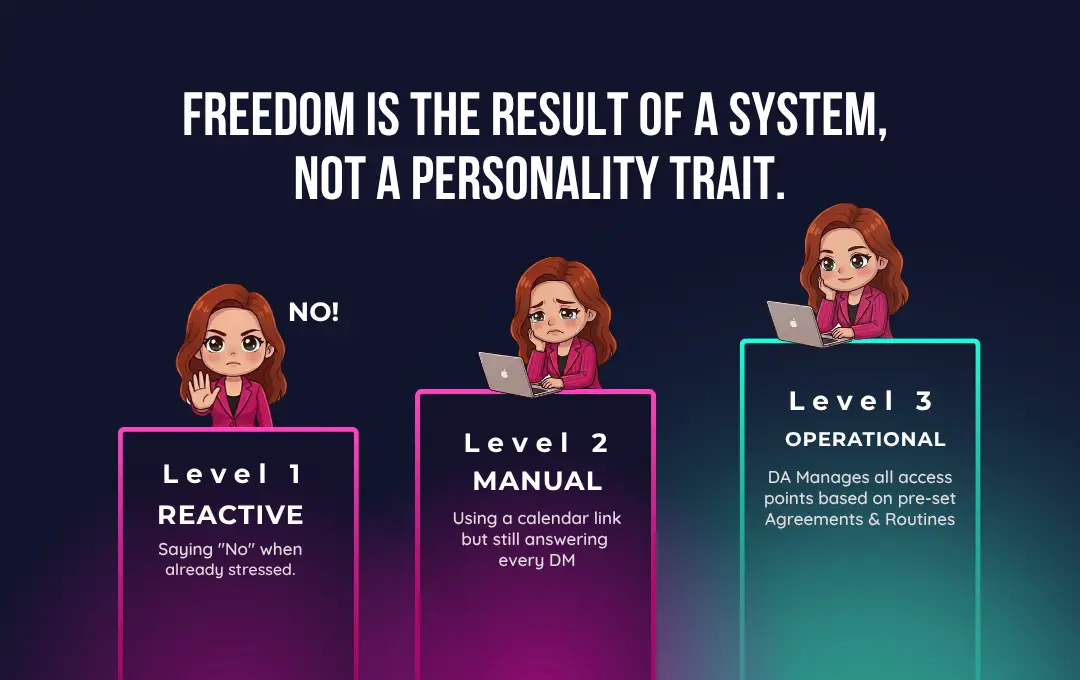
Discipline fails when the system around you is broken. You cannot out-discipline a business that routes everything back to you by default.
- Founder time problems are usually structural, not behavioral
- Operational boundaries define how communication, workflow, and ownership function
- Without systems, requests and decisions naturally escalate to the founder
- Clear workflows reduce interruptions and protect leadership attention
- Distant Assistants maintain the operational systems that protect founder time
Picture a founder with two hours blocked for strategic work.
Within minutes: a team member asks where a task should go, a client wants an update, someone needs
clarification before they can move forward.
Each request is small. Each one requires the founder to stop, think, and respond.
By the end of the block, the founder has handled dozens of small issues. The strategic work never happened. Not because they lacked discipline — because the business structure routed everything back to them.
Three Operational Boundaries That Actually Work
Operational boundaries are the systems that define how work flows through the business. Instead of relying on individual behavior, they create predictable structures.
Three matter most.
Communication boundaries. Define where messages should be sent, when responses are expected, and which issues require escalation. When communication rules exist, clients and team members know how to interact with the business — and interruptions decrease dramatically.
Workflow boundaries. Define how tasks move through the organization. Where requests are submitted, who assigns them, how projects progress through stages. Without this, nobody knows what happens next — so they ask you. Every time.
Task ownership. One person is responsible for making sure something gets done. They execute the work, answer questions, and make routine decisions. When ownership is unclear, tasks drift upward. When it’s clear, work stays where it belongs.
What This Looks Like in Practice
Client communication is the most common source of founder interruptions. Without a system, messages arrive through every channel and land directly with the founder — who becomes the company’s default support desk.
A simple operational boundary changes this completely.
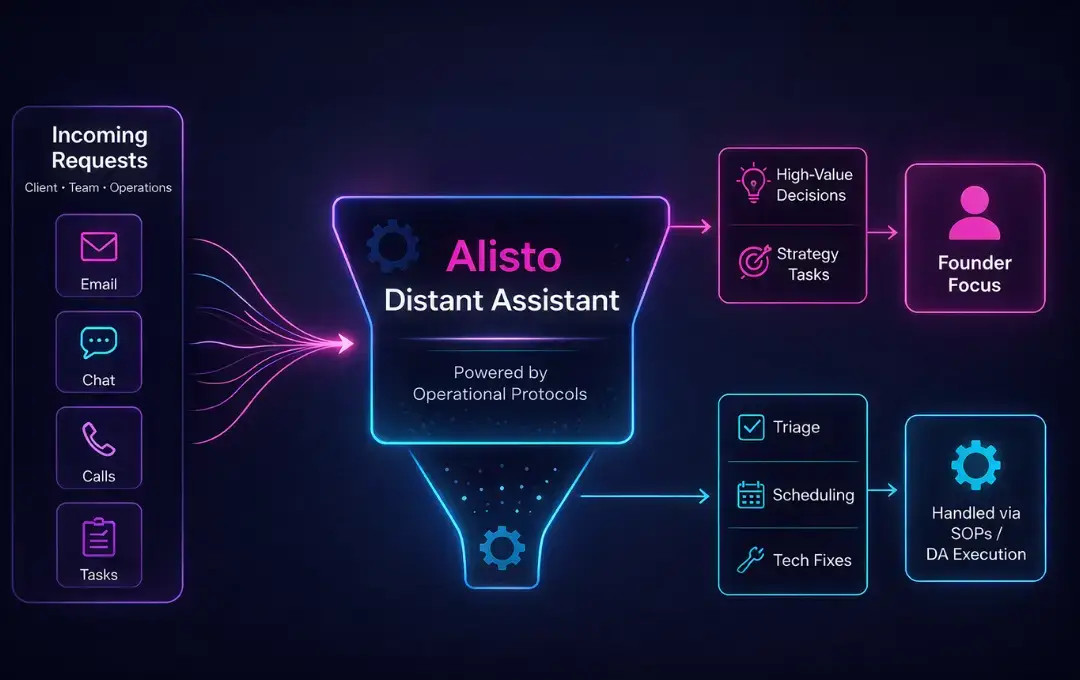
Client messages → centralized inbox → categorized and triaged → routine questions handled by team → operational requests routed to the correct department → strategic decisions escalated to founder.
Clients still get fast responses. The founder only sees what actually requires their input.
For ADHD entrepreneurs this kind of structure isn’t just helpful — it’s the difference between a functional workday and a completely fragmented one.
Why Systems Need Someone to Own Them
Operational boundaries don’t maintain themselves.
Someone has to monitor the systems, route communication, and make sure workflows actually function. This is where a Distant Assistant becomes critical.
A Distant Assistant serves as the operational gatekeeper of these systems. They manage inbox triage, route tasks to the correct team member, coordinate client communication, maintain scheduling systems, and ensure requests follow the correct workflow.
Instead of every issue reaching the founder, the assistant filters and organizes incoming work. Leadership attention gets protected. Operations keep moving.
Once boundaries exist and someone maintains them, the business becomes significantly more stable.
Quick Diagnostic
- Do clients frequently message you directly with routine questions?
- Do team members ask where tasks should go or who owns them?
- Do small operational issues interrupt strategic work constantly?
- Do you rely on personal discipline to protect your time?
If several of these land — the problem isn’t your discipline. It’s your operational design.
Final Insight
Time management is not a personal discipline problem.
It’s a business design problem.
When communication systems, workflow rules, and ownership structures are clear, interruptions drop. And when interruptions drop, founders regain the one thing that actually drives growth.
Attention.