
Momentum used to feel exciting.
Now it feels dangerous.
After burnout, even the idea of building again can create tension in your body — tightness in your chest, urgency in your thoughts, pressure behind your eyes.
Because the last time you built momentum, it cost you.
It cost sleep.
It cost stability.
It cost peace.
So now you hesitate.
You want to move forward again, but you don’t want to collapse again.
Here’s what most productivity advice gets wrong:
Momentum does not have to be loud to be real.
It does not have to be fast to be effective.
And it absolutely does not have to be exhausting to be sustainable.
If you rebuild the same way you scaled before, you won’t create momentum.
You’ll recreate the conditions that broke you.
The Real Problem: Rebuilding at the Same Pace That Burned You Out
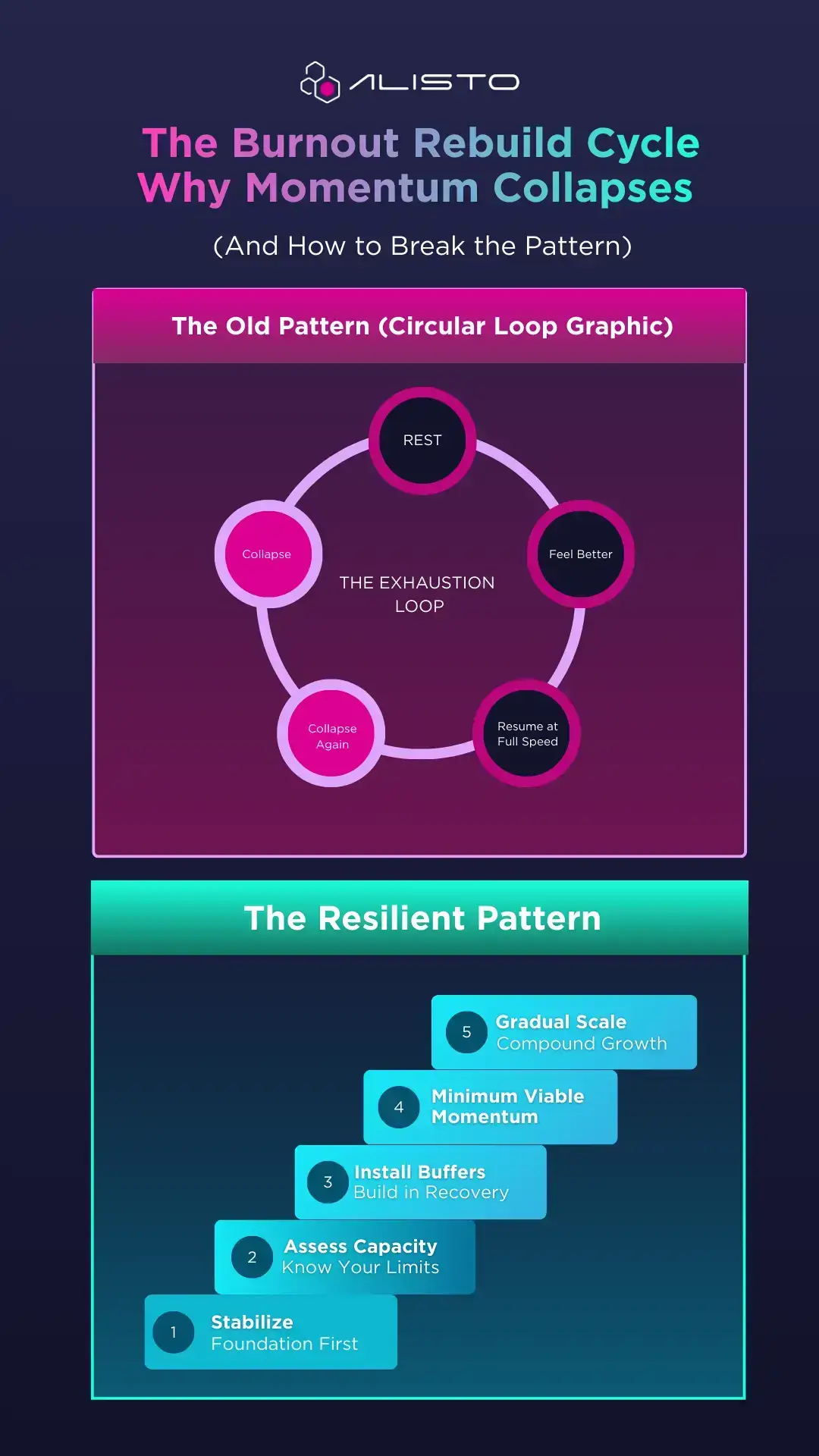
Most founders follow a predictable cycle:
Collapse.
Rest.
Feel better.
Resume at previous speed.
Collapse again.
The assumption is that the collapse was caused by effort. But research shows something different.
The World Health Organization classifies burnout as an occupational phenomenon resulting from chronic workplace stress that has not been successfully managed, not temporary overexertion.
The issue isn’t that you worked hard. The issue is that your system demanded more than your capacity could sustainably deliver.
If nothing structural changes, recovery is temporary.
Momentum without redesign becomes repetition.
The Shift: Minimum Viable Momentum
In startup culture, we talk about Minimum Viable Product.
In burnout recovery, you need Minimum Viable Momentum.
Minimum Viable Momentum (MVM) is:
The smallest sustainable forward movement that does not destabilize your nervous system.
It is not:
A public comeback
A 30-day sprint
A full relaunch
A visibility surge
It is one contained step that feels slightly stretching, but repeatable.
Examples:
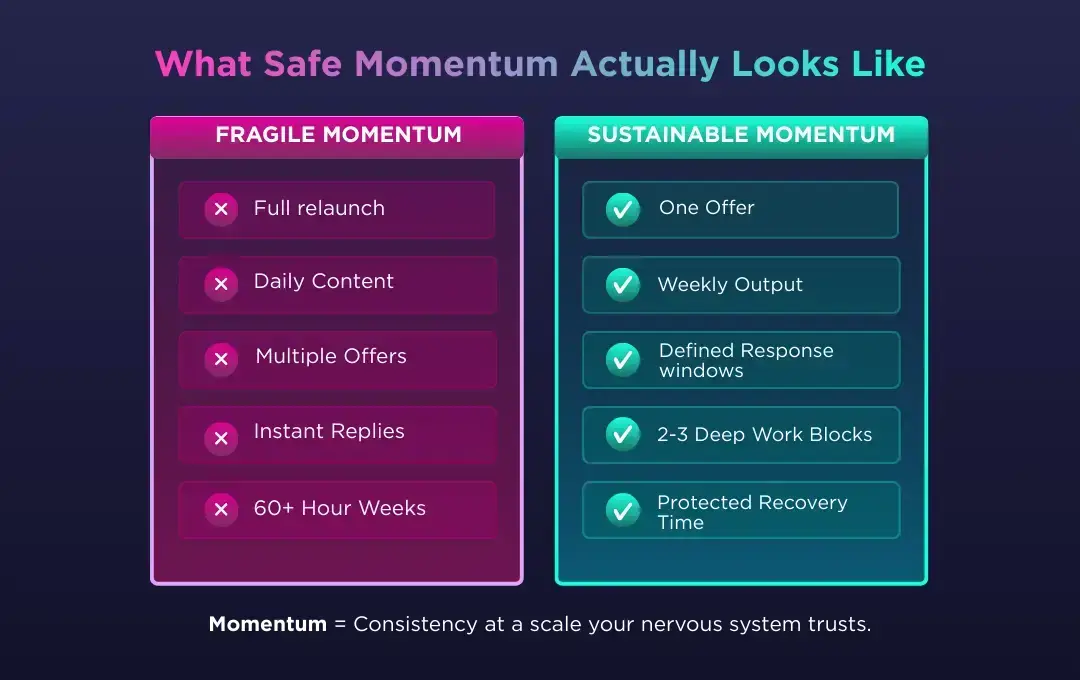
- One client instead of five
- One content piece per week instead of daily
- Two deep work blocks per week instead of full days
- One clearly defined offer instead of multiple experiments
Momentum should create mild expansion, not internal alarm.
If your body tightens when you look at your plan, it’s too aggressive.
Why Rest Doesn’t Automatically Restore Capacity
One of the most misunderstood realities of burnout recovery is this:
Rest reduces fatigue.
It does not automatically restore stress tolerance.
Bruce McEwen’s research on allostatic load explains that chronic stress changes how the body responds to demand over time.
Translation:
After burnout, your nervous system recalibrates slowly. Your previous capacity is not immediately available. If you rebuild without accounting for this shift, instability returns quickly. This is why founders feel “fine” for two weeks — and then crash in week three.
The structure hasn’t changed. Only the energy temporarily has.
Design for Your Lowest Sustainable Week, Not Your Best One
Most founders design plans based on peak energy.
Resilient momentum is designed for your lowest sustainable week.
That means:
- Weekly planning horizons instead of quarterly intensity
- 48–72 hour response windows instead of instant replies
- Built-in buffer days
- Clear stop times
- Defined maximum workload caps
If your system only works when you feel excellent, it’s fragile.
If it works when you feel average, it’s resilient.
Healthy Progress Is Quieter Than You Think
After burnout, most people measure the wrong things:
Revenue.
Output.
Speed.
Visibility.
Those metrics matter, but not first.
Healthy momentum is measured differently in early recovery.
Look for:
1. Completion Without Exhaustion
You finished something and didn’t feel depleted afterward.
2. Predictability
Your week unfolded roughly as planned. Minimal chaos.
3. Emotional Neutrality
Work feels steady — not euphoric, not catastrophic.
4. Faster Recovery
If you overextend slightly, you bounce back in a day, not a week.
Research on resilience shows that resilience is less about avoiding stress and more about shortening recovery cycles.
Momentum becomes safe when recovery is reliable.
The Hidden Trap: Proving You’re “Back”
After burnout, there’s often a quiet urgency:
To prove you’re fine.
To prove you’re capable.
To prove the collapse didn’t win.
So you overcommit.
You relaunch loudly.
You increase visibility.
But urgency is not resilience.
It’s anxiety disguised as ambition.
Resilient momentum is private before it becomes public.
You don’t owe anyone a comeback story.
You owe yourself stability.
Capacity Before Ambition
The most powerful question you can ask right now is:
What can I sustain for 12 weeks without resentment?
Not one strong week.
Not one inspired burst.
Twelve steady weeks. If you can’t calmly repeat it for three months, it’s too aggressive.
Use this filter:
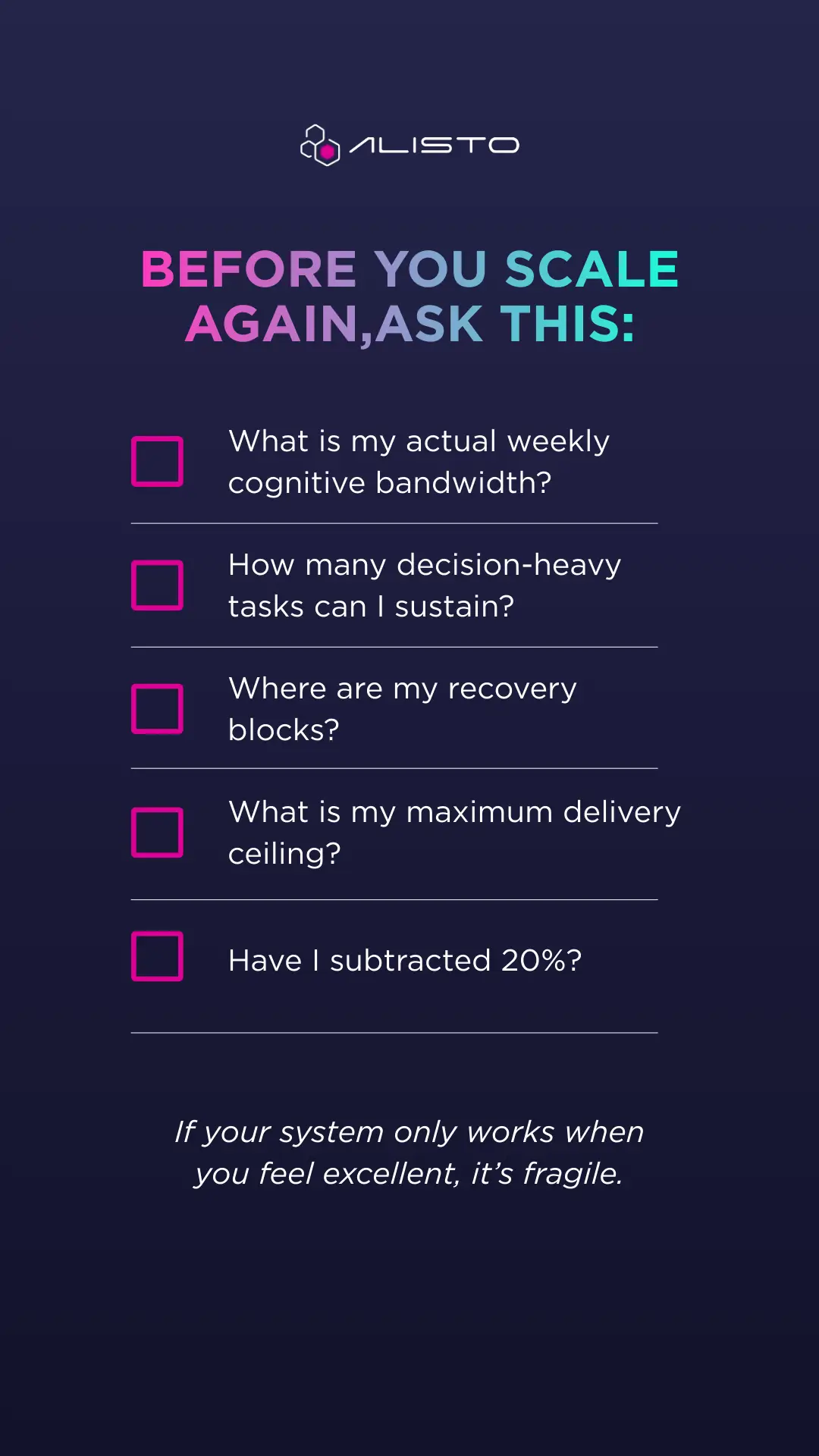
- What is my actual weekly cognitive bandwidth?
- How many decision-heavy tasks fit inside that?
- Where are my non-negotiable recovery blocks?
- What is my absolute ceiling?
Then subtract 20%. That subtraction is what protects you. This is a capacity-aware design.
Containment Creates Confidence
After burnout, expansion must wait. Containment comes first.
Containment means:
- One clear offer
- One focused project
- One defined audience
- One primary communication channel
Research in organizational psychology shows that reducing role ambiguity and workload variability significantly decreases burnout risk.
Clarity reduces stress load. Containment creates clarity. Stability builds confidence. Confidence restores sustainable ambition.
Quiet Momentum Is Not Weak Momentum
There’s a cultural myth that progress must look impressive. But sustainable founders often grow during seasons of:
Reduced visibility
Fewer commitments
Smaller rooms
Slower launches
They aren’t shrinking. They’re stabilizing. And stabilization is what allows long-term growth to hold. Momentum is not speed. Momentum is consistency your nervous system trusts.
The Question You Should Be Asking
If you’re rebuilding right now, ask yourself honestly:
Is my plan truly sustainable — or does it quietly resemble the structure that burned me out?
Most founders can’t see this clearly alone. Because when you’re inside the system, it feels normal. This is where strategic redesign matters.
Not motivation.
Not discipline.
Design.
What Capacity-Aware System Design Actually Looks Like
A proper rebuild examines:
- Decision density
- Delivery load
- Communication boundaries
- Revenue pressure
- Recovery buffers
- Energy fluctuation patterns
Then momentum is calibrated around those realities.
Not hope.
Not ambition.
Not comparison.
Reality.
When your structure protects your capacity, momentum becomes safe again. And when momentum feels safe, consistency becomes natural.
If You Want to Rebuild Without Collapsing Again
You don’t need to push harder.
You need a system that doesn’t extract more than you can sustainably give.
If you’re unsure whether your current plan protects your capacity, or subtly recreates the conditions that burned you out, this is exactly what we assess.
On a Strategy Call, we:
- Map your real capacity
- Identify hidden overload points
- Reduce decision density
- Install structural buffers
- Design Minimum Viable Momentum
So you can move forward without risking another collapse.
Momentum doesn’t have to cost you again.