
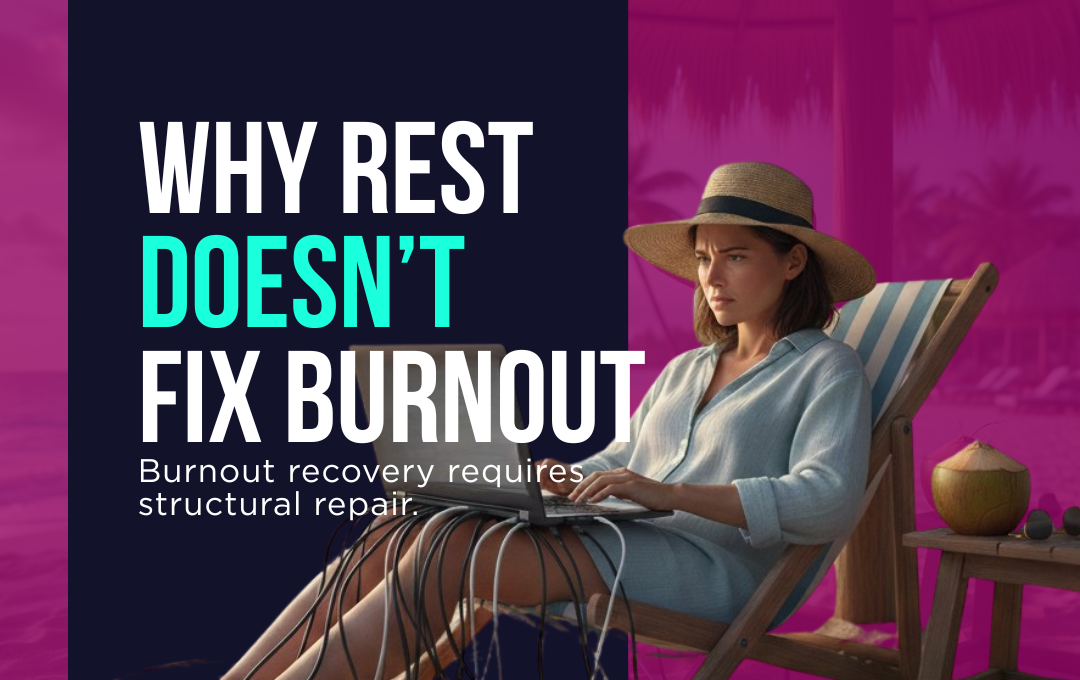
Burnout recovery is widely misunderstood.
Most professionals — especially founders, executives, and high-capacity leaders — believe that stepping away will solve it. Take a week off. Reduce hours. Sleep more. Come back refreshed.
But many don’t.
They return from vacation only to feel heavy again within weeks. Motivation fades. Cognitive load feels unbearable. The same pressure resurfaces.
If that’s happening, the issue isn’t your resilience.
The issue is structural.
Workplace burnout is not simply exhaustion. It is a stress response to chronic workplace conditions that were never redesigned. And unless those conditions change, burnout recovery remains temporary.
Let’s examine what workplace stress research actually says about burnout, why rest doesn’t fix burnout, and what sustainable recovery truly requires.
Burnout Is a Workplace Phenomenon, Not a Personal Weakness
In 2019, the World Health Organization officially classified burnout as an occupational phenomenon, not a medical disorder. It defines burnout as:
“A syndrome conceptualized as resulting from chronic workplace stress that has not been successfully managed.”
The emphasis is clear: chronic workplace stress.
Not personality.
Not grit.
Not mindset.
Christina Maslach, one of the most cited researchers in workplace burnout research, identifies three dimensions:
- Emotional exhaustion
- Cynicism or depersonalization
- Reduced professional efficacy
Burnout emerges when demands consistently exceed support, autonomy, clarity, and resources.
This is why burnout and system failure are inseparable. When the design is misaligned, the individual absorbs the cost.
Why Rest Doesn’t Fix Burnout
Rest reduces fatigue. Burnout is more complex than fatigue.
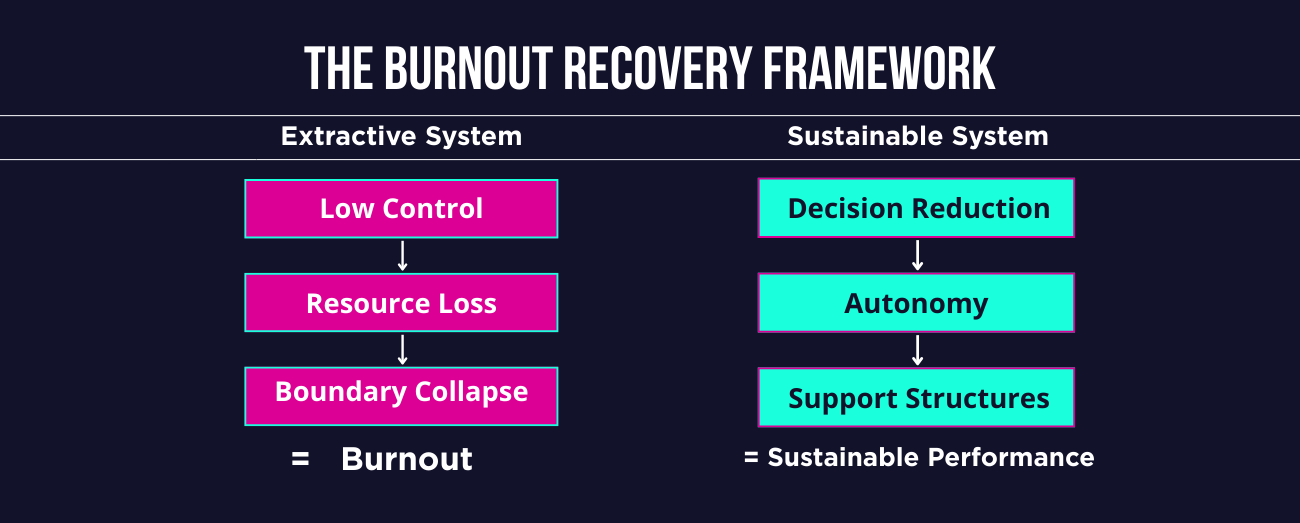
When someone is burned out, they are operating inside a system that extracts more cognitive, emotional, and operational capacity than it restores.
You can temporarily refill the tank. But if the leak remains, depletion resumes.
Burnout Is Caused by Structural Mismatch
Maslach and Leiter’s research identifies six key mismatches that predict workplace burnout:
- Workload
- Control
- Reward
- Community
- Fairness
- Values
When these domains are misaligned, burnout develops, even in high performers.
If someone rests but returns to:
- Unrealistic expectations
- Lack of autonomy
- Constant communication chaos
- Undefined scope boundaries
The stress architecture remains intact.
The nervous system interprets this as ongoing threat exposure. And recovery stalls.
This is precisely why rest doesn’t fix burnout: it doesn’t alter the system generating the stress.
The Neuroscience of Burnout: Why It Lingers
Burnout changes the brain’s stress processing patterns.
Chronic stress affects the prefrontal cortex (executive function, planning, decision-making) and heightens activation of the amygdala (threat detection).
Neuroscientist Bruce McEwen’s research on allostatic load explains how repeated stress exposure alters cognitive functioning and emotional regulation over time.
After prolonged workplace stress, individuals may experience:
- Slower decision-making
- Reduced working memory
- Heightened reactivity
- Lower frustration tolerance
- Decreased intrinsic motivation
Rest can reduce acute fatigue. But neural recalibration requires sustained safety — not just time off.
If someone returns to identical structural pressures, the brain resumes defensive mode quickly.
This is why burnout recovery must involve environmental stability, not just rest.
Conservation of Resources Theory: Why Burnout Becomes Cyclical
Stevan Hobfoll’s Conservation of Resources (COR) Theory offers one of the most practical explanations for founder burnout recovery and recurring workplace burnout.
The theory proposes that stress occurs when resources are:
- Lost
- Threatened
- Or insufficient to meet demands
Resources include:
- Time
- Energy
- Autonomy
- Social support
- Stability
- Emotional bandwidth
- Financial security
Once resources are depleted, individuals become more vulnerable to future stress.
This creates a loss spiral:
- Capacity drops.
- Stress sensitivity increases.
- Recovery slows.
- Smaller stressors feel larger.
Rest may restore energy temporarily. But unless autonomy, clarity, and workload structure change, the resource imbalance remains.
And depletion resumes faster.
Workplace Stress Research Confirms the Pattern
A systematic review in BMC Public Health examined work environment factors linked to burnout and found strong associations with:
- High job demands
- Low job control
- Insufficient social support
- Poor work-life balance
Similarly, research in Frontiers in Psychology found burnout strongly associated with job strain and lack of supportive conditions.
The conclusion across workplace stress research is consistent:
Burnout is predictable when systems are poorly designed.
This reinforces the central truth behind burnout and system failure, design flaws produce chronic overload.
Founder Burnout Recovery Is More Complex
Founder burnout recovery is uniquely difficult because founders are both:
- The primary resource
- And the architect of the system
Unlike employees, founders often experience:
- Continuous decision density
- Cross-departmental cognitive switching
- Emotional labor absorption
- Undefined response windows
- No operational buffers
Even after rest, they return to:
- Unprocessed emails
- Client expectations
- Strategy ambiguity
- Revenue pressure
Without capacity management and structural redesign, time off becomes a pause, not repair.
This is why founder burnout recovery must address system architecture, not just workload reduction.
What Actually Fixes Burnout: Structural Repair
Sustainable burnout recovery requires rebuilding the environment around capacity.
Here’s what workplace stress research and real-world application suggest:
1. Capacity Management
Before re-entry, assess:
- Current cognitive bandwidth
- Emotional resilience
- Operational tolerance
Most professionals plan based on ideal capacity. Burnout recovery requires planning from current capacity.
Capacity management is not laziness, it is strategic stabilization.
2. Reduce Decision Density
High decision load drains executive function rapidly.
Reduce daily cognitive switching by:
- Batching similar tasks
- Implementing response-time policies (48–72 hour SLAs)
- Using templates for repeatable communication
- Limiting open-ended availability
This protects the prefrontal cortex during recovery.
3. Restore Autonomy
Low control predicts workplace burnout consistently across studies.
Reintroduce autonomy through:
- Delegation of repeatable tasks
- Converting synchronous meetings to asynchronous updates
- Creating no-decision or low-demand days
- Clarifying scope boundaries
Autonomy rebuilds psychological safety.
4. Install Boundaries
Burnout thrives in ambiguity.
Install:
- Defined inclusion/exclusion policies
- Clear client expectations
- Response windows
- Role clarity
Boundaries reduce emotional labor and protect capacity.
Resilience Requires Supportive Conditions
Resilience is often framed as an internal trait. Research suggests otherwise.
A study published in Scientific Reports found resilience buffered burnout in healthcare professionals only when supportive environmental conditions were present.
Resilience does not replace structure.
It operates within structure.
Without support, even highly resilient individuals succumb to chronic stress.
The Real Sequence of Burnout Recovery
Based on workplace burnout research and capacity management principles, recovery follows a sequence:
- Physiological stabilization (sleep, reduced exposure)
- Cognitive reframing (remove self-blame)
- Capacity stabilization
- Structural buffer installation
- Controlled re-entry
- Scalable growth only after protection exists
Skipping structural repair is why rest doesn’t fix burnout.
Energy without redesign leads back to depletion.
The Reframe You Need
If rest didn’t fix your burnout, you didn’t fail recovery.
Your system remained extractive.
Workplace burnout is not proof you are incapable.
It is evidence your environment exceeded sustainable capacity.
True burnout recovery requires:
- Capacity management
- Structural redesign
- Decision load reduction
- Autonomy restoration
- Boundary clarity
- Operational support
Rest restores energy.
Structural repair restores sustainability.
And sustainability, not endurance, is what prevents burnout from repeating.
If you are looking for support or just a way for you to restructure your systems, jump into a Coffee Time with us. We’ll start from there. No pressure.