Why Workplace Design, Culture, and Structure Cause Burnout, and How Real Recovery Needs Systemic Fixes
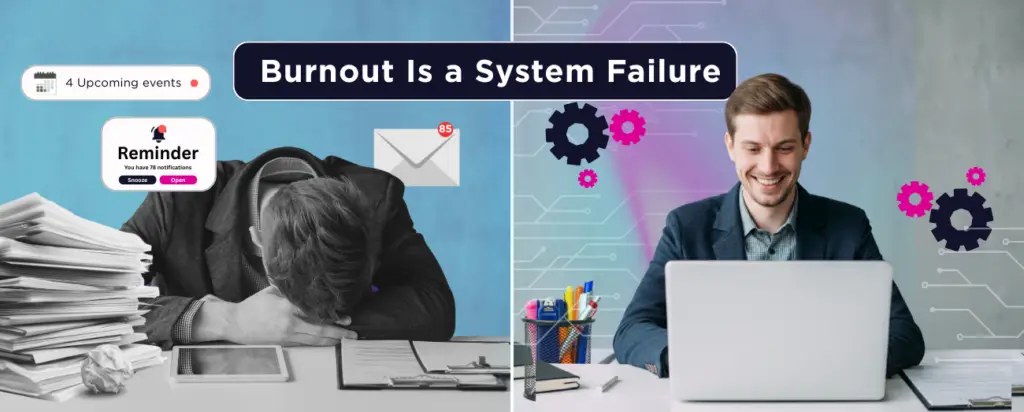
Burnout has reached epidemic levels among healthcare workers, founders, executives, and knowledge workers, yet too many people still think “something is wrong with me.” The truth is different: burnout is rooted in the system you work in, not inside you.
In this evidence-based guide, we explain what burnout really is, why workplace design causes it, and how burnout recovery must involve both individual healing and structural change.
What Is Burnout? Research Definition and Symptoms
According to the World Health Organization (WHO), burnout is officially defined in the International Classification of Disease 11 Revision as:
“a syndrome conceptualized as resulting from chronic workplace stress that has not been successfully managed.”
This means burnout is a workplace phenomenon, not a personal failing. The WHO definition highlights that burnout arises from chronic stress at work and reflects structural conditions, not character flaws.
Academic research confirms burnout typically includes three main components:
- Emotional exhaustion — persistent energy depletion
- Mental distance or cynicism — detaching from work
- Reduced professional efficacy — feeling ineffective or powerless
These patterns reflect prolonged mismatch between job demands and support, a core concept in burnout recovery frameworks.
The Workplace Drives Burnout, Strong Evidence
Burnout research overwhelmingly points to organizational predictors, not personality traits.
A landmark review on burnout as an occupational health issue shows that structural work factors, like high job demands and low job resources, drive burnout more than individual differences.
Healthcare workforce research further highlights how organizational culture, workload, staffing shortages, and leadership quality are strongly associated with burnout outcomes among clinicians and support staff.
These studies reinforce that burnout is rooted in systems, not weaknesses.
Burnout Is Not Just About Hours, It’s Systemic Stress
A common misconception is that burnout is merely “working too much.” But decades of occupational health research show workplace stressors beyond hours are critical:
- High cognitive load and emotional labor
- Conflicting expectations
- Poor work–life boundaries
- Lack of autonomy and decision-making power
- Limited social or leadership support
These dynamics are central to burnout models like the Job Demands-Resources model, which shows burnout increases when demands outweigh available resources.
People can work long hours without burning out if they have autonomy, support, clear expectations, and reasonable workload design — conditions that protect capacity rather than drain it.
Why Internalizing Burnout Is Harmful
Framing burnout as a personal flaw persists because it’s cheaper and easier for organizations than addressing root causes.
Employers sometimes default to wellness tactics like meditation apps, gratitude journals, or resilience coaching without improving job design or leadership support. These programs may help temporarily, but they don’t change the work environment that caused the stress in the first place.
Social narratives that celebrate grit and productivity can further misinterpret burnout as individual failure, adding stigma rather than solutions.
Burnout Isn’t Isolated, It Scales Across Systems
If burnout were purely about individual limits, we’d expect random distribution across workplaces. Instead, consistent patterns emerge within industries and organizational structures.
For example, large studies show high burnout prevalence among frontline healthcare workers — up to 70–90% in some settings, linked to chronic job stress and systemic pressures.
Founder burnout follows a similar logic: rapid growth, ambiguous roles, stretched resources, and high expectations create systemic overload, not individual weakness.

The Core Drivers of Burnout: Design, Control, and Support
Research highlights several structural triggers:
High Demands + Low Control
Burnout increases when jobs demand high effort but offer little autonomy or influence over work. This imbalance is central in burnout theory.
Poor Work–Life Integration
When work demands bleed into personal life without boundaries or support systems, stress accumulates. Research on work–family conflict shows this tension directly connects with burnout and reduced well-being.
Lack of Organizational Support
Support from leadership, peers, and workplace culture correlates directly with burnout prevalence. Environments that lack psychological safety or feedback loops foster long-term exhaustion and cynicism.
These are structural issues, not internal personality traits.
How This Changes Burnout Recovery
If burnout is systemic, recovery can’t rely on rest alone.
Rest helps, but it’s not enough.
Temporary relief doesn’t fix the conditions that caused exhaustion in the first place, and many individuals relapse when returning to unchanged environments. Recovery models emphasize the need to combine rest with environment redesign.
Sustainable burnout recovery requires two things:
- Individual regulation and repair – strategies that support nervous system recovery and cognitive recalibration
- System redesign and support structures – modifying job design, expectations, leadership practices, and organizational culture
Studies show that environments offering real support, autonomy, and clear workload boundaries enhance recovery and resilience more than individual stress management alone.
Burnout and Resilience, How They Interact
Burnout and resilience are not opposites, and being resilient doesn’t make you immune.
Research in occupational psychology suggests that resilience benefits are strongest when supportive work conditions exist. Without support, even highly resilient individuals can succumb to chronic stress and burnout.
Resilience is not toughness, it’s the capacity to adapt within environments that provide psychological safety and recovery resources.
A Needed Narrative Shift
Reframing burnout from “personal failure” to “systemic signal” changes how leaders and individuals approach solutions:
Instead of asking:
“Why can’t I handle this?”
We begin asking:
“What systemic design factors contributed to this?”
“How can we redesign work to protect capacity, not demand it?”
This shift removes shame and creates pathways for strategic burnout recovery and prevention, aligning with evidence that organizational interventions are essential.
What Burnout Recovery Means for You
If you’ve experienced burnout, especially as a founder, leader, or high achiever, here’s the takeaway backed by research:
✔ Burnout is not a sign of weakness.
✔ Your system, not your willpower, failed to protect you.
✔ Rest alone won’t sustain long-term recovery.
✔ Real recovery involves capacity awareness, improved job design, and systemic support.
Your environment needs repair as much as you do.
Key Takeaways on Burnout Causes & Recovery
- Burnout is classified as an occupational phenomenon, not a personal condition.
- Workplace design, culture, and structure drive burnout more than personality traits.
- Burnout recovery requires both individual and organizational action.
- Resilience thrives when supported by systemic change.
Burnout is not proof that something is wrong with you, it’s evidence that something is wrong in your system.