

Burnout among high‑performing founders is not a sign of weakness, lack of discipline, or insufficient grit. It is a structural problem—one rooted in how life itself is (or isn’t) systemized as the business scales.
Most founders wake up with clarity about business priorities, hire great talent, automate sales funnels, and instrument KPIs with precision. Yet their personal lives run on memory, sporadic habits, and sheer willpower.
That mismatch isn’t just uncomfortable. It quietly drains capacity until one day there’s nothing left to give.
Burnout Isn’t About Hours Worked, It’s About Hidden Operational Load
We tend to think of burnout as a consequence of excessive hours. But research tells a different story.
A 2021 paper by Demerouti et al. in New Directions in Burnout Research emphasized that burnout is more closely tied to invisible operational demands and cognitive overload than the number of hours worked. Leaders with poor systems experience decision fatigue, constant context switching, and self‑generated stress, even with a manageable calendar.
Workload is visible. Operations are invisible.
Unmanaged life operations quietly siphon energy through:
- Constant mental effort to remember details large and small
- Last‑minute fixes that should never have been last minute
- Emotional labor that never gets logged as “work”
- Decision after decision without a framework to guide them
That compensation feels like handling it, until capacity collapses.
Burnout doesn’t occur when founders are doing too much. It happens when too much depends on them personally.
If a business can’t run without systems, neither can the person leading it.
The Life Systems Leaders Ignore, And the Price They Pay
Founders instinctively systemize business functions like:
- Sales pipelines
- Financial controls
- Marketing funnels
- Product development workflows
Yet personal life operations are often managed by:
- Memory
- Stress‑driven habit
- Last‑second decisions
Left unmanaged, life operations become predictable sources of friction:
Meals & Nutrition
Skipping meals, relying on caffeine, or making last-minute food decisions damages cognitive performance. Research published in Psychological Science shows that irregular eating patterns impair executive function and stress response.
Health & Medication Routines
Habits that depend on motivation crumble under pressure. A 2024 Lancet review found that routine, consistent self-care is a primary buffer against chronic stress and burnout.
Calendar & Appointments
Overbooking, rescheduling, and reactive planning create time-debt. This adds invisible pressure and often leaks into your mental space even when you’re “off.”
Household Logistics
Uncoordinated chores, errands, and family logistics act as low-level stressors. A 2021 Journal of Consumer Research paper found that unresolved small tasks create persistent background cognitive load.
These aren’t “personal” inefficiencies. Together, they form a systemic failure point in your life operations stack, and they erode leadership capacity, no matter how strong your business systems are.
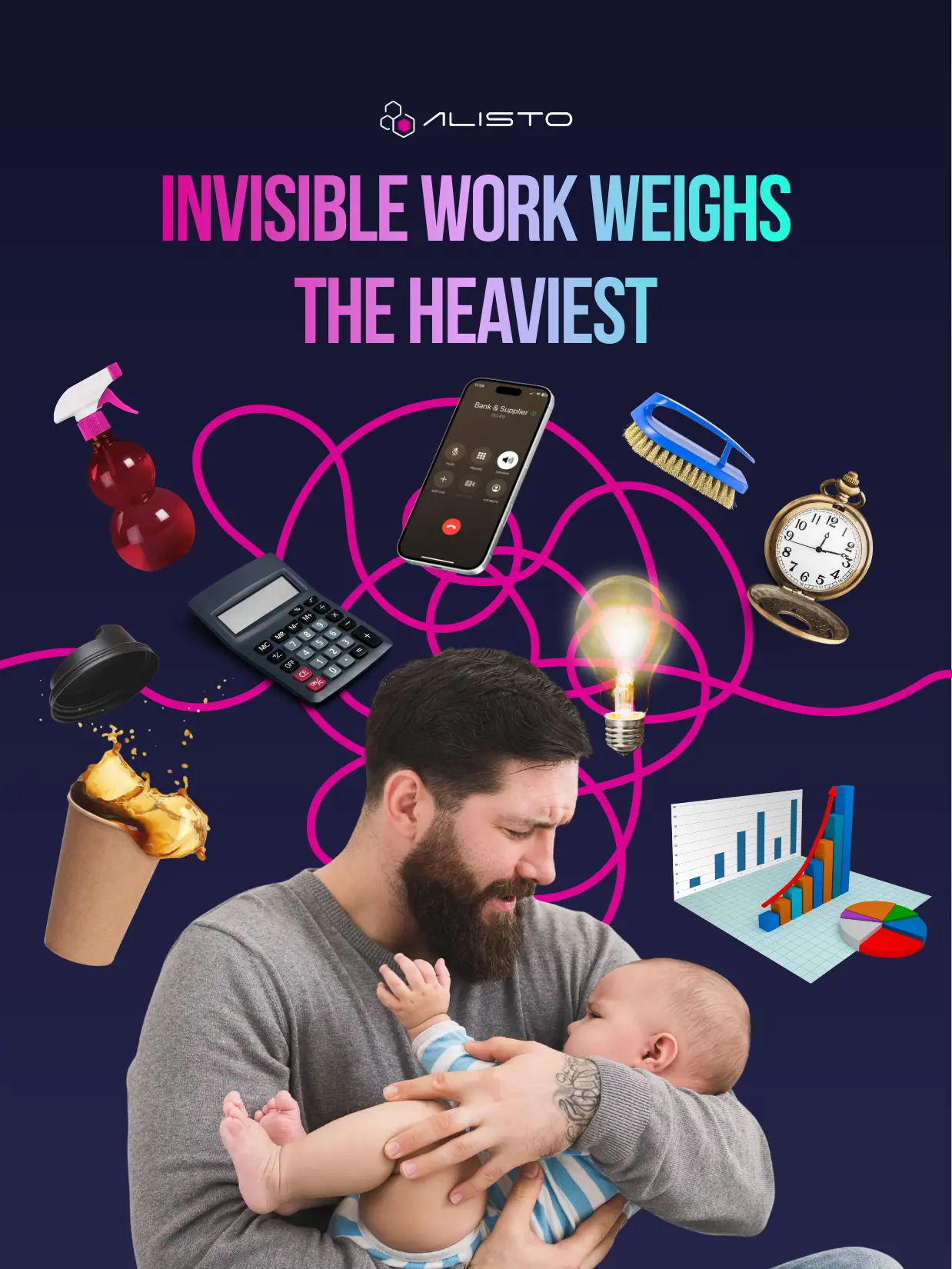 Memory Is Not a Reliable Operating System
Relying on memory to manage your life is like running your company on sticky notes and Slack reminders.
Memory:
- Fails under stress
- Degrades with fatigue
- Increases anxiety when overloaded
Even simple decision-making depletes mental energy. This phenomenon—decision fatigue—has been widely documented, including in studies by Baumeister and Tierney. It leads to procrastination, impulsive choices, and suboptimal leadership.
If a task:
- Happens repeatedly
- Has consequences when forgotten
- Requires energy to remember
…it should not live in someone’s head.
High‑performing leaders don’t outsource their most important functions to willpower, they build systems that work even when motivation and focus fluctuate.
What Capacity‑Aware Design Actually Looks Like
Capacity-aware design begins with a powerful question:
What should not require my attention every day?
Instead of chasing productivity (doing more), capacity-aware leaders focus on sustainability (maintaining quality without collapse). They:
- Remove unnecessary decisions
- Externalize recurring responsibilities
- Assign ownership to systems or people
- Build for low‑energy days, not ideal ones
This isn’t about slowing down, it’s about staying sharp.
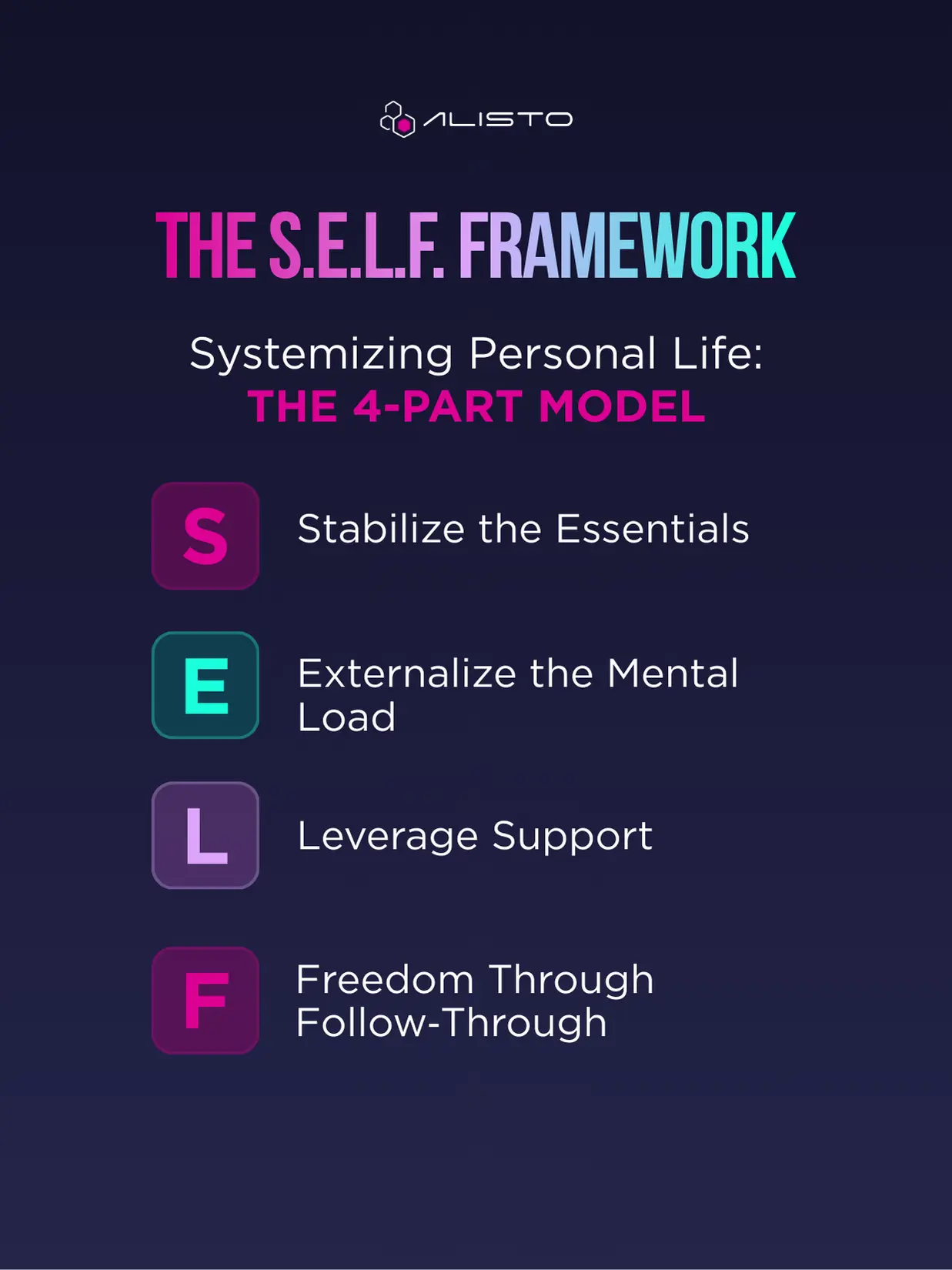
S.E.L.F. as Life Operations Infrastructure
At Alisto, we organize life systems through the S.E.L.F. framework:
S — Stabilize the Essentials
Base routines for food, health, sleep, and scheduling that don’t depend on willpower.
E — Externalize the Mental Load
Move anything important out of your head and into reliable systems.
L — Leverage Support
Design support—people or tools—that actually works rather than relying on ad‑hoc help.
F — Freedom Through Follow‑Through
Real freedom comes from consistency, not flexibility that collapses under pressure.
S.E.L.F. is not a productivity hack.
It is life operations infrastructure for leaders who want sustainability and speed.
What To Do Next (Action Steps That Work)
If this resonates, you don’t need a life overhaul—you need structure that protects your capacity.
1. Download the S.E.L.F. Systems Planner
This is not a glorified to-do list. It’s a diagnostic tool that helps you:
- Identify which areas of your life are silently leaking energy
- Highlight what should be systemized or delegated
- Build clarity—not guilt—about what matters next
2. Book a Capacity Audit with Avy
This is a strategy session, not generic coaching. You’ll walk away with:
- Clarity on your biggest friction points
- A prioritized roadmap for systemizing life operations
- Relief from carrying it all in your head
This is your chance to get strategic about the part of your life you’ve been managing ad-hoc for too long.
Strong leaders don’t burn out because they work hard.
They burn out because their systems didn’t grow with them.
Alisto exists to change that.