
“Capacity planning for service providers isn’t just about hours—it’s math that protects results and energy.”
Most scope creep doesn’t start with clients asking for more. It starts with you guessing what you can handle.
Capacity is not a mindset issue. It’s math. When you quantify your delivery load, you stop making decisions based on hope and start designing offers that are profitable, sustainable, and aligned with your real energy.
In this post, we’ll walk through Alisto’s capacity formula, show how to apply it across different industries, translate the math into clear client policies, and guide you through using a visual dashboard to track your bandwidth.
The Capacity Formula
The core of capacity planning is this formula:
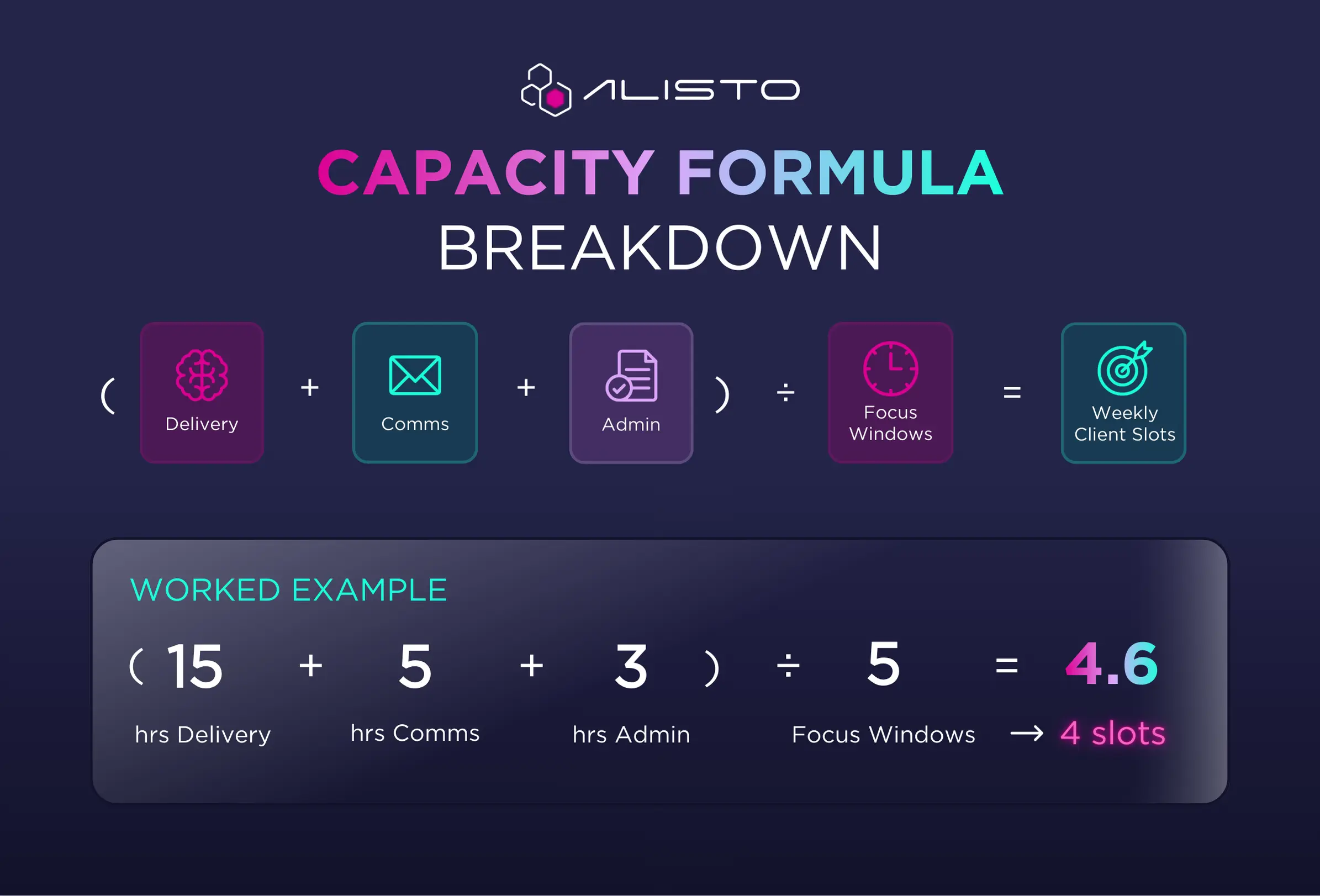
(Delivery + Comms + Admin) ÷ Focus Windows = Weekly Client Slots
Let’s break that down. “Delivery” refers to direct client-facing work—calls, design hours, coaching, writing. “Comms” is all your email, meeting time, feedback loops, and check-ins. “Admin” covers invoicing, prep work, and internal tasks like updating client dashboards. Finally, “Focus Windows” are your actual productive half-days per week—not theoretical ones. Be honest with yourself here.
For example, say you spend 15 hours per week on client delivery, 5 on communication, and 3 on admin. That’s 23 hours total. If you have 5 productive half-days per week, divide 23 by 5: you get 4.6. That rounds down to 4 weekly client slots.
If you oversell beyond that, you’re silently trading margin for exhaustion. And if that number feels off, recheck your assumptions. Most founders overestimate focus time by 20–30%.
Applications by Industry
Let’s look at how these calculations apply to different industries or professions:
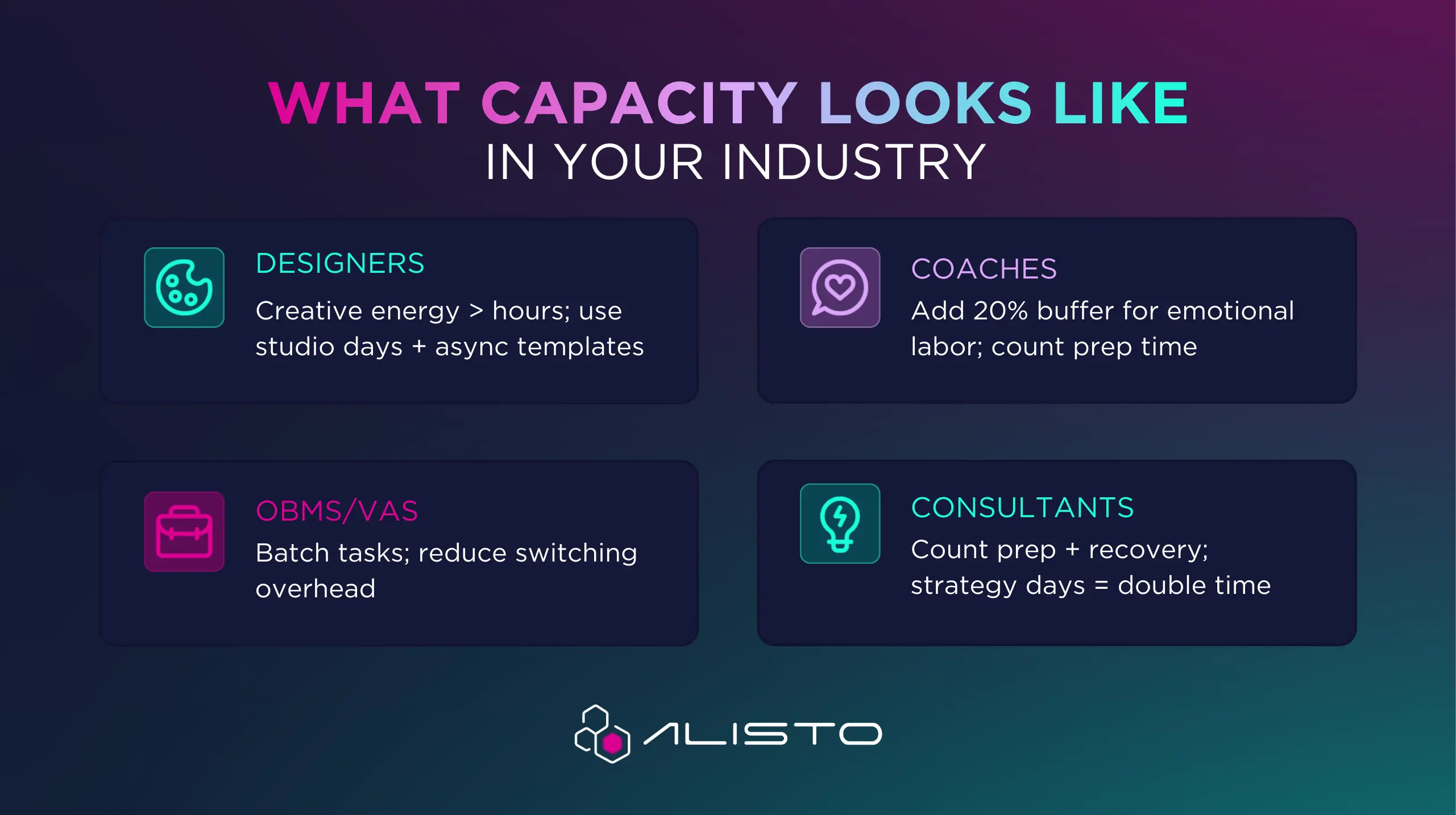
For Designers & Creatives: This formula helps you avoid booking overlapping client projects that each need deep focus. Break deliverables into async modules with set deadlines, and reserve studio days for high-intensity sessions. Remember, your capacity isn’t just about hours, it’s about creative energy. That may mean you can only take on two full branding projects per month, even if you technically have hours for more.
For Coaches & Educators: Include every touchpoint—group calls, curriculum planning, async feedback, prep time for modules, and check-ins. These all eat into your capacity. Add 20% to your total if your work includes emotional labor, which often goes unaccounted for.
For Service Providers (VAs, OBMs, Tech Setup): Count recurring tasks, communication, and the time it takes to context-switch between clients. The real drain might be your mental energy—not the hours alone. Your capacity sweet spot might be fewer clients on retainer, delivered at higher quality.
For Consultants & Strategists: Strategy sessions or VIP days require not just execution time, but also prep and recovery. One strategy sprint might consume 6 hours on paper but 10+ in mental load. Build in space post-delivery for wrap-up and implementation support. Your dashboard should reflect these high-intensity windows.
Translating Math into Client Policies
Knowing your limits is one thing, enforcing them is another. That’s where policy comes in. Policies make your internal limits visible to clients in a kind, clear way. When your calendar is full, your clients should know why and what that means for response times, turnaround, and access.
For example, if you calculated that you can only sustain four active clients per week, then set that as your limit: “We accept a maximum of four clients per delivery cycle.” If you determined your comms load caps you at two hours of back-and-forth a day, set a response SLA like: “Replies within 72 business hours.”
If Tuesdays are your deep work days, block them out publicly: “No calls on Tuesdays—production days only.” These statements reinforce your math with structure. Include them in onboarding kits, proposals, and scheduling confirmations so that your boundaries are aligned with client expectations from day one.
When to Add Capacity (Without Burning Out)
Once you’re consistently running at 85–90% of your max capacity, it’s time to scale—not by taking more on, but by shifting how you deliver.
Option 1: Add Async Assets. Start by identifying what you repeat most: onboarding instructions, milestone updates, and tool walkthroughs. Record short videos or build templates for those. Not only does this save you time, it also enhances your client experience.
Option 2: Delegate Operations. Hire a VA or assistant who can handle the backend tasks that drain you—calendar coordination, sending assets, following up on invoices, or even light tech support. A well-trained assistant can give you back 7–10 hours of high-quality focus for every 5 hours delegated.
Track It Visually: Capacity Dashboard
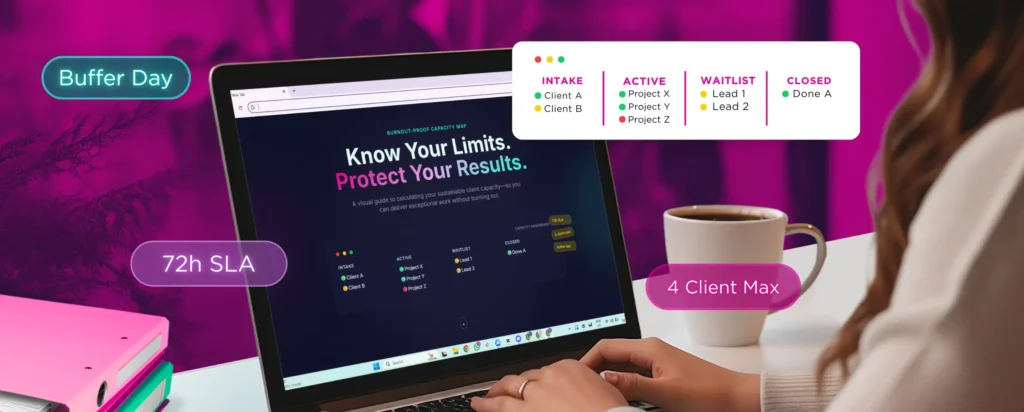
A visual dashboard turns your internal bandwidth into an external system. Tools like Notion, Airtable, or ClickUp are perfect for this.
Your dashboard should have at least four columns:
- Intake: Leads or discovery calls booked.
- Active: Current paying clients.
- Waitlist: Next-in-line clients.
- Closed: Completed or archived clients.
Color-code the status to make it easier to assess at a glance:
- 🟢 Under 75% capacity = open
- 🟡 75–90% = approaching limit
- 🔴 Over 90% = pause or waitlist
Make it a habit to check this dashboard every Friday before you commit to new projects or respond to new leads. It gives you permission to say no—or to raise prices—instead of defaulting to overwork.
Why This Matters
Capacity math is more than a productivity trick. It’s the foundation of sustainable service.
When you calculate and stick to your true capacity:
- You avoid scope creep before it begins.
- Your sales process becomes transparent and trustworthy.
- You make fewer reactive decisions and more strategic ones.
- You create space for recovery, creativity, and scale.
Especially for neurodivergent founders or anyone with energy variability, this structure becomes a form of protection. Boundaries aren’t selfish—they’re how you serve with consistency.
Book a Delivery Design & Handoff
Want help designing this for your real workload? We’ll walk you through your numbers, build a custom dashboard, and write the policy language that protects your time and your transformation.