Use this step‑by‑step guide to choose a delivery model you can sustain — without drowning in calls.
Great delivery isn’t just about access. It’s about the right access.
If recovery crashes follow your best weeks, it’s not a matter of discipline. The problem lies in your delivery structure — it’s demanding more energy than you have. When your delivery model ignores your energy reality, burnout is inevitable, even if your intentions are good.
This post provides a practical framework to fix that. You’ll explore four delivery models that protect your energy while increasing client clarity. You’ll walk through a decision tree, learn how to calculate true capacity (with margin), and finish with operational tools to automate boundaries.
Bonus: Download a worksheet to follow your product from idea to launch to execution.
The 4 Models at a Glance — Why They Work (or Don’t)
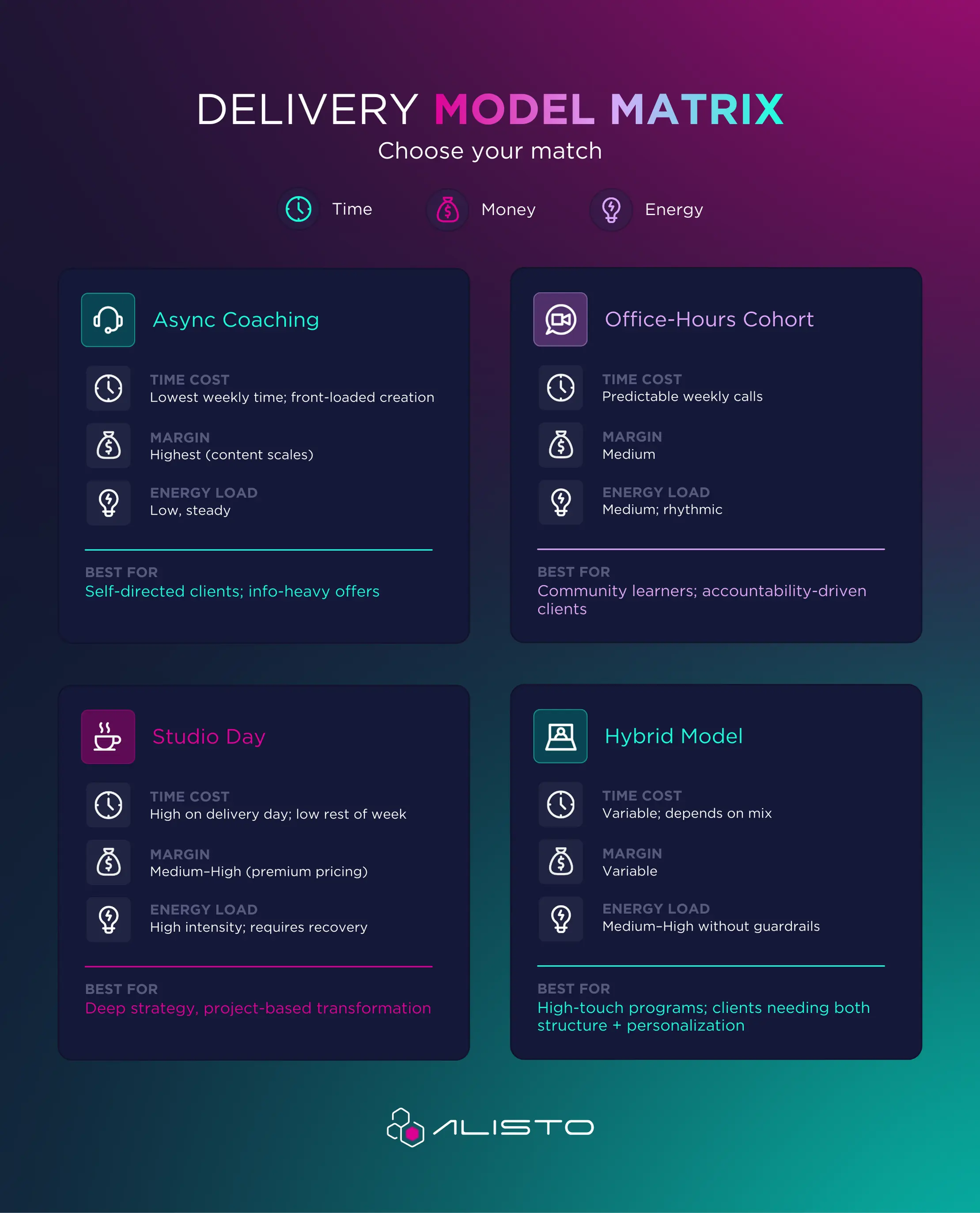
Here are four models structured to align with energy patterns, client needs, and business goals. Below, you’ll also see when each model tends to perform best.
- Async Coaching / Delivery
- What it is: Pre‑recorded modules, written lessons, or content clients consume on their own schedule; feedback works via email/voice/video or periodic check‑ins.
- Why it works: Asynchronous training offers flexibility — learners (and you) engage at times that align with their rhythms.
- Strengths: High scalability (once created, content can be reused), minimal “live‑presence” stress, less drain on weekly bandwidth.
- Trade‑offs: Requires discipline from clients; less real-time feedback/interaction.
- When it fits best: Clients with high self-direction, schedules that vary, and when content is information-heavy (rather than transformation-heavy).
- Office‑Hours Cohort (Group Coaching / Cohort-based Live Sessions)
- What it is: A group of clients moves through a program together. You hold regular “office hours” (e.g. weekly or biweekly) — group calls, Q&A sessions, or group workshops.
- Why it works: Group/cohort programs multiply your leverage — you serve several clients simultaneously.
- Strengths: Shared energy with peers, community support, cost-effective for clients (and efficient for you), consistent schedule and predictability.
- Trade‑offs: Less individualization; some clients might need more tailored help; group dynamics can add complexity.
- When it fits best: When clients have similar goals or trajectories, and need accountability and community as much as content.
- Studio Day (Live Batch / Deep‑Work Days)
- What it is: Intensive, focused sessions or days (in a group or with 1:1 clients) where you deliver, implement, or work on their projects together — “done-with-you” format.
- Why it works: Helps manage energy peaks efficiently: you put all live energy-demanding work into concentrated windows, then recover. Also, clients often pay premiums for concentrated delivery and high-touch service.
- Strengths: Deep focus, clarity of result, premium positioning, and avoids slow drip of scattered sessions.
- Trade‑offs: Requires guardrails — without buffers, prep, or recovery days, you risk overload. This model needs disciplined scheduling and boundaries.
- When it fits best: For transformation-heavy work (e.g. projects, done-with-you services, deep strategy), or when clients want quick, high-impact results.
- Hybrid (Mixed 1:1 + Async + Group Elements)
- What it is: A blend — maybe modules clients do asynchronously, group check-ins, plus occasional 1:1 support or office-hours.
- Why it works: It combines the strengths of different models: flexibility, community, and personalization. When designed intentionally, it gives variety and sustains engagement without overloading you.
- Strengths: Balanced client experience; tiered offering; scalable yet still personal.
- Trade‑offs: Complexity — without strong ops, you may end up with scope creep, scheduling chaos, or over-commitment.
- When it fits best: Higher-touch, premium offers; clients who benefit from both structure and flexibility; when you want to maximize both margin and impact.
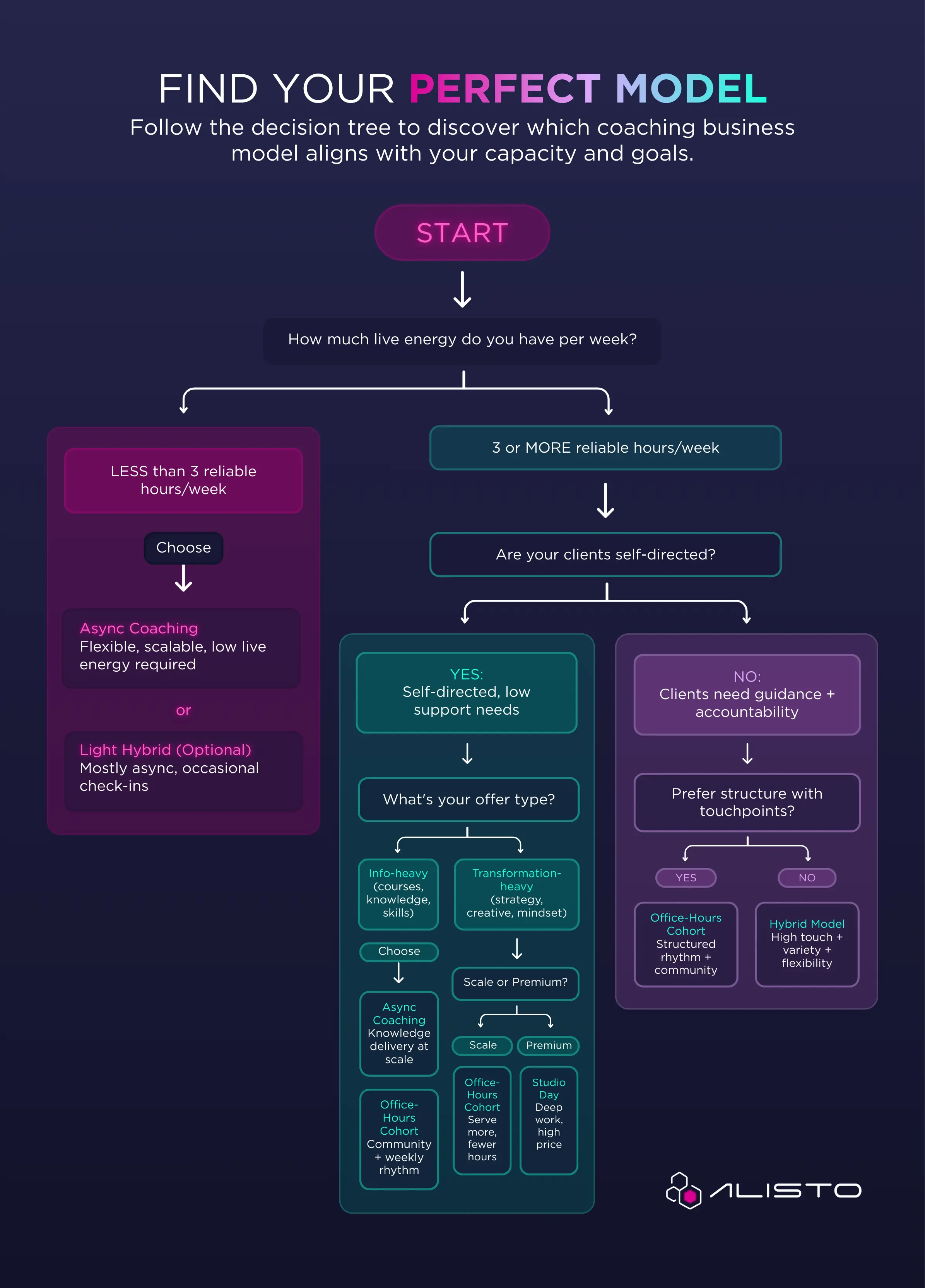
Your Decision Tree: How to Actually Use It
When evaluating which model to pick, consider these branches carefully:
Branch 1: Your Energy Reality
- Do you consistently have 3+ reliable hours per week for live presence (calls, group sessions, deep‑work)?
- Yes → Consider Office‑Hours Cohort, Studio Day, or Hybrid.
- No → Lean toward Async Coaching (or a light hybrid) to preserve energy.
Branch 2: Client Type & Behaviour
- Are your clients self-directed, able to implement without hand‑holding? → Async or Studio Day works.
- Do they need encouragement, live feedback, and accountability? → Cohort, Hybrid, or Studio Day.
Branch 3: Offer Type — Info vs Transformation
- Info-heavy (e.g. training, education, knowledge transfer) → Async or Cohort.
- Transformation-heavy (projects, mindset change, personalized change) → Studio Day or Hybrid (with 1:1).
Branch 4: Growth & Scalability Goals
- Want to scale with minimal hours → Async or Cohort.
- Want to preserve high-touch, premium offerings — Hybrid or Studio Day.
You can turn this into a working worksheet:
- List your energy availability, client profiles, offer type, and growth goals.
- Mark which models pass all four criteria.
- If none pass — consider redesigning the offer or adjusting expectations.
Already working through your Offer Spark Sprint? This post pairs perfectly with pages 5–10 of the workbook. If you haven’t downloaded it yet, grab the full workbook here— it’ll walk you from idea filter to delivery flow in under 2 hours.
Capacity Math: Calculate When to Waitlist or Switch Models
Burnout often hides in calendar math and invisible energy debt. Here’s how to calculate realistically:
- For each client, list out weekly touchpoints: live calls, async feedback, prep time, admin.
- Multiply by number of clients.
- Add ~20–30% buffer for unexpected tasks (reschedules, follow-ups, emergencies).
If total hours > your real energy capacity, you have three choices:
- Waitlist new clients
- Move some clients to a lighter model (e.g. async)
- Increase price to reduce client load (value‑based pricing)
This forces you to treat offers as real assets, not heroic sacrifices.
Policy Pack: The Ops That Protect Both You and Client
One of the biggest reasons coaches and creators burn out is policies‑by-default. Without clear boundaries, you end up serving leaks in your time, not value. Instead: build systems.
What to include:
- SLAs (Service-Level Agreements) — define turnaround times, response times, and what’s included vs. premium.
- Reschedule / Cancellation Policy — how far in advance clients must request changes, number of reschedules allowed.
- Scope Guardrails — define what’s included in the offer, and what counts as add-ons or billable extras.
- Buffer Days / Hours — blocks when you’re not taking calls or tasks, reserved for admin, rest, or deep work.
- Onboarding & Offboarding Process — ensures clear expectations, avoids scope creep from the very start.
These are not “limitations”; they are frameworks that make creative delivery predictable, fair, and sustainable.
Tooling & Infrastructure: Systems That Work Behind the Scenes
Having the right tools is critical. They reduce friction, protect boundaries, and help you scale without burning out.
- Project Management / Client Dashboards (e.g. Notion, ClickUp): Use for roadmap planning, tracking deliverables, deadlines, and client status.
- Asset Library (e.g. Loom, pre‑recorded videos): Great for onboarding, FAQs, tutorials — avoids repeated explanations.
- Canned Replies & Templates: For scheduling, rescheduling, scope‑guarding, feedback — saves emotional and mental bandwidth.
- Client Wiki / Knowledge Base: Central hub for materials, resources, and guidelines — clients can self-serve.
The goal: build a delivery engine that runs even when you’re not “on.”
Why This Matters: Longer-Term Perspective
- Sustainability > Heroism. Many creative entrepreneurs burn out not because of lack of passion but because they built businesses around “always on” energy, not cycles. By choosing a delivery model that reflects your energy reality, you turn ideas into sustainable assets.
- Scalability without Sacrifice. With efficient models (Async, Cohort, Studio Day), you can serve more clients with less incremental energy — boosting margin, preserving time, and protecting well‑being.
- Clear Value for Clients. When you systematize delivery, clients get consistent quality and predictable results. Boundaries become part of the offer.
- Better Market Positioning. A hybrid or premium model positions you as a strategist or facilitator, not just a service provider. That allows for higher pricing, less commoditization, and deeper transformation.
How This Supports Your Creative Strengths + Your “From Inside‑Out” Approach
Because your positioning is built around creative strengths — pattern spotting, hyperfocus bursts, lateral thinking — this model-first, energy-conscious structure is ideal.
- Async or Studio Day models let you align with hyperfocus bursts (batch when energy flows; rest when it drains).
- Cohort or Hybrid models outsource energy-intensive tasks (e.g. onboarding, community support) to structured flows, minimizing reactive overload.
- Policy packs and tooling protect your energy — boundaries become part of the architecture, not something you have to willpower every week.
In other words, you build offers that respect how your brain works, and still serve clients in a way the market values.