
Your best decisions aren’t born at the tail end of a 12‑hour sprint, they arrive when there’s space to think. Time and money are inputs, but recovery is the multiplier that keeps judgment sharp and creativity reliable. So, before you optimize another hour on your calendar, redesign your system to include rest as a core feature, not a prize at the end.
Rest Isn’t a Reward
You don’t have to earn your rest; you need it to keep creating. Most leaders treat downtime like a perk to squeeze in when work is “done.” But real‑world workloads rarely end; they evolve. Reframe rest as strategic, not indulgent. When you build space into your systems, you protect decision quality, creativity, and sustainable pace. In other words, rest is a revenue tool, it preserves the capacity that produces your results.
The good news? The science backs this up, and shows how to put it to work.
The Science Behind Recovery and Innovation
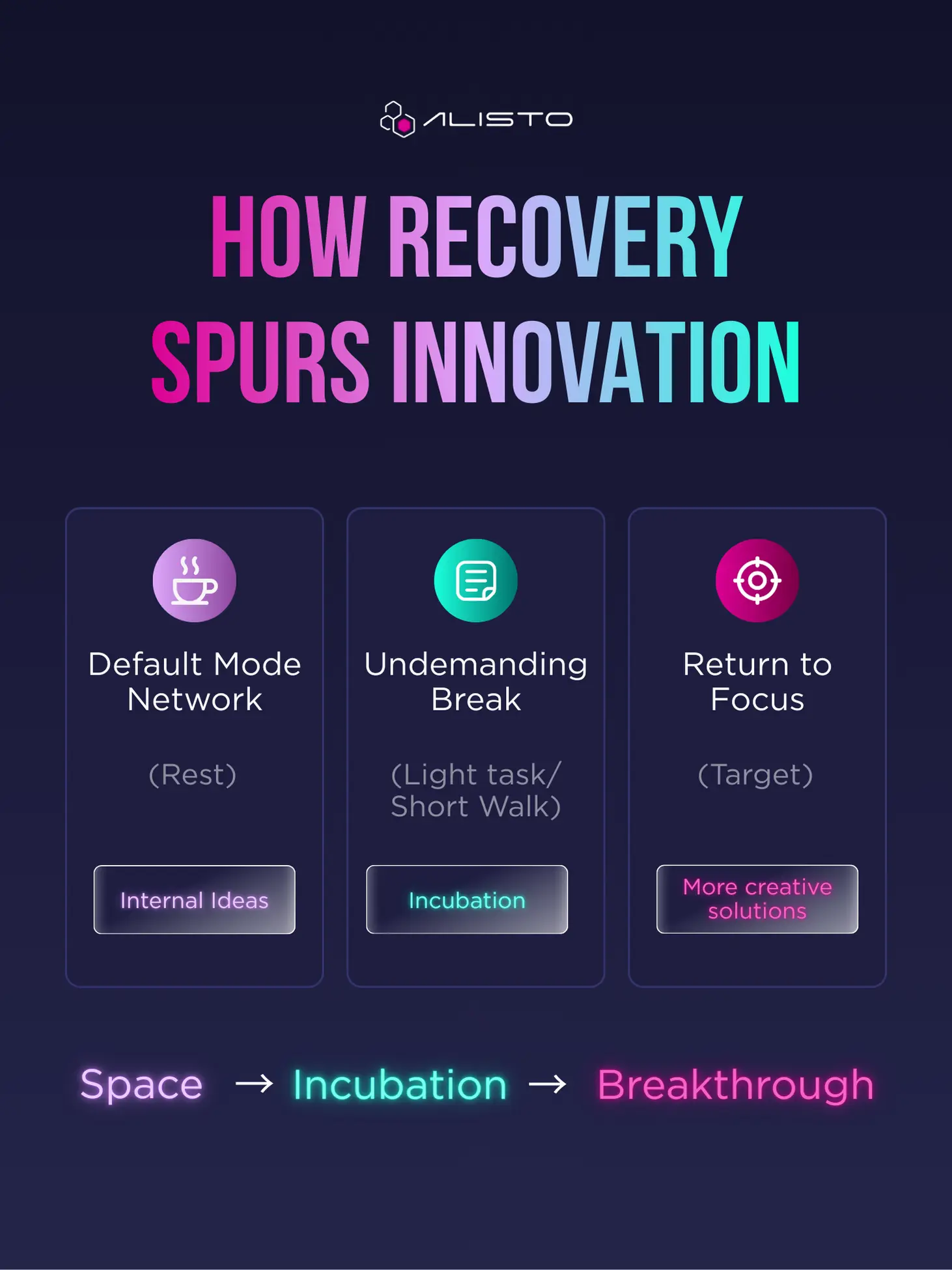
In periods of wakeful rest, the brain engages an organized “default mode network” (DMN)—circuits associated with internally directed thinking, memory, and future planning. This isn’t idling; it’s a baseline mode that supports idea recombination and perspective‑taking.
Breaks don’t just feel good, they prime creativity. In a Psychological Science experiment, participants who took an undemanding break (which allowed mind‑wandering) solved more creative problems afterward than those who rested passively, worked on a demanding task, or took no break at all—evidence for incubation improving creative output.
Recovery also supports consistent performance. A 2017 meta‑analysis of 86 publications (N≈38k employees) found that psychological detachment from work during off‑hours is positively associated with well‑being (better sleep, lower exhaustion) and with task performance (small–moderate effects). Translation: stepping away helps you return sharper, not slower.
If recovery fuels creativity and steadies performance, you need systems that create recovery time on purpose.
Automate for Recovery
Rest isn’t “time off”; it’s capacity on. The fastest way to create space is to let systems carry low‑value work so you can step away without guilt.
- Auto‑email + CRM follow‑ups: Pre‑schedule nurture emails and task reminders so next steps happen while you recover.
- Content batching: Draft, approve, and schedule a week of posts in one sprint; let your calendar drip them out.
- VA handoffs: Build a repeatable SOP for approvals, reporting, and admin. If the process is clear, it runs while you rest.
Think of automation as permission infrastructure: it keeps the flywheel turning while you protect the inputs—clarity, creativity, and judgment—that only you can provide.
Automation creates space; now protect that space at a policy level.

Systems That Protect Weekends and Peace
High output isn’t about doing more; it’s about protecting the right hours.
- “Protected time” policy: Codify no‑work zones (e.g., weekends) and set expectations for response times.
- Recurring off‑grid blocks: Reserve a weekly 2–3‑hour block for deep recovery (walks, reading, thinking)—on the calendar, just like a meeting.
- Team calendar syncs: Publish focus windows and communication windows so messages batch naturally and interruptions drop.
- Digital boundaries: Delay‑send emails outside business hours; route DMs to a triage board; mute non‑critical channels.
These aren’t nice‑to‑haves—they’re performance standards. You’re designing an environment where restorative periods are part of the operating system, not accidents.
And when leaders normalize recovery, teams feel permission to do their best work sustainably.
Rest as Leadership
Teams learn from what you schedule, not what you say. When leaders take visible breaks, defend weekends, and step back after deep sprints, they model that balance is a success behavior. You’ll see clearer thinking, fewer reworks, and steadier momentum because people are working with a replenished attention span—not grinding through depletion.
Rest is not an absence of work; it’s the precondition for quality work.
Book a Discovery Call
If you’re ready to systemize your business for peace and progress, book a free Discovery Call with Alisto. We’ll design workflows that let you rest and grow—with automation, protected time, and recovery‑first focus systems.