

What if your energy was your most valuable business asset?
Most leaders obsess over the usual KPIs: revenue, hours logged, tasks completed. But behind all those metrics is an often-ignored factor that drives them: your energy.
Time is finite. Money can be earned. But your energy? That’s the true throttle behind creativity, decision-making, and leadership presence. It doesn’t just affect your performance—it defines your business’s pace.
Energy isn’t vague or mystical. It’s measurable. And when you treat it like a strategic resource, the ROI becomes real.
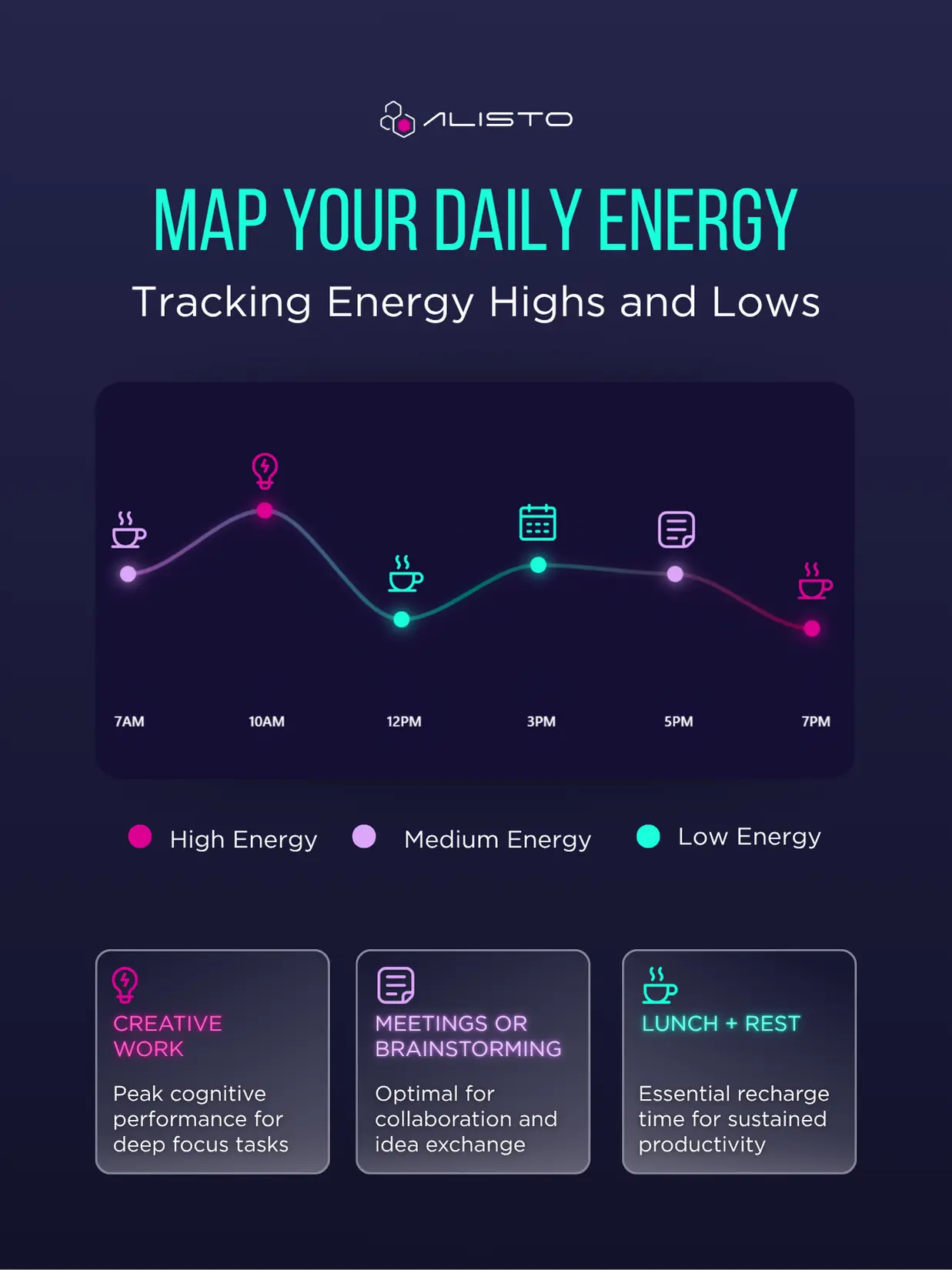
Tracking Energy Highs and Lows
If you don’t measure your energy, you’re guessing. And in business, guessing leads to inconsistency.
Start with awareness. The simple act of noticing when your focus peaks or crashes builds data you can actually use.
Here are a few practical methods:
- Daily energy check-in (scale of 1–10): Log your energy level at set points in the day (e.g., start of work, post-lunch, late afternoon).
- Trigger tracking: Make note of how your energy shifts after key activities like meals, meetings, deep work sessions, or commuting.
- Use wearables or journal apps: Devices like WHOOP or Apple Watch offer biometrics like heart rate variability (HRV) and sleep quality, while journaling apps like Daylio let you tag moods and patterns.
The goal? See your patterns. Do certain tasks always drain you? Do you naturally spike in focus mid-morning?
According to a systematic review on workplace energy, personal energy levels are linked to improved focus, reduced absenteeism, and better performance outcomes — especially when measured and managed over time.
Weekly review lets you answer key questions:
- What drains your energy repeatedly?
- When are you naturally most focused?
- What habits recharge you?
This data forms the backbone of smarter, more sustainable work.
Plan Tasks Around Energy, Not Just Urgency
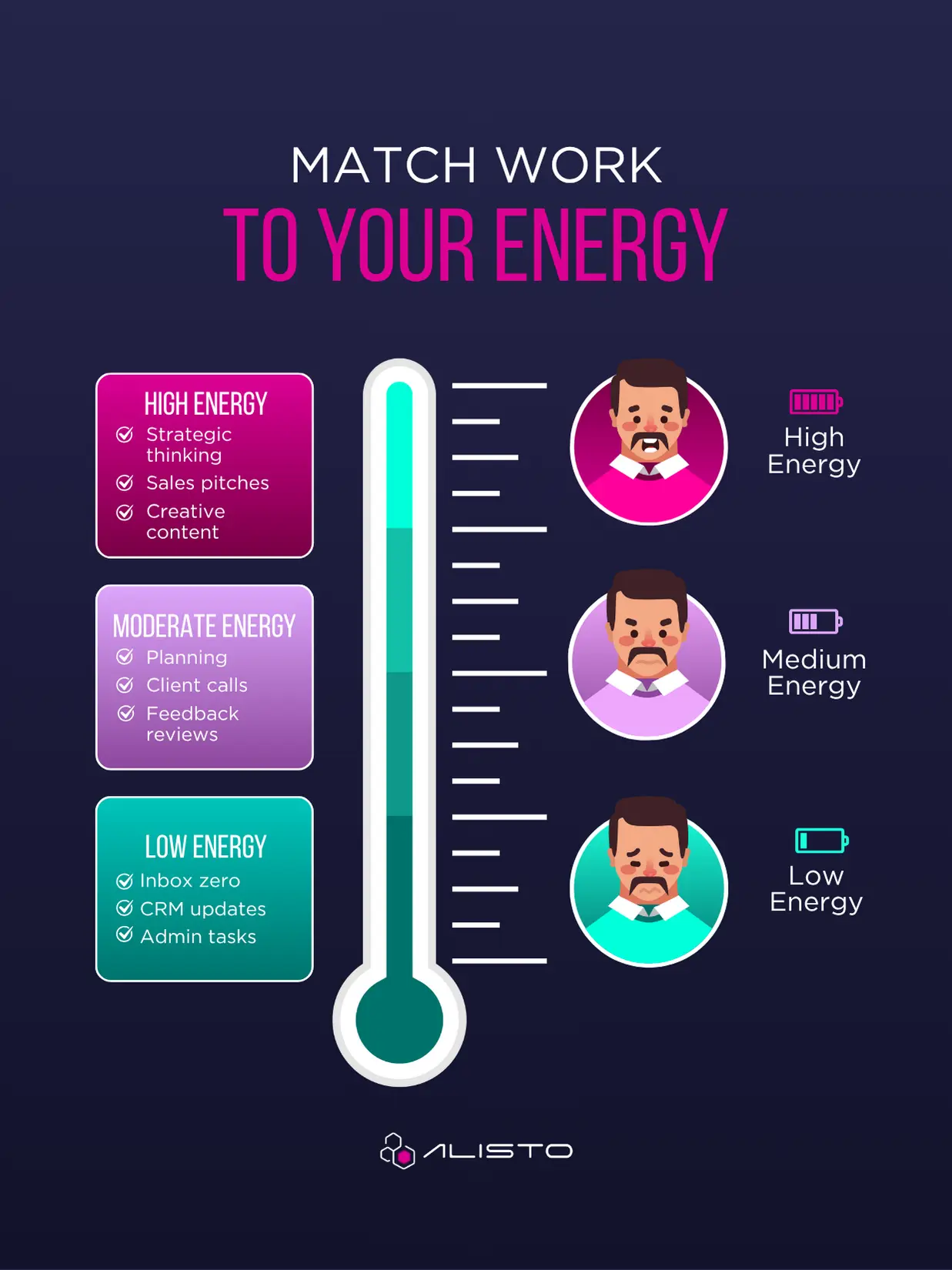
We’ve been conditioned to jump at anything labeled “urgent.” But urgency is often just code for disorganized. Real efficiency comes when you match your task type to your energy type.
Think of your energy like a budget. Spend your peak hours on the work that matters most:
- High energy: Creative work, strategic thinking, sales calls, visibility work (public speaking, leadership coaching).
- Moderate energy: Team syncs, decision-making, client calls, planning.
- Low energy: Admin, documentation, automation setup, inbox clearing.
By aligning work with energy levels, you create flow and reduce friction. You batch similar tasks. You protect focus time. And most importantly, you stop wasting your sharpest hours on shallow work.
This concept is rooted in chronobiology — the study of how our internal biological rhythms impact mental and physical performance. Research shows that aligning your daily work with your natural energy peaks can significantly improve focus and reduce fatigue. For instance, individuals who structure demanding tasks during their peak alertness periods experience greater cognitive efficiency and fewer decision-making errors (ScienceDirect).
When Teams Follow the Leader’s Rhythm
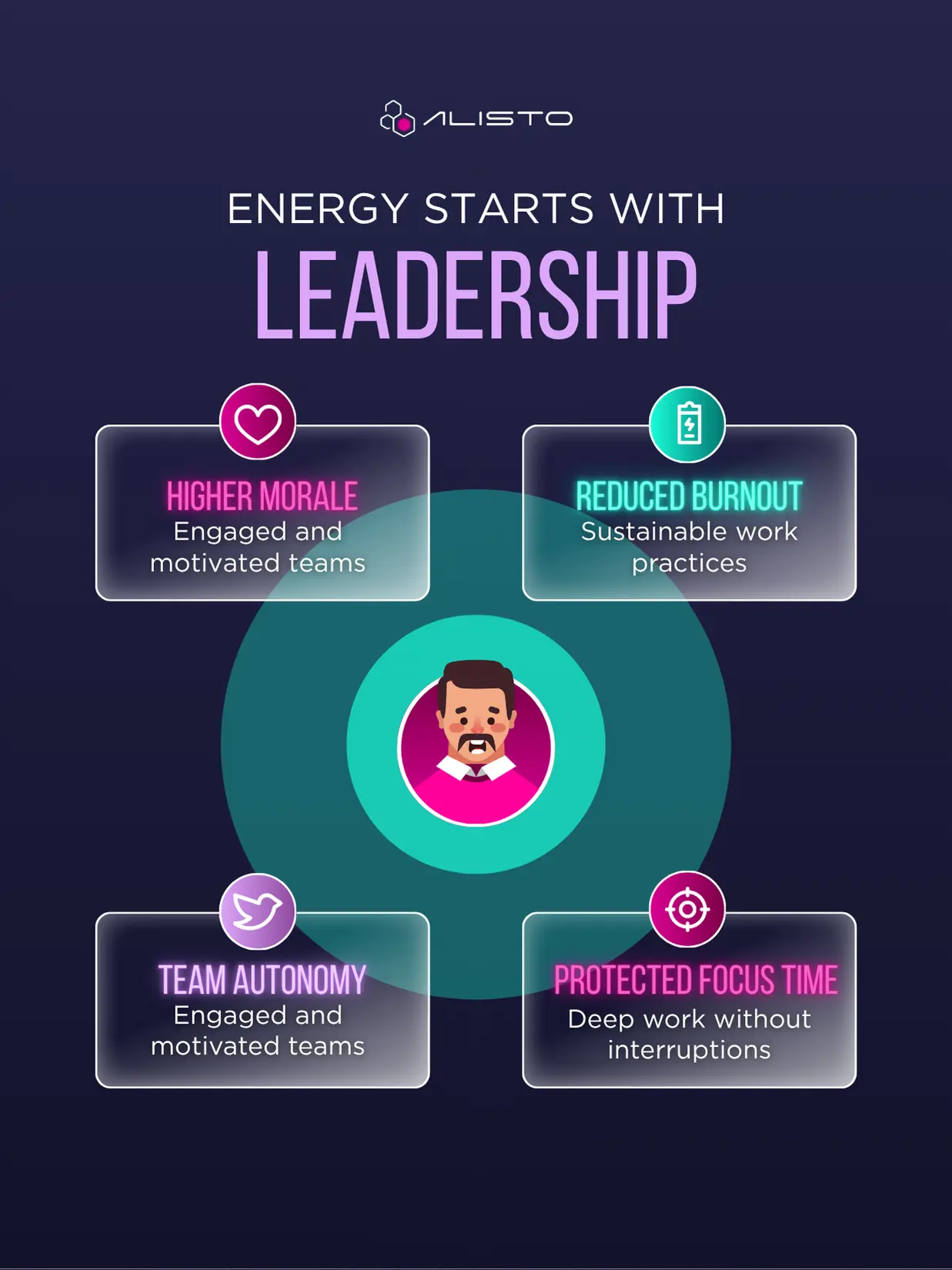
Leadership energy sets the tone.
If you’re always drained, reactive, or burned out, that trickles into your team. But when leaders protect and manage their energy, they model balance, intention, and trust.
Give your team permission to work with their own rhythms. That could mean:
- Letting team members schedule deep work blocks based on personal peak hours.
- Creating “no meeting” zones during peak mental energy times.
- Allowing flexibility in start times for those who perform better outside the 9-to-5 window.
Research supports this approach. A study published in the Journal of Vocational Behavior found that when employees were given greater control over their work schedules — particularly in terms of timing and task management — they reported higher engagement, improved job satisfaction, and better overall performance. The findings emphasized that schedule autonomy, when combined with supportive leadership, directly enhances workplace outcomes (ERIC database – Swanberg et al., 2011).
Energy management fosters a culture of ownership. And that’s where real efficiency is born.
Energy as a Business Strategy
When you start managing energy with the same discipline as finances or time, you unlock compounding gains:
- Sharper decision-making during peak energy zones
- Faster execution on high-impact work
- Reduced burnout across teams
- Greater focus and mental resilience
This isn’t just wellness talk. It’s a leadership system. And the best part? It scales. Whether you’re a solo founder or leading a 50-person team, energy awareness can drive performance across every level.
So instead of tracking just hours, track your energy. Instead of just optimizing calendars, optimize for clarity. Because when you have energy, you have direction.
Ready to Turn Energy into Impact?
Download the free 90-Minute Project Power-Up and learn how to turn your peak energy hours into focused results — without adding more hours to your day.
Your energy isn’t just a personal resource. It’s your business advantage.