

You don’t need to be less available.
You need to be intentionally accessible.
For many entrepreneurs—especially those who are heart-led, people-pleasing, or neurodivergent—boundaries can feel like barriers. They seem rigid, cold, or even anti-client.
But boundaries aren’t punishments. They’re structures that protect your energy, focus, and time—while giving you the flexibility to serve at your best.
Let’s explore how to build healthy business boundaries that empower you to grow without burning out.
Why Boundaries Feel Hard (Especially for Service-Based Founders)
When most people think of “boundaries,” they imagine rejection or rigidity. In reality, boundaries are decisions made ahead of time—pre-emptive agreements that protect your time, energy, and emotional bandwidth.
For entrepreneurs—especially those who are neurodivergent or service-based—maintaining clear boundaries can be especially challenging. Constant context-switching, people-pleasing tendencies, and the emotional labor of client work make it difficult to know when to stop.
The psychology behind boundary resistance
Research consistently shows that unclear work boundaries directly increase stress, exhaustion, and role confusion.
- A large meta-analysis on role ambiguity and role conflict found a strong relationship between boundary uncertainty and depression, anxiety, and overall job dissatisfaction across industries.
- Similarly, another meta-analysis on role conflict and ambiguity showed significant correlations between unclear expectations and emotional strain, lower performance, and burnout.
- More recent research published in the Journal of Occupational Health (2023) found that role ambiguity intensifies the negative effects of job demands on psychological distress, meaning unclear limits make stressful work even harder to recover from.
In simpler terms: When you feel overstimulated, overbooked, or resentful, it’s rarely just a workload issue—it’s a boundary clarity issue.
Clear limits reduce emotional friction. Unclear ones quietly drain your mental energy.
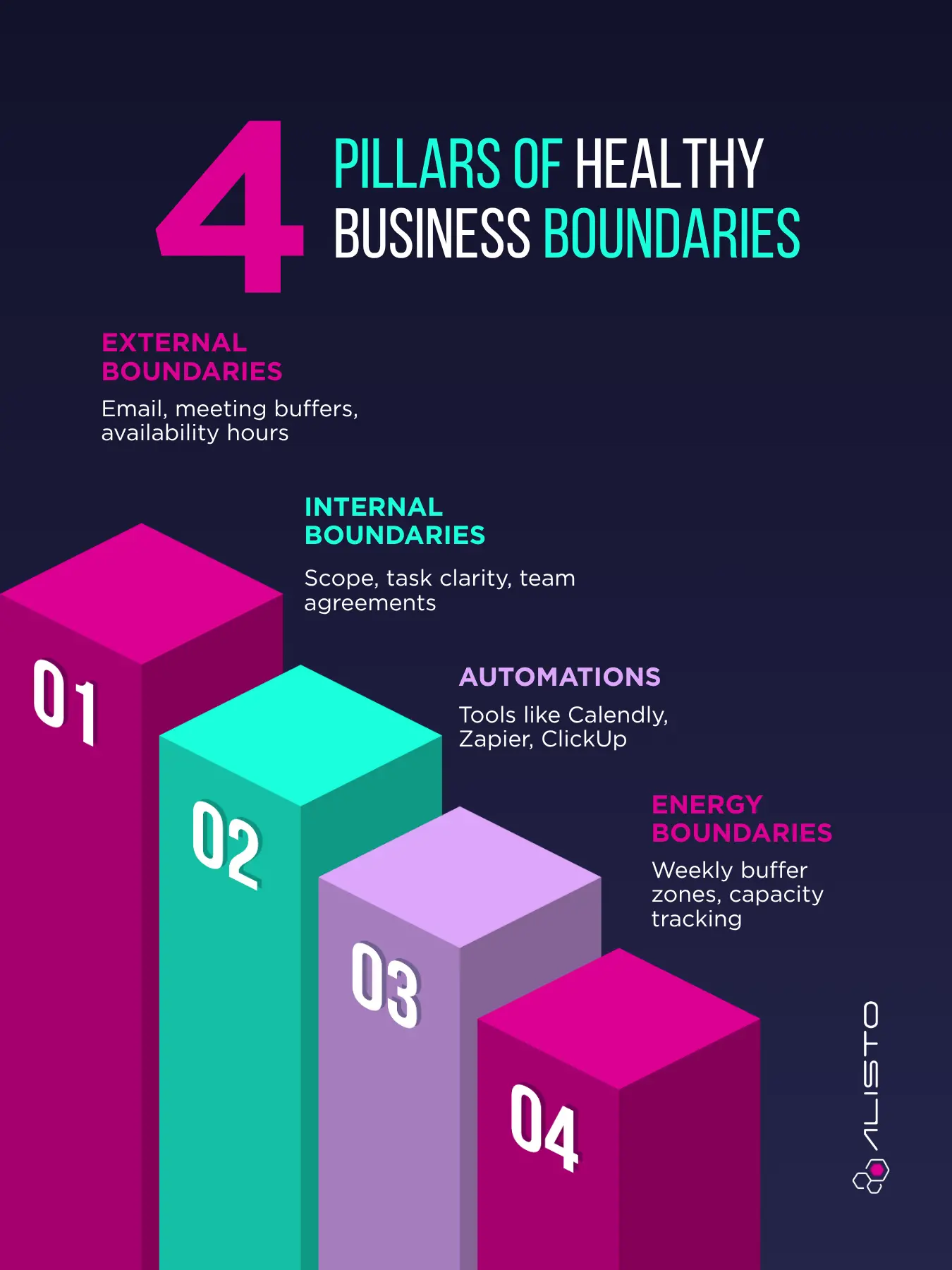
External Boundaries: Managing Email, Availability, and Access
The key to sustainable client relationships isn’t responding faster—it’s setting clear expectations about how and when you communicate.
1. Communicate your response times clearly
Let clients know when to expect a reply.
Example:
“I check emails Monday–Thursday between 10 AM–2 PM and respond within 24–48 hours. This helps me serve you with full focus.”
This simple note not only prevents miscommunication—it also reinforces that your boundaries are part of how you deliver quality work.
2. Protect your calendar with booking buffers
Don’t allow back-to-back meetings. Add at least 15–30 minutes before and after each call for prep and recovery. You can use scheduling tools like Calendly or Acuity to automate this process.
3. Set office hours for messaging apps
If you use Voxer, Slack, or Instagram DMs for client contact, clearly outline when you’re available—and when you’re offline. Clients respect consistency more than 24/7 availability.
4. Automate boundary reminders
Automation can uphold boundaries without you having to constantly enforce them. Auto-responders, “away” messages, and client onboarding sequences can gently teach others how to interact with your business.
Once your external systems are in place, the next step is to turn inward and examine how you maintain internal boundaries within your team.
Internal Boundaries: Protecting Your Team and Project Scope
Internal boundaries ensure that everyone on your team understands what’s expected—and what’s not. Without them, collaboration quickly turns into chaos.
Avoid scope creep
Scope creep happens when “just one more thing” becomes a pattern. To prevent it:
- Use ClickUp or Trello to define tasks with specific “done” criteria.
- Keep a “parking lot” board for new ideas that can’t be acted on yet.
- Hold weekly check-ins to identify potential overload or shifting priorities.
This structure gives your team confidence to say no without guilt and yes with clarity.
Recent organizational research highlights that clear boundaries and accountability systems significantly enhance team performance and retention.
Research in Frontiers in Psychology shows that work engagement (which often depends on clear expectations, role clarity, and communication protocols) negatively predicts turnover intention. R&D professionals working remotely positively affect increased engagement, which in turn reduces turnover intention.
Other team-based research also supports the importance of structure: in healthcare teams, psychological safety and clarity help buffer the effects of stress on turnover intention.
In short: when teams have structured communication, clarity of roles, and psychological safety, they tend to have higher engagement, less turnover intention, and more stability.
While team conversations protect internal flow, technology can reinforce these limits automatically—saving you from constant self-management.
Automations That Uphold Boundaries Effortlessly
Automation isn’t just for efficiency—it’s also for emotional sustainability. By letting systems manage your boundaries, you free yourself to focus on meaningful work.
Try these tools to automate your limits:
- Calendly Rules: Restrict how far in advance clients can book calls (e.g., no same-day meetings).
- Client Welcome Packets: Automate onboarding materials that explain your availability and communication standards.
- ClickUp Tags: Use visual cues like “In Review,” “Paused,” or “On Hold” to communicate progress.
- Zapier Workflows: Automate follow-ups or reminders so clients stay informed without you manually tracking every task.
- Calendly Rules: Restrict how far in advance clients can book calls (e.g., no same-day meetings).
When used intentionally, these automations create a flexible framework—one that protects your energy while keeping your business running smoothly.
How Boundaries Build Better Business Relationships
Boundaries are not cold—they create clarity.
They don’t block collaboration—they enable trust.
And they don’t kill flexibility—they make it sustainable.
Research from Harvard Business Review emphasizes that transparency and clarity from leadership are vital to building trust. When leaders clearly communicate expectations and act consistently, teams are more likely to trust them—and that trust is strongly tied to higher performance and engagement.
Healthy boundaries in business:
- Reduce miscommunication by clarifying how and when you work.
- Enhance client satisfaction by creating predictable, reliable experiences.
- Prevent burnout by maintaining balance between flexibility and structure.
The goal isn’t rigidity—it’s rhythm.
Boundaries help you honor both your capacity and your clients’ needs.
To make boundaries a consistent part of your workflow, you need a system that integrates them into your weekly planning—not as afterthoughts, but as strategic tools.

Build Your Boundaries with the CALM Planner
If you’re ready to create boundaries that actually work for you, start with the CALM Planner—a free resource designed for service-based and neurodivergent entrepreneurs.
Inside, you’ll learn how to:
✅ Design your week around energy, not ego
✅ Add buffer zones to protect focus
✅ Track where your limits are slipping—and reclaim your power
Boundaries aren’t about being less available.
They’re about being available with intention—to the work, the people, and the goals that truly matter.