

Overwhelmed by Your Workflow? Build Calm into Your Business Ops with This Framework
Calm isn’t a vibe—it’s an operational decision.
You don’t need another productivity hack. You need a system that keeps you from spiraling before you even start.
At Alisto, we work with entrepreneurs who don’t just want their businesses to be organized—they want to feel safe in them. That’s why this post isn’t about working faster or harder. It’s about building calm into your business operations, starting with your nervous system.
The Systems Making You Stressed (and Why You Don’t Notice)
Ever sit down to work and immediately feel resistance, dread, or shut down? It might not be you—it might be your workflow.
Your nervous system responds to clutter, confusion, urgency, and overcommitment as threats. According to Dr. Stephen Porges’ Polyvagal Theory, the body’s autonomic nervous system is constantly scanning for cues of safety or danger—even in our digital environments (Porges, 2011 — source).
Signs your business systems are dysregulating you:
- You avoid checking your task board or inbox
- You over-schedule because there’s no visibility of your real capacity
- You jump between platforms, forgetting where things are stored
- You feel more anxious after trying to plan
These are nervous system responses—not character flaws. And they’re completely addressable with operational design.
Let’s look at how these hidden stressors show up in your day-to-day ops—and what they’re really telling you.
🧭 How to Spot Dysregulation in Your Workflow
If your systems create confusion instead of clarity, you’re not disorganized—you’re under-supported.
Dysregulation happens when your workflow overwhelms your nervous system’s ability to process, prioritize, and respond calmly. And it often shows up in subtle ways that get misdiagnosed as laziness, forgetfulness, or bad habits.
Let’s walk through the most common red flags:
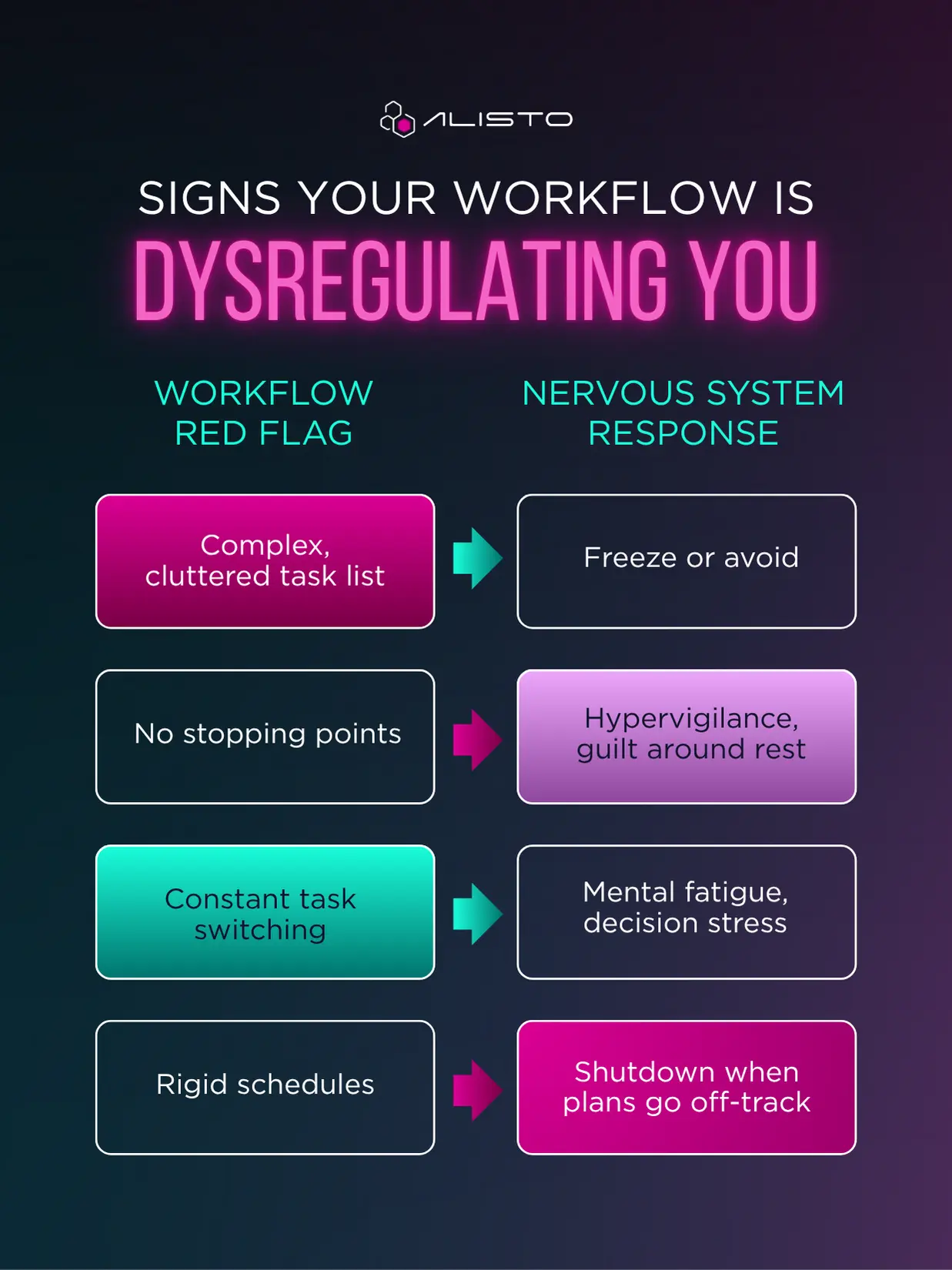
1. Complex Task Lists with No Hierarchy
You open your task list and everything feels equally urgent. You scan. You freeze. You close the tab.
👉 If you find yourself stuck in analysis paralysis, your brain may be overwhelmed—not unmotivated.
2. No Clear Stopping Points
You’re always “on.” There’s no obvious end to your workday, no ritual to shut down your brain.
👉 If you feel guilty or anxious when you try to stop working, your nervous system never got the message that it’s safe to rest.
3. Constant Context Switching
You toggle between emails, client work, notifications, and back again.
👉 If your brain feels like it’s always buffering, your system is burning energy just trying to keep up with the task shifts.
4. Inflexible Systems That Collapse When Life Happens
Your day falls behind by one hour and your whole system implodes. You abandon the plan entirely.
👉 If your workflow can’t adapt to real-life fluctuations, it’s not built for your capacity—it’s built against it.
What these all have in common: they’re not about organization. They’re about regulation.
You don’t need more willpower.
You need systems that soothe, structure, and support you.
To summarize, here is quick reference:
Workflow Red Flag | Nervous System Impact |
Complex task lists (no hierarchy) | Overwhelm → shutdown |
No clear stopping points | Decision fatigue → avoidance |
Constant context switching | Anxiety, hypervigilance |
Inflexible systems | Masking → burnout |
A regulated workflow doesn’t mean less work—it means less cognitive drag. Your tools should help your brain feel safe, not strained.
Tools That Regulate (Not Escalate)
Once you start to recognize dysregulation in your workflow, the next step is to re-design your systems for safety and ease. That’s where tools become transformative—not just functional.
Here are a few tools and practices we use with clients to build calm into operations:
- ClickUp (Visual Workflows): Reduces uncertainty through dashboards that reflect priorities and capacity.
- Loom (Delegation & Decompression): Asynchronous video reduces meeting fatigue and preserves emotional bandwidth.
- Ritual Builder (System-Based Check-ins): Turns “How are you doing?” into a visual, actionable workflow pulse.
- Digital Margin Blocks: Color-coded buffer zones in your calendar that help protect focus and regulate energy flow.
Each of these tools helps create regulatory structure—systems that support focus, flow, and emotional pacing (see also: Porges, 2011; Dana, 2018).
✅ What Calm Operations Actually Feel Like
Picture this:
- You open your dashboard and know exactly what matters today
- Your calendar has built-in space to breathe
- Your systems reinforce your energy—not drain it
- You leave work with a sense of completion, not guilt
That’s what nervous-system-aware ops feel like.
📞 Ready to Build Your Calm-Informed System?
If your business still runs on chaos and adrenaline, it’s not sustainable—and it’s not your fault.
Let’s change that.
Book a free Workflow Audit Session with the Alisto team and discover how we turn chaos into calm—without sacrificing output.