You might scoff at the word “ritual”—it sounds woo‑woo, maybe indulgent. But the truth? For high-functioning, neurodivergent entrepreneurs, the right ritual is a leadership tool—not a fluffy add‑on.
Stop trying to force productivity with sheer willpower. Instead, learn how rituals can create structure for your brain, reduce friction, and level up how you show up as a leader.
What People Get Wrong About Routines
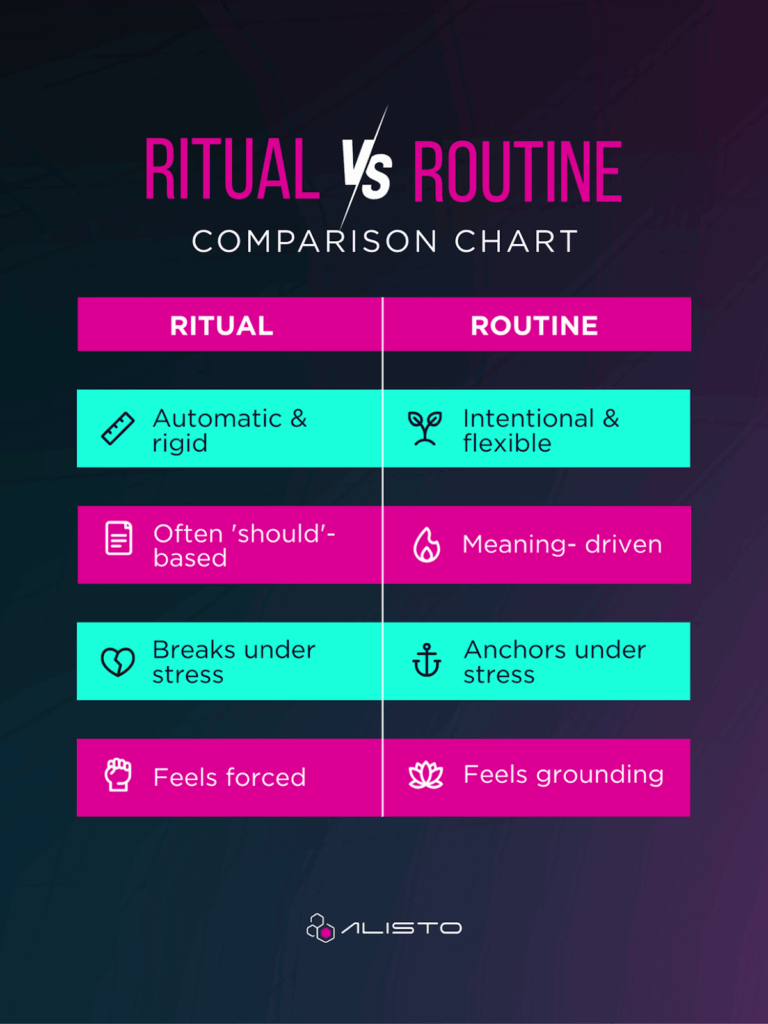
Routines are often painted as boring rules—wake at 5, meditate, hit the gym, repeat. But rituals differ. Harvard Business School’s Michael Norton distinguishes between habits and rituals based on meaning and intentionality. What you do, and why you do it, matters. When reversing the order of a personally meaningful action feels off—in contrast to brushing your teeth, which you do automatically—that’s a ritual, not a habit Harvard Business School Library.
So even simple acts—like lighting a match to start work—can signal the mind to shift gears differently than an autopilot routine ever will.
Why Leaders Need Rituals, Not Routines
- They Preserve Cognitive Energy
A Queen’s University researcher explains that when repetitive work processes are structured (e.g., habit-embedded rituals), employees use less cognitive energy on those tasks—freeing bandwidth for creative or complex work World Economic Forum. - Rituals Prime Your Brain
Productivity experts highlight how rituals tap into the habit loop: cue, routine, reward. The cue prepares you mentally; over time, it deepens focus without effort Forbes.com. - They Optimize for Neurodivergent Strengths
Entrepreneurs with ADHD often excel with novel, fast-paced, high-stimulation tasks. Rituals translate that energy into consistency—without trying to muzzle it FasterCapitalproductivelifehacks.net.
My Real-Life Ritual Journey
When I (Avy, founder of Alisto) first scaled my business, I celebrated mornings with motivational memes and noise—until burnout hit. Spinning on too many tasks, drowning in decision fatigue, and collapsing by afternoon became normal.
Then I tried something different:
- I picked one sensory cue: the first song of my “focus playlist.”
- I added a bit of movement: a short desk stretch.
- I opened my task list and wrote just one priority—not a list, just one.
That simple ritual—with sound, motion, clarity—did what routines never could. It grounded me, focused me, and invited momentum without guilt.
How a Ritual Wins Where Routines Fail
| Routine | Feeling | Ritual | Effect |
| Try to sit and start work | Overwhelm, resistance | Play focus-start cue + stretch | Brain says “ready”—you start |
| Journal before caffeine | Another “should do” | Brew coffee first | Cue is comforting, done with ease |
| Same boring breakfast | Brains ignore it | Listen to energizing music | Your brain wants the cue |
Even small rituals can transform how your brain shows up—without changing your whole day.
Leadership-Building Rituals Are Reproducible
You’re not just building for one person—you’re building a rhythm your team can see, respect, and rely on.
Whether you’re solo or scaling fast, you’ll model focus, communicate priorities, and safeguard core work—without needing superhuman attention.
How to Try It, In 5 Minutes
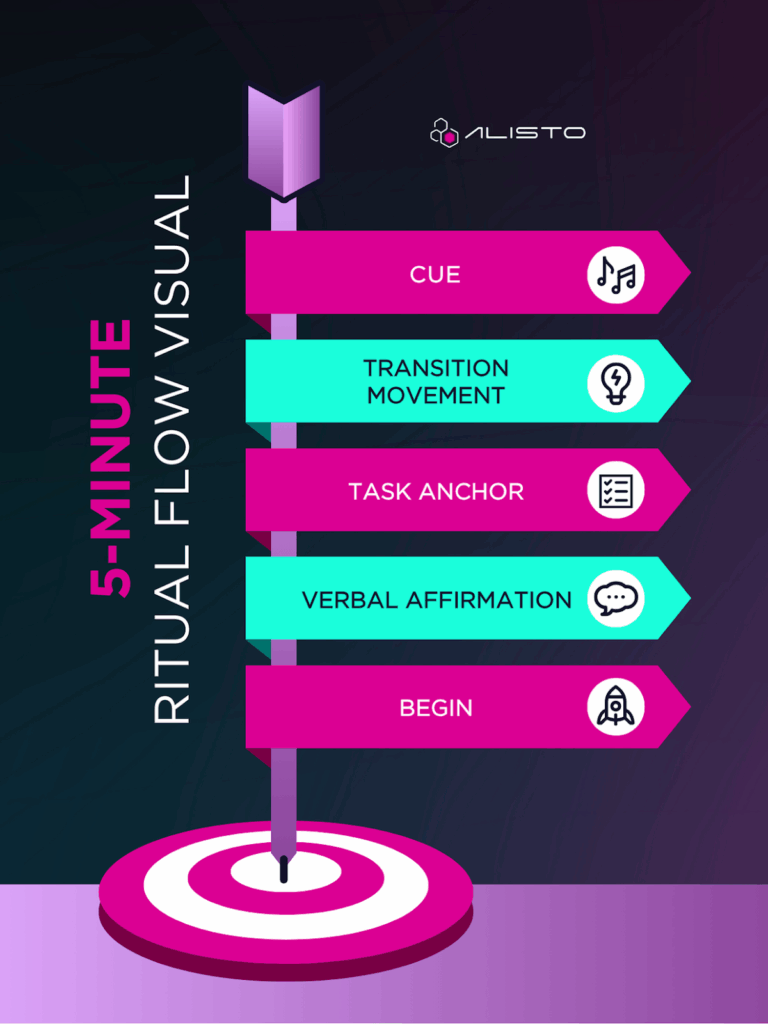
- Pick Your Cue – sound, scent, phrase, movement—something repeatable and neutral.
- Choose 1 Step – deep breath, open dashboard, fix your posture—simple.
- Define 1 Action – what’s one thing you can begin in that moment?
That’s a ritual. Under 5 minutes, with structure that doesn’t shackle—it frees.
Ready to Create Your Own Ritual?
Ditch the idea that structure has to feel boring. Your brain didn’t create chaos for lack of discipline—it wants rhythm.
The Focus Ritual Builder puts you in control. It helps you choose sensory cues, craft the flow, and if you want, hand it off to an Alisto VA to automate in your tools and calendar.
Download the Focus Ritual Builder now and start designing your workday your way.