A committed direction is not a plan. It is the beginning of one.
The founders who move fastest after committing to a direction are not the ones with the most motivation or the most detailed vision. They are the ones who translated the commitment into a sequenced, ownership-assigned task list before the first week was over — and handed most of it to someone else.
That translation is the 90-Day Move Map. And when it is built correctly, the majority of it does not belong to the founder at all.
What the 90-Day Move Map Is

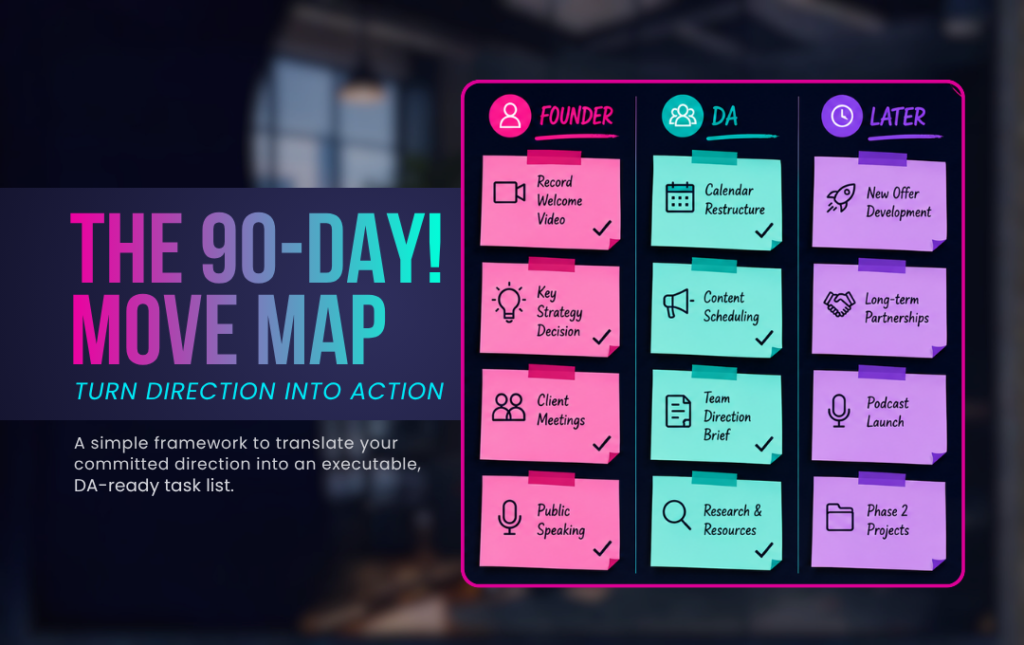
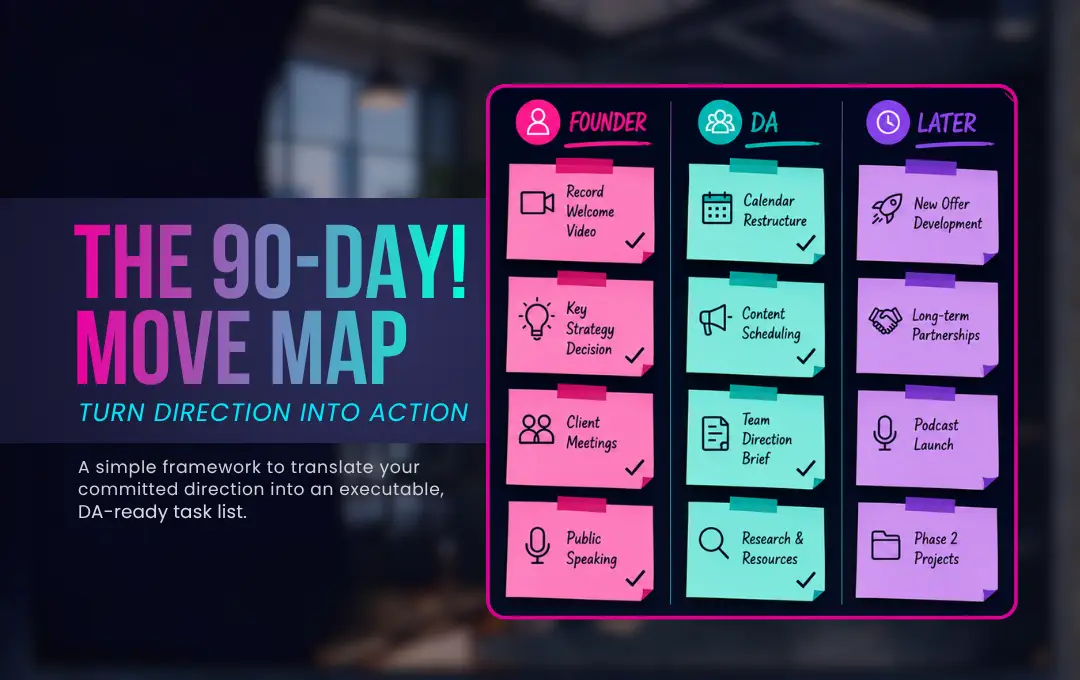
The 90-Day Move Map is a sequenced task document that translates a committed direction into specific, owned, executable next moves across a 90-day cycle. It is not a project plan — it does not include Gantt charts, resource allocation tables, or dependency diagrams. It is not a backlog — it is not an undifferentiated list of everything that could be done. It is a working document with three specific columns and a defined scope: the tasks that need to happen in this cycle, assigned to the person who should own them, sequenced in the order that makes execution efficient.
The defining characteristic of a functional Move Map is the ownership column. Every task has a name next to it — either the founder, the DA, or a specific contractor. Tasks without an owner do not belong on the Move Map. They belong in the Holding System until ownership is resolved.
The practical effect of building the Move Map this way is that the document immediately reveals how much of the committed direction the founder is attempting to execute alone. Most founders who build a Move Map for the first time discover that their instinct is to put their own name on 70 to 80 percent of the tasks — including many that do not require them specifically. The Move Map makes that pattern visible. Making it visible is the first step to changing it.
The Three Columns
Founder tasks are tasks that require the founder specifically — their voice, their relationships, their decision-making authority, or their expertise. Recorded content that features the founder’s face or perspective. Strategic decisions that the founder needs to make and cannot delegate without losing something material. High-value client relationships that the founder owns. Public appearances, media, and speaking. The category test is simple: if someone else could do this task with the right skills and a clear brief, it does not belong in the founder column.
DA tasks are everything else that needs to happen in the current cycle. Communications management, calendar restructuring, Holding System maintenance, content scheduling, client follow-up, research, task routing, brief drafting, system updates, milestone tracking. The DA column is where operational leverage lives. A well-built Move Map typically has more tasks in the DA column than in the founder column, because most of what a business requires to execute is operational support work, not founder-specific work.
Deferred tasks are tasks that are real and relevant to the committed direction but do not need to happen in this 90-day cycle. They belong on the Move Map so they are not forgotten and do not end up in the founder’s head as open loops — but they have a future date attached to them, not a current one. The deferred column is the Move Map’s version of the Holding System: a formal place for things that are real but not right now.
The three-column structure does two things simultaneously. It produces a DA-ready task list the moment it is built, because the DA column is immediately executable. And it produces an accurate picture of the founder’s actual workload — not the aspirational version, the honest one.
How to Build the Move Map Without Creating an Overwhelm Document
The most common Move Map failure mode is scope creep at the build stage. The founder starts listing tasks, the list grows, and by the time the document is finished it contains 60 items, none of them sequenced, half of them belonging to directions other than the committed one. The result is a document that is technically complete and functionally useless.
Building a Move Map that stays functional requires four constraints applied during the build process.
The first constraint is the 90-day scope. Every task on the Move Map has to be something that needs to happen within the current 90-day cycle. Tasks that are relevant to the committed direction but belong to a later phase go in the deferred column, not the active list. This constraint alone eliminates 30 to 40 percent of the items that typically appear in first-draft Move Maps.
The second constraint is the ownership test. Every task gets an owner before it is added to the list. If the ownership is unclear — if the task could plausibly belong to either the founder or the DA — the default is the DA column, pending the founder’s confirmation. Defaulting to delegation rather than founder ownership produces a more accurate document and surfaces the founder’s ownership assumptions for review.
The third constraint is the specificity standard. Tasks have to be specific enough to be executable without additional clarification. “Work on content” is not a Move Map task. “Draft three LinkedIn posts for the first two weeks of the direction cycle, using the voice brief and the approved topic list” is a Move Map task. Vague tasks produce bottlenecks — the DA has to interrupt execution to get clarification on what the task actually requires.
The fourth constraint is the sequence. The Move Map is not a flat list. Tasks that have dependencies are ordered to reflect them. The Team Direction Brief gets drafted before it gets distributed. The Holding System gets built before the review cadence gets scheduled. The calendar audit happens before the new recurring commitments get added. Sequencing the tasks during the build prevents the execution traffic jams that unsequenced task lists consistently produce.
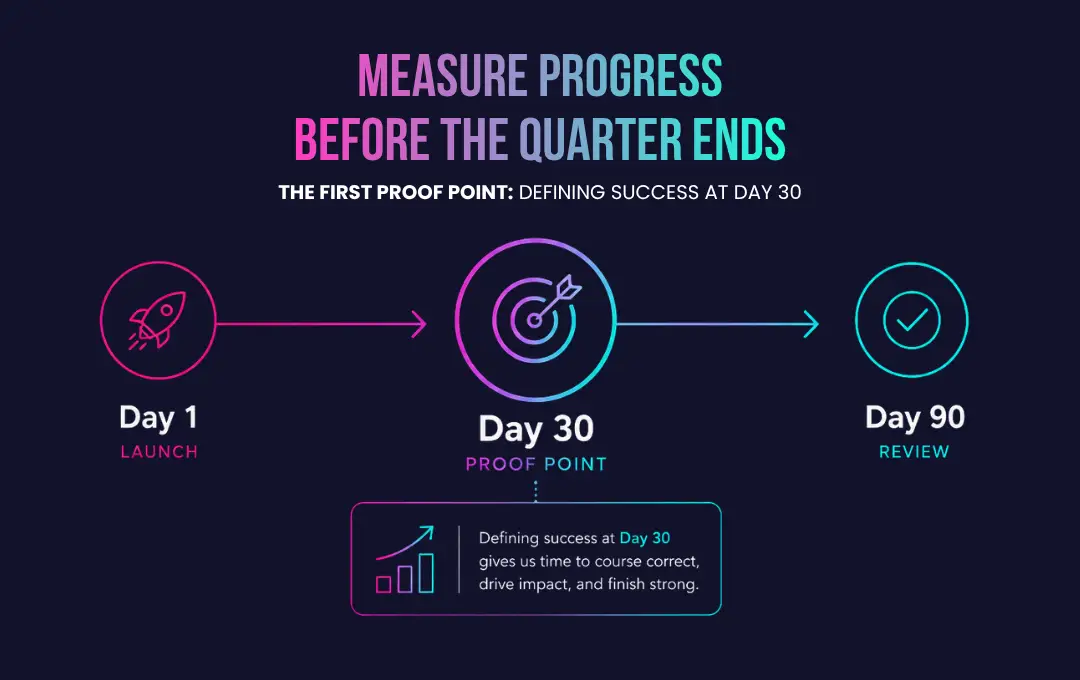
The First Proof Point: Defining Success at Day 30
A 90-day commitment without a defined 30-day proof point is a plan without a feedback mechanism. The first proof point is the operational check that tells the founder and the DA whether execution is on track before the cycle is half over.
The first proof point is defined during the Move Map build, not after execution has started. It is a specific, observable outcome — not a feeling or an intention, a result. A number, a deliverable, a milestone. Something the founder and DA can look at on day 30 and answer yes or no: did this happen?
Defining the proof point requires the founder to answer one question: if we execute the DA column tasks on schedule for the first 30 days, what should be visibly different in the business? The answer to that question is the first proof point.
Common first proof points for a VISION-frame direction commitment: the Team Direction Brief is live and confirmed by all recipients. The content calendar for the first six weeks is drafted, approved, and loaded into the scheduling tool. The first cornerstone piece — a blog, a video, an offer page — is published. The Holding System is built and the initial batch of parked items have been processed. The specific proof point depends on the committed direction. What matters operationally is that it exists, it is written down, and both the founder and DA know what they are measuring at day 30.
The proof point review at day 30 is a 30-minute session between the founder and the DA. The DA brings the data. The founder asks two questions: did we hit the proof point, and if not, what in the operational structure needs to adjust for the next 30 days? The review is not a performance evaluation. It is a course-correction mechanism.
How the DA Takes Ownership of the Delegation Column
Once the Move Map is built and the DA column is populated, the handoff process has three steps.
The DA reviews the DA column in full and flags any tasks where the brief is insufficient to execute without clarification. This review happens before execution starts, not when the task comes up. A DA who discovers mid-execution that a task lacks the information needed to complete it has to interrupt the founder — which is exactly what the Move Map is designed to prevent. Front-loading the clarification review eliminates that category of interruption.
The founder resolves the flagged items — either providing the missing brief information, adjusting the task description, or reclassifying the task to the founder column if it turns out to require founder input more than initially assessed. This resolution session runs 15 to 20 minutes and happens within the first two days of the cycle.
The DA begins execution and updates the Move Map in real time — marking tasks complete, noting dependencies that are blocking progress, and flagging items that are tracking behind their expected completion date. The Move Map is a live document throughout the cycle, not a static one. A Move Map that is not being updated is not being used as an execution tool.
What Happens to the Move Map at Day 90
At the end of the 90-day cycle, the Move Map goes through a close-out process. The DA compiles the completion data: what percentage of founder-column tasks were completed, what percentage of DA-column tasks were completed, what was deferred and why, and what proof points were hit.
The close-out review is a 45-minute session where the founder and DA review the completion data and draw two specific conclusions. First: what in the committed direction worked well enough to continue into the next cycle? Second: what in the operational structure — the task categories, the ownership assignments, the sequence, the volume — needs to be adjusted for the next Move Map to be more accurate or more executable?
The deferred column from the current cycle gets reviewed and either moved to the next Move Map’s active columns, moved to the Holding System with a review date, or formally closed.
The next Move Map is built within one week of the close-out review, before the next direction cycle begins. The gap between direction cycles — the period when the previous Move Map is closed and the next one has not been started — is when operational drift is most likely to accumulate. Keeping that gap as short as possible is a material factor in maintaining execution continuity.
For nonprofit organizations: the 90-Day Move Map translates directly into a program workplan with clear ownership between leadership and operational staff. The three-column structure — leadership tasks, staff or DA tasks, deferred tasks — gives the executive director a document they can use in supervision conversations, board updates, and funder reporting without producing a new document for each context. The first proof point at 30 days becomes the program milestone that the whole team can see and confirm, replacing the vague quarterly check-in with a specific, observable outcome that tells everyone whether implementation is on track.